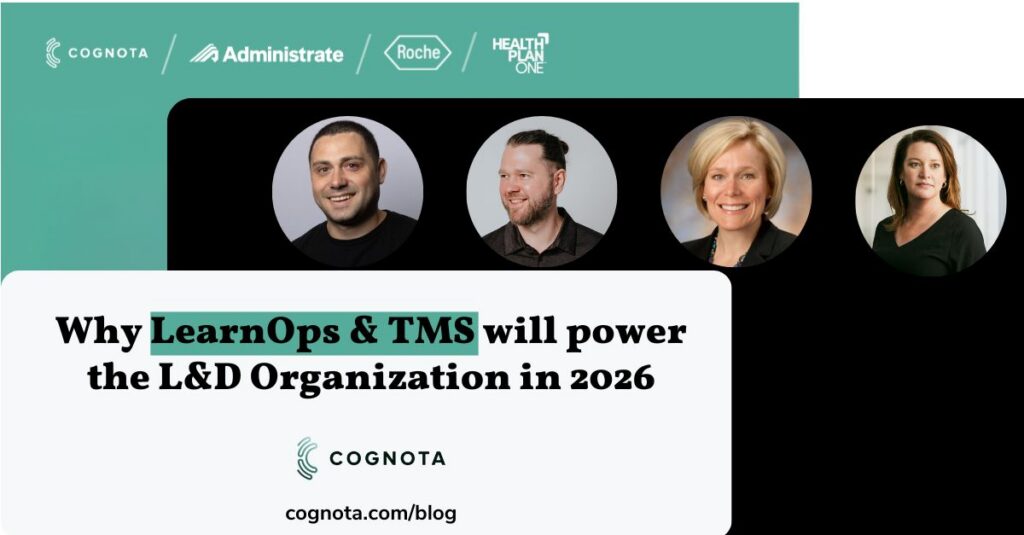
LearnOps and training management systems are emerging as the two gears, one engine that will define how high‑performing L&D teams operate in 2026, especially as they’re asked to do more with less while proving measurable impact to the business. Here’s a recap from our recent webinar. You can check out the full recording here.
Working smarter, not just adding tools
Many L&D teams are still running operations on Excel, email, and ad hoc processes, even as AI and new platforms flood the market. The core problem is less about lacking tools and more about how work is organized: intake is inconsistent, priorities are unclear, and data is scattered across spreadsheets and siloed systems. This creates administrative drag, duplicated work, and very limited visibility into capacity, costs, and impact.
What LearnOps really is
LearnOps borrows from DevOps and RevOps: it’s the discipline of running L&D like a business with clear operating models, shared processes, and an integrated platform. It spans how you align to corporate strategy and stakeholders, plan programs and resources, govern intake, manage budgets and capacity, and measure impact with meaningful data. A LearnOps platform like Cognota centralizes this backbone work: it formalizes intake, structures needs analysis, tracks projects and tasks, and surfaces insights your CHRO and CFO care about.
Case study: transforming intake, tracking, and ROI
At Health Plan One, Shannon Kelleher inherited a small, overextended L&D team with no standardized intake, limited stakeholder engagement, and no way to see who was working on what. Implementing Cognota forced the team to design from the end state backward, starting with the metrics needed for quarterly reviews and CHRO reporting, then configuring project fields, tasks, and time tracking accordingly. Once all requests were funnelled through Cognota, they gained enterprise‑wide visibility into who was requesting training, could run proper needs analysis (and sometimes determine training wasn’t the answer), and could distribute work based on true capacity instead of who grabbed it first.
Within their first year, they were able to report 510 projects, 12,450 development and delivery hours, and 3,283 development hours, which became the foundation for KPIs and clearer expectations for developers. This data not only improved job satisfaction by defining what good looks like, it also enabled a robust ROI initiative with the ROI Institute on a large strategic program, something they couldn’t realistically attempt before.
Where training management systems fit
Training management systems (TMS) like Administrate pick up where LearnOps planning leaves off: they orchestrate the complex logistics of delivering high‑stakes training at scale. A TMS focuses on scheduling trainers, classrooms, equipment, and cohorts, handling constraints, last‑minute changes, and automation that cannot be managed reliably in spreadsheets. Administrate, for example, aims to reduce up to 90% of the manual work involved in moving large groups of people through classroom and virtual training, while integrating with existing LMS platforms rather than replacing them.
At Roche Diagnostics, Cristy Mangin’s team expanded from one to three buildings, with millions of dollars of lab equipment and strict learner‑to‑analyzer ratios governed by the FDA. Before a TMS, scheduling felt like “Hunger Games”: native knowledge lived in a few people’s heads, Excel and Smartsheets clashed, and classrooms or analyzers were frequently double‑booked for customers versus learning programs. Implementing Administrate allowed them to automate much of the scheduling logic, cut scheduling effort to roughly a quarter of previous manual time, and significantly reduce conflicts across classrooms and labs.

Two gears, one engine for 2026
LearnOps and TMS address different but complementary sides of the L&D equation: LearnOps ensures you are investing in the right work, with clear governance, intake, planning, and measurement, while TMS ensures you deliver that work efficiently and reliably at scale. Together, they help L&D leaders meet rising expectations for operational excellence, move beyond “order taking,” and build data‑driven business cases even in decentralized or budget‑constrained environments. As organizations push toward adaptive, AI‑enabled operations, teams still running on spreadsheets will struggle to keep up, making a modern LearnOps backbone and a robust training management layer critical foundations for the L&D organization of 2026.