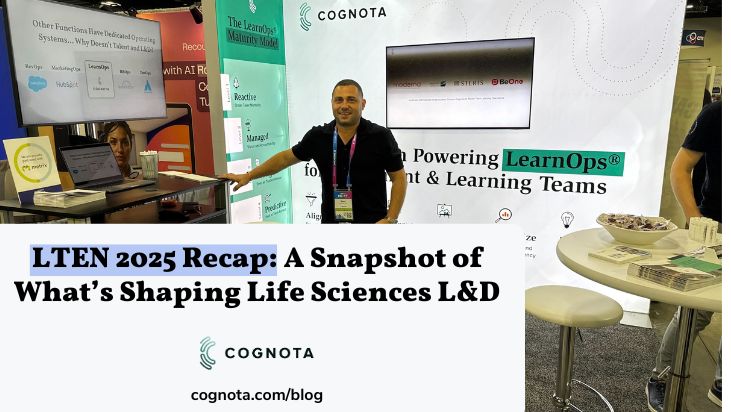
The LTEN 2025 Annual Conference brought together learning professionals across the pharmaceutical, biotech, medical device, and diagnostics industries to explore how L&D can better support business impact, adapt to AI advancements, and evolve training strategies. Held in Aurora, Colorado, the event offered a range of workshops, labs, and networking experiences—focused on solving practical challenges and navigating what’s next for learning in life sciences.
Cognota was on-site to take part in the discussions and share insight into how learning operations can serve as a catalyst for more agile, measurable, and business-aligned L&D.
Session Spotlight: Maximizing Business Impact for Life Sciences Through Learning Operations
Cognota’s Founder & CEO, Ryan Austin, joined Laura Last, Executive Director and Head of Global Talent Development at BeOne Medicines, for a featured session on July 30 titled:
“Maximizing Business Impact for Life Sciences Through Learning Operations.”
The session focused on operationalizing L&D strategy—moving away from fragmented, tool-heavy approaches and toward a unified operating model grounded in LearnOps®.
Key themes included:
-
Transitioning from reactive support functions to strategic business partners
-
Addressing challenges like data silos, lack of governance, and inefficient planning cycles
-
A real-world example from BeOne Medicines, which adopted Cognota across multiple learning functions to improve project tracking, cross-functional collaboration, and metrics visibility
-
The LearnOps Maturity Model, which outlines the evolution from siloed processes to predictive and AI-driven operations
The audience response reflected a clear appetite for this kind of strategic discussion, with several attendees continuing the conversation with Ryan and Laura afterward.
Common Threads Across the Conference
Across sessions and demos, certain themes emerged consistently—highlighting both the challenges and opportunities facing L&D in life sciences:
-
Neuroscience-informed learning: Designing programs that align with how the brain learns best—prioritizing safety, curiosity, and engagement
-
Reimagining facilitation: Upskilling trainers to be adaptive, tech-savvy guides—not just content experts
-
AI as an enabler, not a replacement: Freeing up teams to focus on strategic, human-centered work
-
EQ in the field: Sales reps who succeed are those who build trust, read the room, and pivot in real time
-
Start small, iterate fast: MVPs and fast feedback loops are key to applying AI and scaling innovation in training
Notable Tech and Strategy Themes
Many workshops and tech demos emphasized how AI and automation are already being applied in life sciences to improve learning design, enablement, and field readiness:
-
AI-powered simulations from Novartis and others demonstrated scalable ways to practice customer conversations without pulling reps out of the field
-
Automated coaching tools showed how L&D can support front-line managers with real-time feedback loops
-
Several sessions, including Cognota’s, spotlighted the shift toward operational excellence—where efficiency, effectiveness, and strategic alignment are all measured and improved continuously
From field development to enterprise learning transformation, the focus was squarely on delivering learning that drives business outcomes—not just activity.
Design That Drives Change: A Look at Metrix’s Contribution
Our Toronto-based partner, Metrix Group, brought valuable perspective to LTEN this year—showcasing how thoughtful design and strategy can translate complex ideas into meaningful behavior change.
In their session with Anthony Mancuso of Novartis and Jessica Knox, CEO at Metrix, “From Overload to Action: Rethinking Field Development,” they tackled a common challenge in life sciences: cognitive overload and content-heavy training. The session offered a framework for transforming programs through real-world scenario design, reflection, and peer-driven insight—turning information into impact.
Their presence across from our booth made for a fun (and familiar) Canadian collaboration on-site.
The Bigger Picture: LearnOps and the Future of L&D
With growing pressure on L&D teams to show measurable impact, the conversation around Learning Operations is gaining momentum. What used to be a back-end process challenge is now a strategic priority.
The LearnOps model—modeled after proven disciplines like DevOps and RevOps—provides L&D with the structure needed to:
-
Align better with business priorities
-
Plan and measure more effectively
-
Adapt to change faster
-
Operationalize AI in a practical, controlled way
As shown in the LearnOps Maturity Model presented during our session, L&D teams are moving from siloed and reactive to integrated and predictive. And in regulated industries like life sciences, that evolution is no longer optional.
Final Thoughts
LTEN 2025 reflected the current state of learning in life sciences: a function in transformation, navigating rising expectations, shrinking timelines, and the promise (and pressure) of AI.
The opportunity ahead is clear—if L&D can shift from fragmented efforts to connected operations, the function can deliver more value, more consistently, and at greater scale.
If you missed our session or want to learn more about operationalizing your learning strategy, we’d be happy to connect.
Book a customized consultation to discover how one connected platform can transform how your team plans, executes, and measures learning.