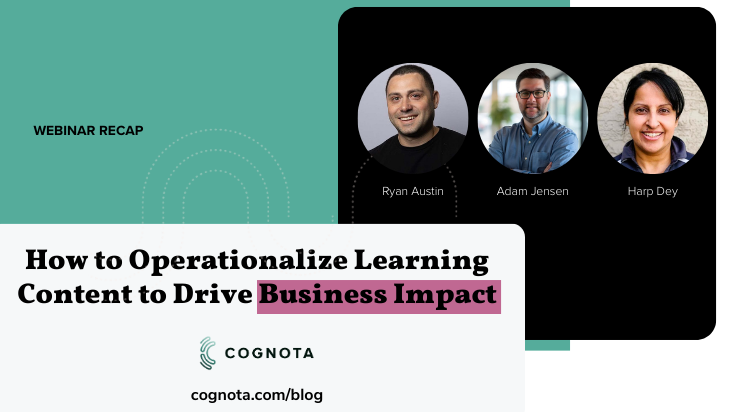
A recap of the powerful webinar discussion featuring learning operations experts from Cognota, Xyleme (a MadCap Software Company), and Nutrien on transforming L&D through systematic excellence.
Learning and development leaders across North America gathered virtually to explore one of the industry’s most pressing challenges: How do you transform learning operations from reactive cost centers into strategic business drivers?
The conversation, led by Ryan Austin, Cognota CEO, Adam Jensen, VP of Sales Engineering at Xyleme (a MadCap Software Company), and Harp Dey, Senior Manager of Global Learning Content and Systems at Nutrien, revealed both realities and possibilities for the future of learning operations.
The Strategic Influence Gap
Ryan Austin opened with a striking statistic from recent research with Brandon Hall Group: “Only 18% of L&D leaders say that they have a full seat at the table.” Despite decades of discussion about earning strategic influence, the vast majority of learning organizations remain on the periphery of business decision-making.
The root causes run deeper than many realize. Ryan Austin explained: “The biggest hurdles on running the function like a business, to be able to speak to the business, was really behind the workflows. You know, harder access to data.”
The research revealed concerning operational gaps:
- Only 40% of learning teams use formal intake processes
- 64% lack visibility into workload and capacity
- 41% lack time to measure impact
- 33% don’t know what to measure
- Fewer than 10% consider themselves mature in optimizing learning operations
The Learning Operations Framework
Ryan Austin positioned Learning Operations (LearnOps) as the natural evolution for L&D functions: “We’re not reinventing the wheel here. Again, the concept is to run learning and development, or talent development like a business function. Well, let’s look at other business functions. Software development. They have DevOps. Sales and marketing, they have RevOps.”
The core insight? “Value creation is how you get the seat at the table. Your CEO stands up on stage once a year, or writes in the report, these are the three big, five big business goals we need to invest in. And you need to ask yourself, what part of that business plan does your department own to drive value creation?”
Ryan Austin emphasized that operational maturity becomes even more critical as AI transforms the learning landscape: “How are we going to expect AI to work to its fullest capability if it’s sitting on top of a data set that has low maturity.”
The Content Factory Revolution
Adam Jensen introduced the concept of transforming content operations from chaotic, project-based approaches to systematic “content factories.” He described the current challenge many organizations face: “Content is being created, it lives everywhere, it can be in PowerPoints, PDFs, in the LMS, as e-learning courses, SharePoint – versions kind of scattered everywhere.”
The solution involves treating content like a manufacturing operation: “Think of it like a production line. Authors are creating structured content in a single source of truth. We can analyze it and review it, and publish it, and deliver it everywhere that learners need, all from one central source.”
This approach unlocks significant advantages: “You don’t build a brand new car from scratch every time, right? You build standardized components on a production line… And content can work the same way.”
Organizations implementing content operations report impressive results:
- 30% reduction in development time
- 50% decrease in maintenance and update cycles
- 40% lower translation costs
Real-World Success: Nutrien’s Integrated Approach
Harp Dey provided concrete evidence of LearnOps success at Nutrien, a global fertilizer company with 26,000 employees. Her insights revealed how integrated systems and processes create measurable improvements.
System Integration Excellence
Nutrien operates four primary systems working in harmony: “We have Cognota, Xyleme (a MadCap Software Company), and Enable now, and then we also have our learning management system. Each of these tools that we have, they were chosen very strategically, to meet the needs of our business.”
Collaborative Development Impact
The results of systematic operations are clear: by having subject matter experts input content directly into Cognota, Nutrien has been able to streamline development significantly. What once required lengthy effort can now be completed much more efficiently, enabling developers to spend more time on strategic instructional design and high-value content creation rather than repetitive setup work.
Advanced Personalization
Perhaps most impressively, Nutrien has implemented automated content personalization: “We have a middleware that when we tag courses in Xyleme (a MadCap Software Company), it will actually personalize the learning for the individual in the LMS… When the learner goes to launch the course, it will actually look at what’s in that person’s profile, take all the tagged pages that are associated with that learner, and then show that learner that material.”
Building Organizational Buy-In
The conversation addressed a critical challenge: securing executive support for learning operations initiatives. Adam Jensen emphasized the importance of demonstrating both efficiency and agility: “It’s also how nimble you become, right? Things like rebranding, right? Rebranding content becomes very easy when you centralize content in an operational format like this.”
Harp Dey shared Nutrien’s collaborative approach: “It’s about showing the business that you do have a very laser-focused strategy. And it’s not just having a laser-focused strategy, it’s also about bringing the business along in those decisions and in that journey as well.”
She emphasized the importance of collective decision-making: “It’s about bringing people along on the journey, it’s about thinking what that journey looks like, and bringing everybody along with you.”
The AI-Ready Future
The discussion touched on how operational maturity positions organizations for AI integration. Adam Jensen described emerging capabilities: “We are semantically indexing all the content that goes there… I can build a chatbot, point it at Content Living and Syndicate, and it can answer the questions that a learner or a person in the organization has using the well-vetted versioned, well-maintained content.”
Ryan Austin revealed exciting developments: “We offer something called LearnOps AI, so that it’s an assistant that partners with every user, so you can actually ask it questions like which tasks are overdue, which projects have risks.”
Measuring What Matters
When asked about key metrics, Harp Dey provided practical guidance: “What you really want to know is, how is that content being consumed? Are you putting courses out there that people are consuming? Are you putting courses out there people are not consuming? Because if they’re not, pull it off.”
Ryan Austin added strategic context: “It really starts with the business partnership and what it is that you even need to measure… Measurement and the KPIs, you don’t want to look at it as one data set. You can do that, but it should vary from program to program.”
The Path Forward
The webinar concluded with a clear message: Learning Operations represents a fundamental shift toward systematic excellence that enables L&D functions to operate as true business drivers.
Ryan Austin’s final insight captures the opportunity: “You create your own seat at the table” by demonstrating measurable contributions to business objectives through operational excellence.
For organizations ready to begin this transformation, the experts recommend starting with an operational maturity assessment to understand current capabilities and develop a roadmap for systematic improvement.
The conversation demonstrated that while the journey to operational maturity requires commitment and strategic thinking, the rewards extend far beyond efficiency gains—they enable learning organizations to claim their rightful position as strategic business partners driving competitive advantage through human capital development.
Join the growing LearnOps community of over 10,000 L&D professionals to continue exploring the future of learning operations.