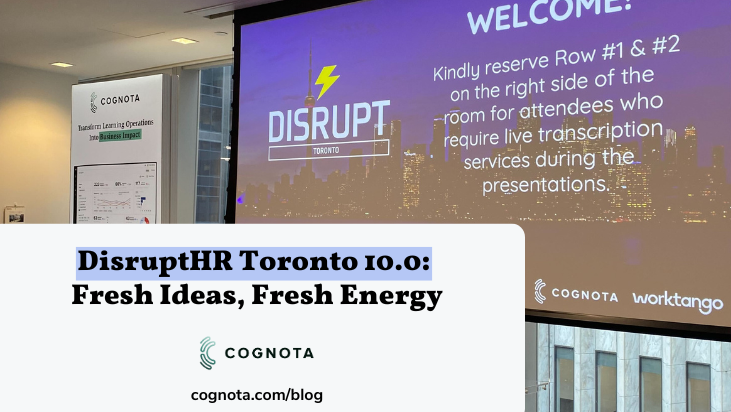
Toronto’s HR community came alive last night at DisruptHR Toronto 10.0, hosted in Deloitte’s stunning office space on Adelaide. With panoramic views, buzzing networking spaces, endless snacks and drinks, and a packed speaking room, the event more than lived up to its reputation as one of the most dynamic HR gatherings in the city.
Tickets sold out three weeks before the doors opened, with a lengthy waitlist of hopeful attendees. That level of demand set the tone: Toronto’s HR and talent leaders are hungry for fresh ideas, and DisruptHR delivered in spades.
Why DisruptHR Matters
For those who may not know, DisruptHR is not your typical HR conference. The format itself is designed to keep energy high and ideas flowing:
-
14 speakers
-
5 minutes each
-
20 slides that auto-advance every 15 seconds
No long-winded keynotes, no drawn-out panels, just sharp, punchy insights designed to energize, challenge, and inspire. It’s what’s known as the Pecha Kucha style of presentation, and it’s as exhilarating for the audience as it is for the presenters.
As the organizers put it: “Teach us something, but make it quick.”
That spirit of disruption is why DisruptHR has grown into a global movement, popping up in cities across the world. And here in Toronto, the 10th edition felt like both a celebration and a challenge: a celebration of how far the HR community has come, and a challenge to keep pushing boundaries.
The Atmosphere: High Energy, High Impact
Deloitte’s downtown space couldn’t have been a better backdrop. Multiple floors of networking areas gave attendees plenty of chances to connect before and after the talks, with the main session room filling quickly as anticipation built.
Drinks were flowing, snacks were abundant, and conversations covered everything from AI in HR to the evolving expectations of Gen Z employees. The buzz was tangible, and by the time the first speaker hit the stage, the audience was fully primed for an evening of ideas.
Highlights from the Stage
Each of the 14 speakers brought something unique, but a few talks stood out as especially timely given the challenges HR and L&D leaders are navigating right now:
-
Sustainable Performance and Burnout
Bridget McDermid (TD Bank) struck a chord with “Burnt Out, Brilliant, and Breaking: A Letter from Your Top Performer.” At a time when teams are being asked to deliver more with less, her talk underscored the urgent need to balance ambition with well-being. -
AI and the Human Factor
AI was top of mind throughout the evening, but two perspectives resonated most. Lydia Wu’s “Fight, Flight… Automate?” cleverly linked our evolutionary biology to our struggles with adapting to AI, while Nabil Vasrani (Deloitte)’s “Agentic AI for a Reimagined HR” painted a picture of technology that empowers rather than overwhelms. Both reminded us that adopting AI is as much about people as it is about tools. -
Culture as Competitive Advantage
Nicole Calihoo (Deloitte)’s talk on “Creating Cultural Safety” reinforced that culture isn’t just a soft concept, it’s strategy. Especially now, organizations that foster inclusion and belonging will be the ones that thrive. - Rethinking Productivity and Trust
Kerry O’Brien (Clio) spoke on “The Crucial Chemistry of Trust,” highlighting how trust underpins performance. Sarmishta Revanoor (Deloitte) followed with a provocative reminder in “We Should All Be Slackers” that sometimes less is more. Together, their talks reframed productivity around relationships and smarter, not harder, work.
These moments captured the essence of DisruptHR: challenging assumptions, sparking debate, and reminding us that the future of work is being shaped right now.
Key Themes and Takeaways
While the talks spanned diverse topics, a few themes cut across them all:
-
AI and Automation Are Here, but Humans Still Matter
Multiple talks, from Lydia Wu’s evolutionary lens on AI to Nabil Vasrani’s exploration of agentic AI, reinforced that technology can transform HR, but only if it amplifies rather than replaces human judgment and connection. -
Well-Being and Trust as Core Business Strategies
Bridget McDermid and Kerry O’Brien’s talks hit on the same chord: organizations cannot thrive if their people are running on empty or operating without trust. -
Culture Is the Real Competitive Advantage
Whether through Nicole Calihoo’s focus on cultural safety or Tania Dea’s emphasis on connection, the message was clear: culture is no longer a “soft” topic, it’s strategy. -
New Perspectives Are Essential
From neurodiversity to longevity, speakers encouraged attendees to expand their view of who belongs in the workforce and how value is created.
Networking That Actually Worked
One of the standout elements of DisruptHR Toronto 10.0 was the networking. Because the talks were so short, there was plenty of time before, during breaks, and after the sessions to connect. Deloitte’s multi-floor setup meant conversations could spill into different corners of the venue, making it easy to meet new people.
For Cognota, these conversations were invaluable. As the world’s first LearnOps® platform, we’re deeply invested in how HR and L&D teams evolve their operations. Talking with practitioners last night confirmed what we’ve been hearing:
- Teams are under more pressure than ever to show impact.
- AI and automation are top of mind, but many don’t know where to start.
- Culture and operations must work hand in hand as without one, the other falters.
These are exactly the challenges LearnOps is designed to help solve, so it was energizing to see the resonance in real-time conversations.
Final Thoughts
DisruptHR Toronto 10.0 was more than just an event. It was a pulse check on the future of work in our city. The sold-out crowd, the electric talks, and the meaningful conversations all pointed to one thing: HR is ready to disrupt itself.
At Cognota, we’re excited to keep these conversations moving forward with the HR and L&D community. The momentum from DisruptHR Toronto 10.0 makes it clear—teams are ready to work smarter, harness AI responsibly, and build cultures that drive impact.
Book a customized consultation to discover how one connected platform can transform how your team plans, executes, and measures learning.