Learning and Development (L&D) leaders are under more pressure than ever. Between budget scrutiny, the need to demonstrate ROI, and the rapid rise of AI, the expectations for learning teams are shifting dramatically. But are organizations truly ready to adapt?
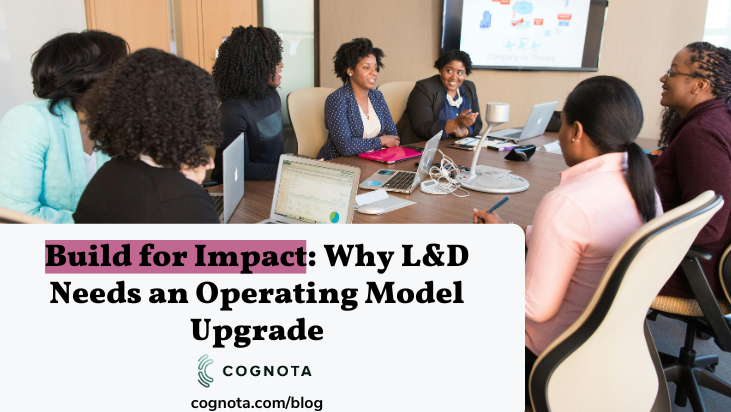
That question anchored a recent panel discussion hosted by Cognota, bringing together leaders from Deloitte, CIBC, and Cognota. Inspired by a private roundtable dinner in Toronto, the conversation explored what it really takes to evolve the L&D operating model for today’s demands—and tomorrow’s opportunities.
From budget realities to AI readiness, here are the key insights that emerged.
The Shifting Budget Landscape
Budget challenges were a recurring theme. According to research shared during the session, 49% of employers cite budget and resource management as their top operational challenge.
Neil Samuel of CIBC was quick to ground this statistic in reality:
“In banking and financial services, the demand for reskilling and compliance training keeps rising, but the budgets aren’t growing at the same pace. That creates a tension—how do we prioritize what really moves the needle?”
The answer, Samuel suggested, lies in sharper alignment between business priorities and learning investments. Rather than spreading resources thin across competing requests, high-performing teams are doubling down on impact-driven initiatives.
Benoit Hardy-Vallée of Deloitte agreed, noting that budget scrutiny is pushing L&D leaders to adopt a portfolio mindset:
“Think of your programs like an investment portfolio. Some are about compliance and risk management, some are about enabling the strategy, and some are about innovation. You need to decide where to allocate capital—time, money, people—based on what drives measurable outcomes.”
This shift from “order-taking” to strategic capital allocation reflects a broader evolution in how L&D functions see themselves: not just service providers, but true business partners.
Why the Operating Model Matters
The panelists converged on a central idea: you can’t solve budget challenges without rethinking the operating model itself.
Ryan Austin, CEO of Cognota, framed it this way:
“We’ve seen that most learning teams don’t fail because of talent or technology. They fail because their operating model wasn’t designed to scale. Without the right processes for intake, planning, resource allocation, and measurement, even the best LMS or AI tool won’t deliver value.”
At Deloitte, Neil Hunter echoed the point with an internal example:
“When we looked at our own global learning operations, we realized we had tremendous expertise but fragmented workflows. Standardizing the operating model—across intake, governance, and delivery—helped us unlock both efficiency and quality.”
Panelists emphasized that formalizing LearnOps practices—the discipline of managing learning as an operational system—can lead to 10–30% efficiency gains. That’s not just cost savings—it’s reclaimed capacity that can be reinvested in innovation.
The AI Readiness Question
Of course, no modern L&D discussion is complete without AI. The panel tackled the question: what does an AI future-ready tech stack look like?
Here, the conversation turned pragmatic. Despite the hype, only 9% of L&D teams operate at a Predictive maturity level today, according to Cognota’s LearnOps Maturity Model.
Hunter cautioned against treating AI as a silver bullet:
“AI can automate content curation, personalize learning paths, and even predict skill needs—but if your data is siloed and your processes aren’t consistent, the models won’t have a strong foundation. Readiness is less about the tool itself and more about the plumbing behind it.”
Samuel added that analytics and governance need to come first:
"At CIBC, we’ve been focused on getting our learning operations data clean and reliable. That’s what allows us to even consider predictive analytics or AI operators. Without trust in the data, you can’t trust the AI.”
The consensus: AI will transform L&D, but only for organizations that invest first in operating model maturity.
If You Could Redesign from Scratch…
One of the most engaging moments came when the moderator asked: If you could redesign your L&D operating model from scratch, what three capabilities would you prioritize?
Here’s how the panelists responded:
-
Governance and Intake – Hardy-Vallée stressed the importance of a disciplined intake process: “Without a filter, L&D becomes a dumping ground for every request. A robust intake system ensures you’re working on the right problems.”
-
Data and Measurement – Samuel highlighted analytics as non-negotiable: “You can’t manage what you don’t measure. Building an operating model that embeds ROI measurement is critical.”
-
Agility and Experimentation – Hunter underscored adaptability: “The world changes too fast for rigid systems. Your operating model needs built-in agility—room to experiment, iterate, and pivot.”
Taken together, these priorities point toward a future where L&D functions are strategic, data-driven, and agile, rather than reactive and fragmented.
Key Takeaways for Leaders
For senior L&D leaders—CLOs, VPs, and directors—the panel offered a clear set of lessons:
-
Budget pressures aren’t going away. Treat your portfolio like capital investment, prioritizing initiatives with measurable impact.
-
Operating model maturity is the unlock. Formalizing LearnOps practices can deliver efficiency gains and strategic credibility.
-
AI is not magic. Invest first in governance, data, and standardized processes before layering on AI.
-
Future-ready models balance control with agility. Governance and measurement provide discipline; agility provides resilience.
Conclusion: Building for Impact
The panel closed with a simple but powerful reminder: L&D must build for impact, not activity.
As Ryan Austin summarized:
“The organizations that thrive in the next decade won’t just be the ones that adopt AI or cut costs. They’ll be the ones that redesign their operating models to deliver measurable business impact—consistently, efficiently, and at scale.”
For learning leaders navigating today’s challenges, the message is clear. The future of L&D isn’t just about learning content or technology. It’s about operations. And the time to upgrade is now.
🎥 Watch the full panel discussion on demand:
Build for Impact: Why L&D Needs an Operating Model Upgrade
💡 Want to see how Cognota helps you operationalize this?
Book a customized consultation to discover how one connected platform can transform how your team plans, executes, and measures learning.