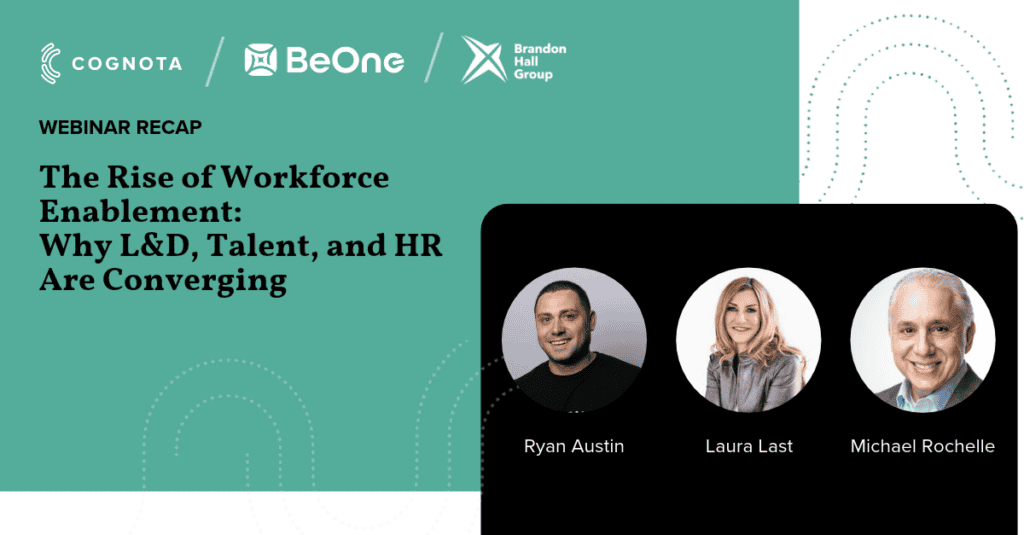
Do L&D, Talent, and HR teams want to work as one, or is it being pushed on them?
“I think we’ve always wanted to converge, but we didn’t have the tools to do it.” Laura Last gave that answer without a pause, late in our October 27 webinar. Laura is Head of Global Talent Development and Enterprise Learning at BeOne Medicines, and her team has spent the last few years stitching things together to work more closely across those functions.
She joined Michael Rochelle of Brandon Hall Group and our CEO Ryan Austin for a conversation about why these teams are being pulled toward the same goals now, how far apart they still are, and what a shared plan looks like in practice.
The pressure is coming from the business
L&D and Talent leaders have talked about a seat at the table for a long time. What’s changed is the pace. Digital transformation needs recruiting, career development, organizational development, L&D and talent management moving toward the same business goals at the same time.
That doesn’t mean merging the teams, and Ryan was clear on the point. Each function keeps its own work and expertise. What has to change is how they plan and execute together.
How far there is to go showed up in a conversation Ryan had the day before the webinar, with a Chief Learning Officer who reports to a CHRO. Asked what the team was doing with HR operations, the CLO’s answer was “absolutely nothing.”
Even award winners aren’t connected yet
Brandon Hall Group’s Excellence Awards data comes from award-winning organizations, the ones you’d expect to have this figured out. Even there, one in four don’t connect learning initiatives directly to business goals, one in three don’t connect learning and talent strategy, and about half aren’t sure they have the right primary tools.
That gap gets expensive when CHROs and CLOs are asked what the investment in learning produced. With L&D, Talent, and HR working from separate plans and systems, the answer is hard to put together. The model Michael sees ahead is built around capability: shared priorities across learning, talent and HR, budgets that grow because the work is visibly tied to strategy, and technology that connects people, processes and systems.

What a shared plan looks like at BeOne Medicines
BeOne’s 2020 to 2030 strategic plan sets the business goals, and the people function maps back to them. When Laura joined in 2021, the idea she kept coming back to was that top talent drives everything else. Those goals now sit under six HR pillars, and talent development, talent management and the HR business partners plan from one shared calendar. The 2026 calendar is running and the 2027 version is already built. The functional learning teams in commercial, clinical operations and quality work toward the same goals.
The work underneath is practical: a skills framework, individual development plans for every employee, year-end reviews run by talent management, and six leadership programs from new leaders up to the most senior. Next on Laura’s list is measuring the impact of those programs, which she’s planning with her CHRO and Head of Talent Management. She calls it a journey that’s still under way, as it is for most of the people who joined us.
Stitched together is the norm, and it costs more than it looks
We asked the audience whether their L&D, Talent, and HR work runs through one connected system or several stitched together. 58% chose stitched together, with spreadsheets, email and memory next. Michael expected the stitched number to be higher, and called “stitched” generous for systems that “cross like ships in the night.”
Disconnected tools create friction at every handoff, and because they don’t share data, the insight that justified buying them never shows up. They cost money and time too: separate contracts, upgrades and service teams, usually managed by a team of fewer than five people.
That’s why Michael, an analyst who covers the whole market, would take less functionality in one unified platform over more spread across several. Most organizations use about 20% of what their tools can do. Five years ago, nearly every organization that came to Brandon Hall Group about technology wanted to buy something new. Now nearly all of them want to consolidate.
BeOne knows that starting point well. When Laura brought her commercial team to see Cognota at DevLearn, their reaction was, “We do a lot of this stuff, we just do it in 17 different places.” They’ve consolidated a lot since then, and Laura is looking forward to having it all in one place.
Talent is the bridge to workforce capability
As these functions come together, someone has to own workforce capability. In Michael’s view, it belongs with the CHRO and the head of talent. “Learning is a catalyst for building workforce capability,” and on its own it doesn’t produce anything. The business sets the capabilities it needs and the timeline, and talent connects that demand to where people are today. His advice for L&D teams: take a field trip down the hall to the talent management group.
At BeOne, that walk is a short one. Talent development and talent management sit in different teams but are, in Laura’s words, “tied at the hip.”

If you’re a team of one
One attendee covers L&D, organizational development and talent across every level of their company, on their own. Laura’s advice was to find every efficiency you can, keep learning from peers so you can make the case for what you need, and enjoy being able to make decisions yourself. Michael called technology “the great equalizer” for small teams. You can’t keep swinging an axe at trees. You need something that does the heavy lifting so you can go home.
Getting colleagues on board
Another attendee wanted to know how to bring L&D, recruiting and HR colleagues around to a joint approach. Start with the business goals. Every company has a CEO telling the organization where it needs to go, and everyone in L&D, Talent, and HR has a part in getting there. Ryan’s suggestion is to think of yourselves as solutions and product people rather than functions, and to meet as a group every quarter to talk openly about those goals.
It won’t happen in one meeting. Laura needed a lot of conversations, at more than one organization, and it helped to find the people in her corner. Michael’s addition was accountability: if you ask the business for more, be ready to say, “If you give me this, then I will deliver this.”
Watch the recording
The full conversation is on demand, including Michael’s reaction to the poll and Laura’s walk through BeOne’s shared calendar. If you’d like to talk through how your own L&D, Talent, and HR teams plan and run this work, we’d be happy to.