A leadership development request arrives from Sales. Succession planning needs an update before the next board meeting. A performance cycle is behind schedule because no one can see who owns the next approval. None of these issues start with missing employee data. They start with work that has no shared operating rhythm.
That is the real distinction in HRIS versus TalentOps. An HRIS provides the employee record that People teams rely on. TalentOps is the operating discipline that helps Talent, HR, and L&D teams decide what work to take on, who will do it, what it will cost, where risk is building, and whether the work produced a business outcome.
For enterprise People teams, treating the two as interchangeable creates a familiar pattern: a growing stack, scattered requests, overloaded program owners, and executive questions that take too long to answer. The goal is not to force one system to do every job. It is to connect the work around the systems your teams already depend on.
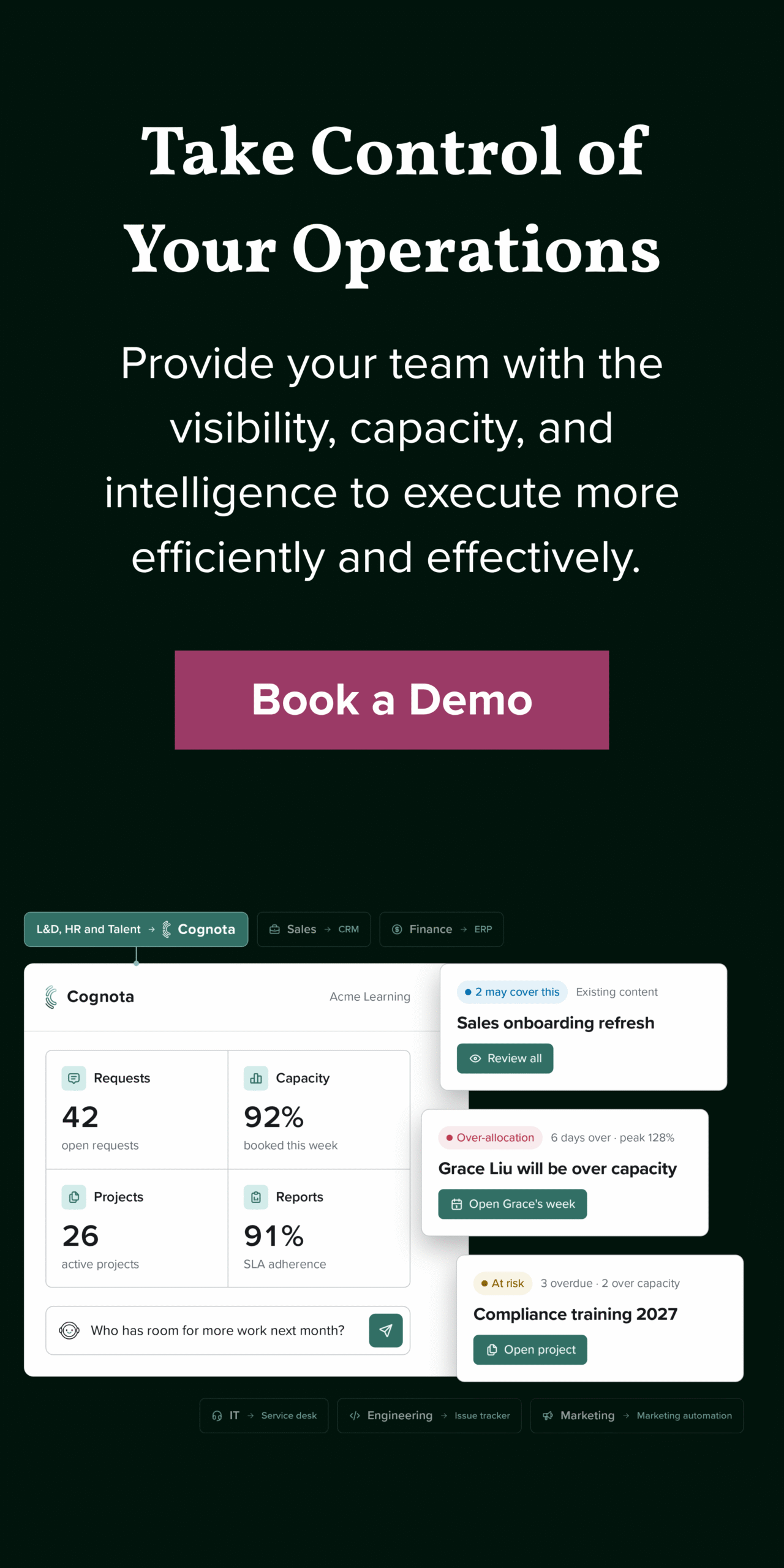
See Cognota in action to understand how an operations layer can give your People teams one view of demand, capacity, priorities, and delivery risk.
HRIS versus TalentOps: Different Jobs, Better Together
The simplest way to understand the distinction is to separate information about the workforce from the work required to enable that workforce.
An HRIS is a system of record. It holds foundational employee and organizational information that supports the broader People function. That information matters to Talent teams because programs need the right populations, structures, and reporting context.
TalentOps is how the team runs the operational work around talent programs. It creates a consistent way to receive requests, assess priorities, assign owners, coordinate approvals, manage external support, track budget, and report progress. It turns a set of individual projects into a managed portfolio.
Consider a leadership program. The employee and organizational data may already be available through the HRIS. But the operational questions remain: Which business unit has the greatest need? What work has to move for this program to launch? Does the team have enough capacity to design, communicate, facilitate, and measure it? Which stakeholders need to approve the scope? What gets delayed if this work becomes the priority?
Those are TalentOps questions. They are not minor administrative details. They determine whether a high-visibility program reaches the right people with the expected quality and on the expected timeline.
For a CHRO, CLO, or Chief Talent Officer, the distinction is especially useful because the work rarely stays within one team. Talent, L&D, HRBPs, HR Ops, and workforce planning leaders may all contribute to the same strategic initiative. A shared operating model makes dependencies visible before they become missed commitments.
Why the Gap Shows Up as Teams Scale
At smaller volumes, experienced practitioners can carry operational complexity in meetings, inboxes, and personal spreadsheets. At enterprise scale, that approach breaks down. Demand comes from dozens of business leaders. Programs share subject matter experts, vendors, communications resources, and budgets. A change in one priority affects work across the portfolio.
The 2026 Brandon Hall Group and Cognota Joint Research Report found that 83% of teams use three to eight tools to manage their operations, while 69% want to consolidate. The issue is not that every team needs fewer specialized systems. It is that few teams have a single operational view across the work moving between them.
Without that view, leaders cannot reliably answer basic questions: What has been requested? What is approved? Who owns the next action? What is at risk? How much capacity is committed, and to what business priority? Teams become reactive not because they lack talent, but because their operating environment hides the signals needed to make trade-offs early.
This is also why an HRIS investment alone does not resolve operational friction. Better employee records do not automatically create an intake process, capacity plan, governance model, or portfolio decision framework. Those practices require deliberate ownership.
The cost of unclear ownership
Unclear ownership is expensive in ways that rarely appear as one line item. Teams duplicate discovery work. Stakeholders receive conflicting updates. A program is approved before its delivery effort is understood. Leaders discover too late that the same expert is committed to three high-priority initiatives.
The same 2026 research found that teams with a dedicated operations lead reported 34% faster delivery, 28% lower costs, and 39% higher stakeholder satisfaction. Those results point to a practical truth: operational discipline improves how existing capacity is directed toward alignment, quality, and impact.
A dedicated operations role is not the only answer. Some organizations distribute the responsibility across Talent, L&D, and HR Ops leaders. What matters is that someone owns the operating rules and that the rules are visible to the people doing the work.
What TalentOps Adds to the People Technology Conversation
TalentOps is not another label for talent management. It is the way Talent work moves from an incoming request to a measurable outcome. A strong model follows a repeatable cycle: align, plan, execute, measure, and optimize.
Align begins with demand. Teams need one front door for requests and a way to connect each request to business priorities. This gives HRBPs and business leaders a clearer path to ask for support, while giving Talent leaders the evidence to distinguish urgent work from important work.
Plan makes the delivery reality visible. That includes effort, owners, dependencies, budget, external partners, and delivery risk. Planning is where a leadership team can make an informed trade-off instead of accepting every request by default.
Execute is the discipline of moving work forward with clear workflows, decisions, and approvals. This is particularly valuable for cross-functional programs such as performance cycles, leadership development, succession planning, and skills initiatives, where no single person can deliver the outcome alone.
Measure connects activity to the results leaders care about. Completion of a project is useful, but it is not enough. Teams also need to understand stakeholder satisfaction, delivery performance, cost, adoption, and the business measures tied to the initiative.
Optimize uses those signals to improve the next decision. Which request types consume disproportionate effort? Where do approvals stall? Which programs produce meaningful outcomes relative to their cost and capacity? This is how People teams move beyond reporting activity and start managing performance.
When an HRIS-Centered Approach May Be Enough
Not every organization needs a formal TalentOps model immediately. If a Talent team manages a small, stable portfolio with clear ownership, limited dependencies, and predictable demand, lightweight processes may be sufficient. Adding new operational structure before the work warrants it can create unnecessary overhead.
The inflection point comes when the team can no longer see the whole portfolio without assembling data from multiple places. It may arrive when executives ask for better budget visibility, when HRBPs struggle to understand request status, or when critical programs compete for the same constrained expertise.
A useful diagnostic is this: can your leadership team see, in one conversation, what your People teams have committed to, what capacity remains, what is at risk, and what outcomes are being pursued? If the answer depends on a series of follow-up messages and manually reconciled spreadsheets, the operating gap is already present.
Build the Operating Layer Around the Work
The best next step is not a technology-first conversation. Start by mapping how a request becomes a delivered talent outcome. Identify where demand enters, who prioritizes it, how capacity is assessed, where decisions are approved, and how results are reviewed. The gaps will usually appear quickly.
Then establish common rules across Talent, L&D, and HR Ops where the work overlaps. Shared intake criteria, defined ownership, visible priorities, and consistent measures reduce friction without removing each team’s expertise. An operations layer can support this model by making the work, decisions, and risks visible in one place.
Cognota is built for that role: the operating system for workforce enablement teams. It does not replace the HRIS. It helps People teams turn visibility into signals, signals into decisions, and decisions into outcomes.
The most effective People teams do not ask their HRIS to carry the full burden of operational management. They give their teams a clear way to decide what matters, execute with ownership, and show leaders what the work made possible.