A business leader needs a new manager program, a compliance deadline shifts, and three regional teams request different onboarding support. The work arrives through email, meetings, chat, and spreadsheets. Someone has to sort it, size it, prioritize it, assign it, and explain what will not get done. That is the problem behind the question, what is LearnOps?
LearnOps® is the operating model for how Learning and Development teams align demand to business priorities, plan capacity and budgets, execute work with clear ownership, measure results, and optimize over time. It gives L&D leaders one way to run the work behind learning – not just the learning experiences themselves. The goal is simple: move from reacting to requests to making disciplined decisions about where the team’s time, expertise, and investment will create the most value.
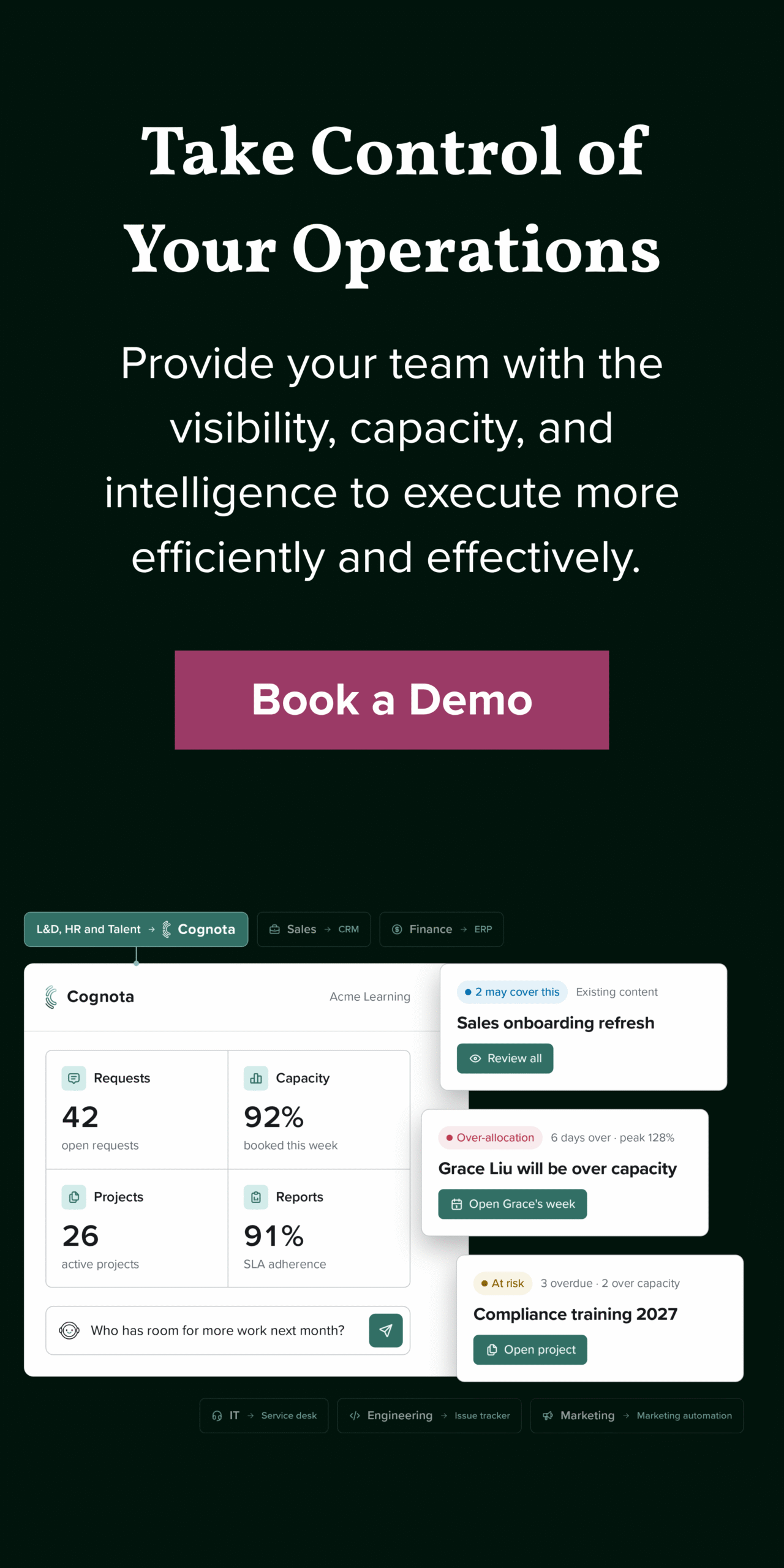
For L&D leaders managing enterprise demand, this is not an administrative issue. It is a strategic one. When requests, resources, costs, and decisions live in different places, it becomes hard to answer basic executive questions: What is the team working on? Why does it matter? What capacity is available? What will be delayed if a new priority enters the plan? See Cognota in action to understand how an operating system for workforce enablement teams can bring those answers into view.
LearnOps is the operations layer for learning
Learning teams already use systems to deliver and track learning. LearnOps does not replace those systems. It addresses a different part of the work: the operating layer between business demand and delivery.
Think about the work that happens before a program is built and after it is launched. A business stakeholder submits a request. An L&D partner clarifies the need. A leader determines whether the request supports a priority. The team estimates effort, evaluates available capacity, secures approvals, manages vendors, tracks spend, and monitors delivery risk. Then it measures whether the work achieved the intended outcome.
Without a defined operating model, those decisions are often made through institutional memory and individual effort. Experienced team members become the routing system. Leaders spend too much time chasing status. Stakeholders see activity, but not always the trade-offs behind it.
LearnOps creates a repeatable way to manage that work. It makes the path from request to outcome visible, with shared rules for priorities, ownership, approvals, capacity, and measurement.
Why LearnOps matters now
The pressure on L&D has changed. Enterprise learning teams are expected to support transformation, build critical capabilities, enable leaders, meet regulatory requirements, and respond quickly to changing workforce needs. Yet many teams are still coordinating operations across disconnected tools.
The 2026 Brandon Hall Group and Cognota Joint Research Report found that 83% of teams use three to eight tools to manage operations, while 69% want to consolidate. That fragmentation creates more than inconvenience. It weakens planning. A team may know its project list, for example, but lack a current view of the effort required, the budget committed, the people available, and the business impact at stake.
The result is a familiar cycle: urgent requests get attention first, strategic work gets squeezed, and leaders struggle to show why certain choices were made. LearnOps helps teams replace that cycle with operational discipline.
This does not mean every request needs a heavy process. A mature model makes room for fast, low-risk work while giving larger or more complex initiatives the governance they require. The point is not bureaucracy. It is clarity proportionate to the decision.
The five parts of a LearnOps operating model
A practical LearnOps model follows the work from first demand through continuous improvement: Align, Plan, Execute, Measure, and Optimize.
Align demand to business priorities
Alignment starts with one front door for requests and a consistent way to capture the information needed to evaluate them. What business outcome is at stake? Who owns it? Who is affected? Is there a deadline, risk, or dependency? What happens if the work is delayed?
This is where L&D shifts the conversation from “Can you build this?” to “What problem are we solving, and is learning the right response?” It also gives HRBPs and business leaders a clearer route to request support without creating side channels that bypass priorities.
Plan capacity, cost, and commitments
A prioritized portfolio still fails if it cannot be delivered. Planning connects approved work to the people, budget, vendors, and time required to do it well.
Capacity should not be treated as a simple headcount number. It should show what team time goes toward: strategic alignment, quality assurance, stakeholder partnership, design, administration, and delivery. When a new initiative arrives, leaders can see the trade-off rather than making a promise based on optimism.
This is especially valuable for CLOs and People leaders who oversee several teams. They need a view across programs and portfolios, not a collection of isolated project updates.
Execute with visible ownership
Execution is where good plans often lose momentum. Work moves across subject matter experts, learning partners, designers, reviewers, procurement processes, and external specialists. Unclear handoffs create delays that no project status meeting can solve.
LearnOps establishes roles, workflows, approvals, and decision points so everyone knows who is responsible for moving work forward. It also surfaces delivery risk early, when a leader can still adjust scope, sequencing, or support.
When specialized expertise is needed, the decision should be connected to the same operating picture. Teams can assess whether to use internal capacity, shift priorities, or engage vetted external support based on the value and urgency of the work.
Measure more than completion
Completion rates and satisfaction scores can be useful signals, but they do not show whether L&D is investing in the right work. LearnOps connects operational measures with business intent.
At the operational level, teams can examine intake volume, cycle time, delivery reliability, capacity use, cost, and stakeholder satisfaction. At the initiative level, they can define the outcomes that matter for the request, such as manager readiness, quality improvement, risk reduction, or faster adoption of a new process.
The right measures depend on the work. A compliance initiative has different evidence requirements than a leadership program. What matters is agreeing on success before delivery begins, then using results to inform the next decision.
Optimize the system, not just the project
Optimization turns data into better operating choices. If a request type repeatedly stalls at approval, the issue may be governance. If a team misses deadlines despite full utilization, the problem may be overloaded work in progress. If one business unit consistently submits unclear demand, intake criteria may need improvement.
This is the difference between reviewing a project after it closes and improving the conditions under which every future project runs.
What LearnOps maturity looks like
Most teams do not begin with a fully defined operating model. They develop it in stages. Cognota’s LearnOps Maturity Model describes five levels: Reactive, Managed, Strategic, Predictive, and Adaptive.
Reactive teams are skilled and committed, but work is driven by the loudest request or nearest deadline. Managed teams have more consistent processes and visibility. Strategic teams connect their portfolios to business priorities and can explain their trade-offs. Predictive teams use operating data to anticipate demand and risk. Adaptive teams continuously adjust resources and decisions as conditions change.
Only 1% to 6% of teams reach the Adaptive stage. That is not a reason to dismiss the model. It is a reminder that operational maturity is built through practical improvements, not a single transformation event. A team may start by standardizing intake, then build capacity planning, then establish outcome measures for its highest-value work.
The research supports the value of that progression. Teams with a dedicated operations lead report 34% faster delivery, 28% lower costs, and 39% higher stakeholder satisfaction, according to the 2026 Brandon Hall Group and Cognota research. Those results do not mean every team needs the same structure. They show that ownership and operational focus matter.
LearnOps is a leadership discipline
At its best, LearnOps changes how L&D is perceived. The team is no longer asked to absorb every request and prove its value after the fact. It can show demand, make priorities visible, explain capacity constraints, govern decisions, and connect delivery to outcomes.
That creates better conversations with the business. A leader can say yes with confidence, no with context, or not yet with a clear path forward. Each response is grounded in evidence rather than personal influence or the latest escalation.
The most useful first question is not whether your team has every element of LearnOps in place. It is where visibility breaks down today. Start there. When your People teams can see the work clearly, they are better positioned to lead it with purpose.