A missed deadline is rarely just a missed deadline. For an L&D leader, it may signal unclear intake, competing executive priorities, unplanned work, or a team whose capacity is committed before the quarter begins. A LearnOps® maturity assessment helps separate the visible problem from the operating issue underneath it – so your team can make better decisions before delivery risk becomes business risk.
Most enterprise learning teams do not struggle because they lack expertise or effort. They struggle because demand, priorities, budgets, external partners, approvals, and delivery work live across disconnected systems. Leaders are then asked to prove impact without a reliable view of what the team is working on, why it matters, and what trade-offs are being made.
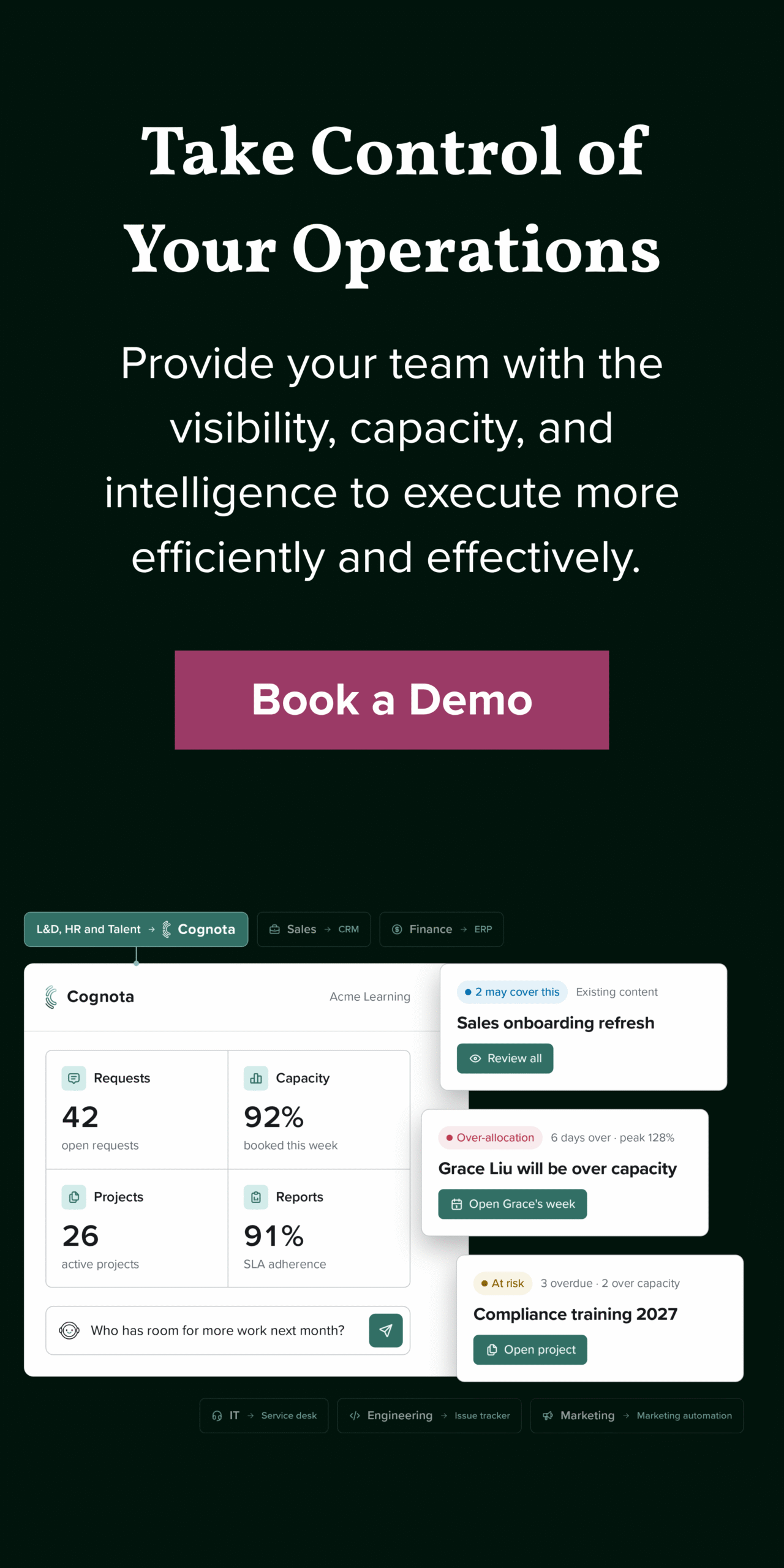
If that describes your environment, schedule a platform demonstration to see how an operations layer can connect requests, priorities, capacity for impact, and delivery decisions in one place.
The goal is not to score your team for the sake of a score. It is to establish a shared view of how work gets done today, identify the constraint holding back performance, and focus improvement where it will matter most.
What a LearnOps® maturity assessment measures
A useful assessment looks beyond whether learning programs are delivered on time. Delivery matters, but it is an outcome of a larger operating model. The assessment should examine whether your team can align work to business needs, plan with confidence, execute with clear ownership, measure results, and improve how decisions are made.
That means asking direct questions. Is there one front door for learning requests? Can leaders see which work is approved, deferred, or at risk? Does the team know the full cost of a program before it commits resources? Are roles and approvals clear when business priorities change? Can you explain which investments are producing the intended workforce or business outcome?
The answers reveal whether operations are enabling strategic work or consuming the time needed to do it well. The 2026 Brandon Hall Group and Cognota Joint Research Report found that 83% of teams use three to eight tools to manage operations, while 69% want to consolidate. Fragmentation is not merely inconvenient. It makes it harder to spot delivery risk, protect capacity for high-impact work, and give stakeholders a credible picture of progress.
The five stages of LearnOps® maturity
The LearnOps Maturity Model provides a practical way to describe your current state without treating maturity as a finish line. Teams move through five stages: Reactive, Managed, Strategic, Predictive, and Adaptive. Progress is not always linear. A major reorganization, new compliance requirement, or shift in workforce strategy can expose gaps that were not visible before.
Reactive: Work arrives faster than it can be organized
Reactive teams are driven by urgent requests, inboxes, meetings, and individual heroics. Priorities often change informally, and leaders have limited visibility into capacity, spend, or project status. The team may deliver valuable work, but it depends too heavily on people remembering what needs to happen next.
The first improvement is not a complicated transformation. It is creating a consistent intake process and a visible way to evaluate demand. One front door for requests makes the work visible. It also creates the basis for saying yes, no, or not yet with context.
Managed: The team has structure, but not always alignment
Managed teams have repeatable processes for projects, approvals, and delivery. They can usually report on active work and assign ownership. The challenge is that structure may still sit apart from business planning. Work is managed efficiently, but the team may not have a clear method for comparing the value of competing requests or forecasting the capacity needed for quality and impact.
At this stage, connect intake to prioritization. Define the criteria used to assess requests, such as business objective, audience reach, risk, required effort, and expected outcome. The point is not to make every decision mathematical. It is to make the rationale visible and consistent.
Strategic: Learning operations support business decisions
Strategic teams plan work against enterprise priorities and can explain how their portfolio supports workforce goals. Leaders can see demand, planned capacity, costs, ownership, and major risks before delivery starts. Governance is clear enough that decisions do not stall when several People teams or business partners are involved.
This is where LearnOps®
becomes a management discipline rather than an administrative function. Teams can make trade-offs deliberately: pause lower-value work, bring in specialized support, or shift capacity toward a priority initiative without relying on guesswork.
Predictive: Signals shape decisions early
Predictive teams use historical operational data to anticipate workload, constraints, and delivery risk. They do not wait until a project is late to discover that approvals are blocked or subject matter experts are unavailable. They identify patterns across demand, cycle time, budget, and resource needs early enough to act.
Predictive does not mean pretending every outcome can be forecast perfectly. Business conditions change. It means using available signals to make better calls, document assumptions, and revisit plans when those assumptions no longer hold.
Adaptive: The operating model evolves with the business
Adaptive teams continuously improve how work enters, moves through, and is measured across the organization. They can respond to change without losing governance or exhausting the people responsible for delivery. Only 1% to 6% of teams reach this stage, which makes it a useful aspiration but not a requirement for meaningful progress.
An Adaptive team is not a team with no friction. It is a team that sees friction quickly, understands its source, and has the operating discipline to address it. That is a different standard from simply working faster.
How to run the assessment without creating more work
Start with a cross-functional working session that includes learning leaders, operations owners, finance partners where appropriate, and key business stakeholders. A maturity assessment is less reliable when it relies only on the perspective of the people closest to the work. Leaders may believe priorities are clear while project owners experience constant changes and duplicate requests.
Assess the operating model through five areas: Align, Plan, Execute, Measure, and Optimize. In Align, examine how demand is connected to business priorities. In Plan, look at portfolio decisions, capacity for alignment and quality, budgets, and delivery dependencies. In Execute, assess workflows, ownership, approvals, and visibility into risk. In Measure, determine whether teams can connect work to outcomes that matter. In Optimize, look for how operational data informs the next planning cycle.
Avoid averaging every answer into one polished score. A team might be Strategic in planning but Reactive in intake, or strong in execution but weak in measurement. Those differences are useful because they point to the constraint that deserves attention first.
For example, if projects are routinely delayed, do not assume the problem is project management. The issue may be that work enters without a defined sponsor, approvals happen outside the workflow, or the team commits to new requests without seeing the impact on existing priorities. Fixing the root cause reduces recurring friction more effectively than asking people to work harder.
Turn findings into a focused operating plan
The best assessment ends with a small number of decisions, not a long list of improvement ideas. Choose one priority for the next planning cycle, assign an accountable owner, define the signal that will show progress, and set a review point.
A Reactive team may focus on standardized intake and priority criteria. A Managed team may focus on connecting project plans to budget and capacity decisions. A Strategic team may focus on creating earlier risk signals or improving outcome measurement. The right next step depends on the gap, the business context, and the change capacity of your People teams.
Dedicated operations ownership can accelerate progress. The same 2026 joint research found that teams with a dedicated operations lead reported 34% faster delivery, 28% lower costs, and 39% higher stakeholder satisfaction. Those results are not automatic. They reflect the value of having someone accountable for the system of work, not just the work itself.
A LearnOps® maturity assessment gives leaders a more useful conversation than, “How busy is the team?” It asks, “Is our operating model directing effort toward the outcomes the business needs most?” That question creates the visibility to lead – and the signals to execute.