A request for leadership training arrives by email. A compliance initiative appears in a planning meeting. A business leader asks for a new onboarding program in chat. By Friday, the Learning and Development team has three urgent asks, no shared view of effort, and no clear answer to the question that matters most: what should move forward first?
That is the operational problem learning intake software is designed to solve. It creates one front door for demand, then gives workforce enablement leaders the information to assess requests against business priorities, available capacity, cost, risk, and expected impact. The goal is not to make intake feel more bureaucratic. It is to make better decisions before work starts.
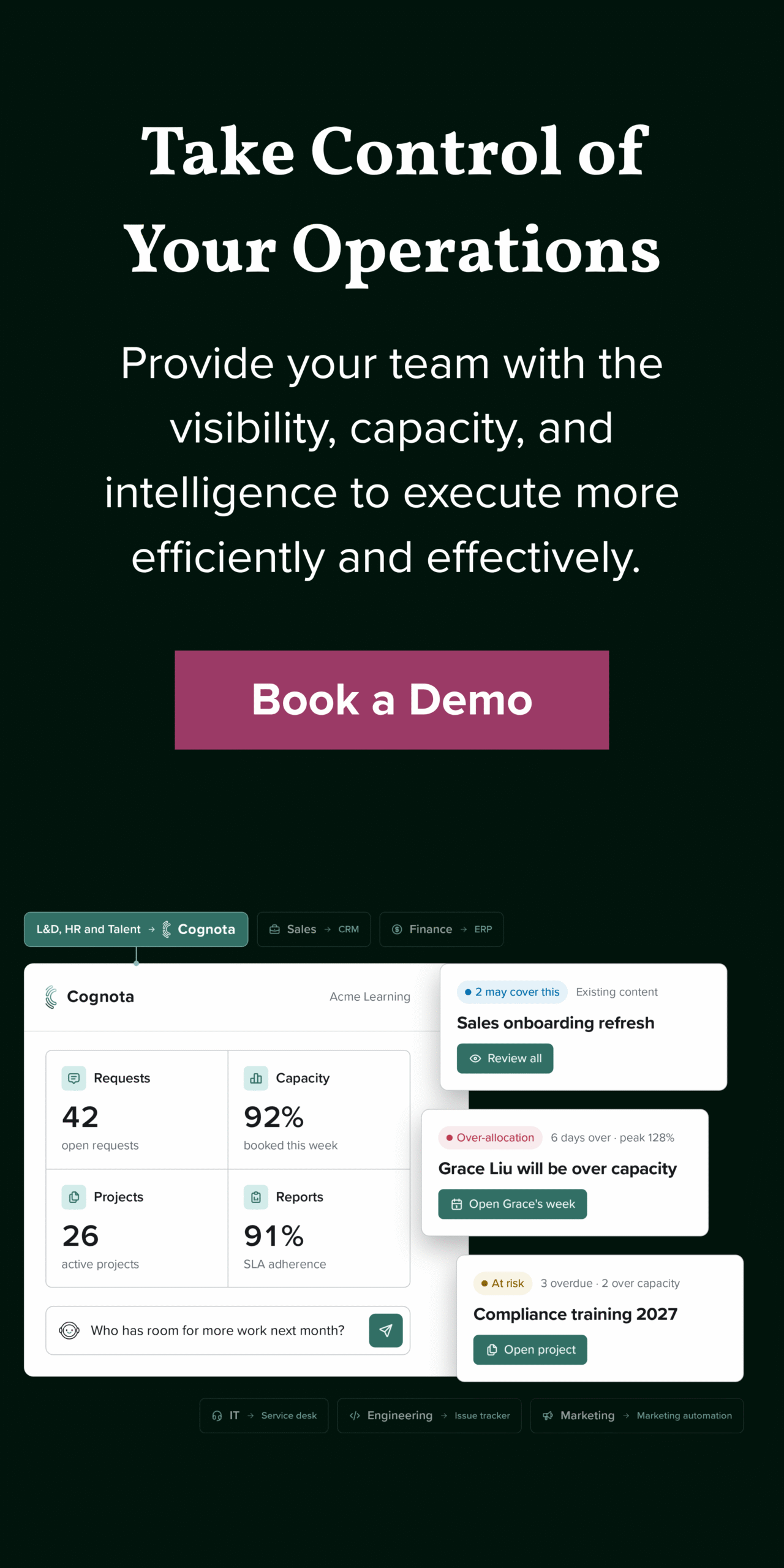
For L&D leaders managing growing demand with limited visibility, see Cognota in action through a platform introduction. The difference is not another place to submit a form. It is a way to turn incoming work into signals your team can use.
What Is Learning Intake Software?
Learning intake software manages the process of requesting, reviewing, prioritizing, and assigning learning work. It replaces scattered emails, spreadsheets, slide decks, and informal conversations with a structured workflow that captures the right details from the beginning.
A useful intake process asks more than, “What training do you need?” It establishes the business problem, intended audience, urgency, sponsor, delivery date, dependencies, budget considerations, and definition of success. That context helps L&D distinguish a genuine capability need from a request that may be better addressed through process changes, communication, manager support, or existing resources.
This matters most in enterprises where a learning team serves many business units. Without a consistent intake process, the loudest requester can become the highest priority. That may keep stakeholders happy in the moment, but it leaves the team reactive and makes business alignment difficult to prove.
Learning intake software is not a system of record or a learning delivery system. It is the operations layer for the work your team must evaluate and deliver. It connects demand to the decisions, people, budget, and delivery work behind every initiative.
Why Intake Breaks Down as Demand Grows
Most teams do not set out to create a fragmented intake process. It happens one request at a time. A senior leader sends an email. A familiar business partner calls directly. A project begins before the L&D team has been consulted. Each exception feels reasonable, until the team has no dependable view of its full workload.
The result is more than administrative frustration. Leaders lose visibility into what their capacity is going toward: strategic alignment, quality delivery, or simply keeping up with the latest urgent request. They also struggle to explain why one initiative must wait while another moves ahead.
The 2026 Brandon Hall Group and Cognota Joint Research Report found that 83% of teams use three to eight tools to manage their operations, while 69% want to consolidate. That tool sprawl creates handoffs, duplicate data, and status updates that consume time without improving decisions.
A weak intake process also obscures delivery risk. If scope, approvals, subject matter expert availability, vendor needs, or cost are discovered late, the team may commit to a date it cannot reasonably meet. The work becomes a scramble, and stakeholders see the delay without seeing the upstream decision that caused it.
The real cost is unclear prioritization
Teams often frame intake as an efficiency problem. It is also a governance problem. When every request follows a different path, the organization has no consistent rules for deciding what deserves investment.
A standardized workflow does not mean every initiative receives the same answer. A time-sensitive regulatory requirement should be handled differently from a leadership development idea with a longer horizon. The value comes from applying clear criteria, documenting the rationale, and making trade-offs visible to the right people.
What Effective Learning Intake Software Should Do
The strongest platforms support the full operating cycle, not just request collection. Intake is where the work begins, but its value depends on what happens after submission.
Align requests to business priorities
Every request should connect to a defined business objective, audience need, or workforce outcome. This gives leaders a way to assess whether proposed work supports a current priority or should be reconsidered. It also gives stakeholders a more productive conversation than a simple yes or no.
For example, a sales leader may request product training because pipeline conversion is slipping. Intake should surface whether the gap is product knowledge, sales process, manager coaching, systems friction, or something else. Learning may be part of the solution, but it should not be the assumed solution.
Plan with capacity, cost, and dependencies in view
A request is not a plan. Once work is approved, teams need to understand the effort required, who owns each part, which experts must contribute, and what the initiative will cost. Capacity visibility is especially valuable when it shows what the team is choosing to invest in: higher-quality design, faster response to critical needs, or strategic programs with broader impact.
This is where learning intake software moves beyond a digital form. It should connect approved demand to planning and execution so leaders can see committed work, unallocated capacity, bottlenecks, and competing priorities in one place.
Execute with accountable workflows
Approval by itself does not create clarity. Effective workflows define the roles, approvals, handoffs, and milestones required to move work forward. That structure matters when an initiative crosses L&D, Talent, HR, business leadership, finance, procurement, or external expertise.
Clear ownership also prevents the familiar status chase: “Who is waiting on whom?” Instead of relying on meetings and inbox searches, teams can see the next decision, the responsible owner, and the risk of delay.
Measure more than volume
Request counts are useful, but they are not evidence of impact. Leaders need to see patterns in demand, delivery time, stakeholder satisfaction, cost, workload distribution, and outcomes tied to priority initiatives.
Measurement should fit the work. Some programs warrant deeper evaluation because they are business-critical or expensive. Others may only require evidence that they were delivered on time, reached the intended audience, and solved the stated need. The point is to establish measures at intake, not invent them after launch.
Optimize the operating model
Over time, intake data reveals where the team needs to improve. Perhaps one business unit consistently submits incomplete requests. Perhaps review cycles stall at the same approval point. Perhaps urgent work consumes a disproportionate share of capacity without a corresponding business case.
Those insights help leaders improve the system, not merely process more requests. This is the difference between managing activity and building operational maturity.
How to Evaluate Your Current Intake Process
Start with the path a request takes today. If the answer depends on who asks, how urgent they sound, or which channel they use, your team does not have a reliable front door yet.
Then examine the quality of information captured before a commitment is made. Can your team identify the business sponsor, audience, desired outcome, deadline rationale, estimated effort, cost, and dependencies? If key details are gathered only after work begins, intake is functioning as a notification mechanism rather than a decision process.
Finally, look at what leaders can see without asking the team to assemble a manual update. They should be able to understand demand volume, priority mix, work in progress, delivery risk, and the capacity allocated to the work that matters most. If visibility lives in separate spreadsheets and meetings, the process will remain difficult to scale.
From Reactive Requests to Strategic LearnOps®
Learning intake is an early indicator of LearnOps® maturity. Reactive teams accept work as it arrives and rely on individual heroics to deliver. Managed teams begin to standardize requests and track work. Strategic teams use demand, capacity, and outcome data to shape priorities with the business.
The most advanced teams move toward predictive and adaptive operations, where patterns in demand and delivery help them anticipate decisions before they become fire drills. Only 1% to 6% of teams reach the Adaptive stage, but the point is not to chase a label. It is to identify the next practical improvement for your operating model.
A dedicated operations lead can accelerate that progress. The 2026 Brandon Hall Group and Cognota Joint Research Report found that teams with a dedicated operations lead reported 34% faster delivery, 28% lower costs, and 39% higher stakeholder satisfaction. Those results reflect disciplined operating practices: clear demand management, visible ownership, and decisions grounded in shared data.
Learning intake software gives those practices a system to live in. It helps teams align requests, plan the work, execute with accountability, measure what changed, and optimize based on evidence.
The next request will arrive whether your process is ready or not. The question is whether it becomes another urgent task in someone’s inbox or a visible decision that moves your workforce strategy forward.