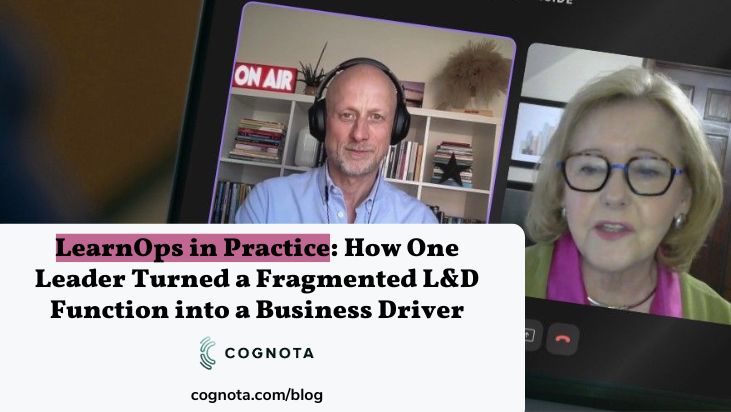
In a standout episode of The Learning & Development Podcast, David James sat down with Martha Soehren—former Chief Talent Development Officer and SVP at Comcast Cable, LearnOps® Academy Instructor, and current consultant with Cognota—to explore that very question. Over nearly 15 years, Martha led one of the world’s largest talent development teams, serving 125,000+ employees across a Fortune 10 media and technology powerhouse.
But Martha didn’t just “deliver training.” She transformed how L&D operated—embedding governance, linking development to performance, and positioning talent as a true business enabler.
This isn’t theory. It’s a lived playbook for how L&D leaders can earn credibility, drive strategic outcomes, and scale talent impact—backed by governance, storytelling, and data.
A Blueprint for L&D Transformation
When Martha stepped into the top learning role at Comcast, things were, in her words, “a mess.” Multiple business units operated in silos. Learning content was inconsistent. And the team had little visibility or authority to drive systemic change.
Her solution? A radical shift toward centralized learning operations, executive governance, and measurable business alignment.
“You can’t measure impact if you’re not connected to the business. You have to build partnerships, design with purpose, and have the data to tell the story.”
Martha Soehren
Here are five big takeaways from her journey—along with how they connect to the LearnOps® approach.
1. Create Strategic Alignment with Executive Governance
At Comcast, Martha didn’t build L&D in a vacuum. She co-chaired a Learning Council with the company’s CEO—bringing together the top 10 executives to guide strategy, allocate budget, and champion key initiatives.
“Once you get senior executives on side, they will stand up for you when you’re not at the table.”
Martha Soehren
This governance model ensured alignment between learning investments and enterprise goals. It also gave her team the credibility and air cover needed to experiment, scale, and course-correct.
How LearnOps® Helps:
Cognota’s Strategic Alignment module helps learning teams mirror this structure. It connects intake, goals, and budget into a single source of truth—so every project maps directly to business priorities. Whether you report to a steering committee or operate solo, Strategic Alignment keeps you laser-focused on what matters most.
2. Move from Silos to a Unified Operating Model
Before centralizing L&D, Comcast had more than 79 separate reporting lines for learning professionals scattered across functions. Technicians were taught 11 different ways to climb a utility pole—only three of which were actually safe.
“How do you expect consistent customer service when agents and techs are getting 30+ different onboarding courses that all look different?”
Martha Soehren
Martha’s business case was rooted in logic and data: unify operations, standardize quality, and reduce waste. With centralized learning ops came better collaboration, clearer ownership, and a shared approach to quality.
How LearnOps® Helps:
Cognota consolidates learning planning, resource management, and execution into one connected platform. By eliminating spreadsheets and scattered tools, teams can standardize intake, streamline program development, and unify operational workflows—whether you’re 5 people or 500.
3. Design for Outcomes—Not Outputs
One of the most compelling moments from the episode was Martha’s example of solving a recurring service issue in a regional division. Her team partnered with field operations to understand why technicians were being called back to homes unnecessarily. The result? A targeted learning program that delivered a 700% ROI.
“We didn’t just launch training. We sat down and asked, ‘What does success look like?’ Then we designed to achieve it.”
Martha Soehren
From call centers to cable technicians, success meant behavior change. And behavior change meant aligning every initiative with metrics the business already cared about.
How LearnOps® Helps:
With Cognota, teams can define project goals upfront, align them to KPIs, and track outcomes across every program. Whether it’s completion data or business impact metrics, your team gets visibility into what’s working—and what needs to change.
4. Tell a Better Story with Your Data
Data alone doesn’t earn executive support. Storytelling does.
Martha emphasized the power of data-driven storytelling—using real performance metrics, qualitative narratives, and cross-functional benchmarking to make a compelling case.
“By having that data and telling the story of how things were being done, I got a lot of buy-in.”
Martha Soehren
She even reviewed ATD’s State of the Industry and benchmarked against peers to show Comcast’s leadership what was possible—not just what was broken.
How LearnOps® Helps:
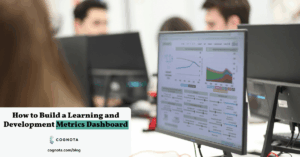
Cognota’s platform automatically connects your planning and execution data to impact dashboards. You can show what your team is working on, where resources are going, and what the measurable outcomes are—without manual reporting. It’s your story, already visualized.
5. Embed Talent Development Across the Org
Later in her career at Comcast, Martha assumed responsibility for Talent Development—and saw firsthand the power of integrating learning with succession planning.
Her team didn’t just train leaders. They built pipelines. Programs were co-designed with business leaders, linked to promotion pathways, and tracked through robust talent reviews. The result? One early program saw 83% of frontline supervisors promoted within two years.
“We had the whole enchilada—learning, performance, succession, engagement—all feeding the same pipeline.”
Martha Soehren
Leadership was no longer a destination. It became a capability.
How LearnOps® Helps:
The LearnOps Maturity Model guides organizations from reactive intake to adaptive strategy. At advanced levels, L&D teams evolve into true partners in workforce planning, talent mobility, and performance enablement. Cognota’s platform helps teams move from content providers to transformation enablers.
LearnOps in Action: Why It Matters Now
In the closing moments of the episode, David James noted:
“So many L&D teams want to modernize—but they feel stuck. Martha didn’t wait for permission. She took control of the narrative.”
That’s what LearnOps is all about. Taking control of the operating model so learning teams can stop chasing intake requests—and start driving strategy.
At Cognota, we’ve spent years building the platform and methodology behind modern L&D operations. We’ve captured thousands of hours of analysis, research, and conversations with leaders like Martha—and distilled them into the LearnOps® Framework and Maturity Model.
Whether you’re navigating growing complexity or just trying to justify your team’s existence, LearnOps gives you a roadmap for operational excellence—and a platform to support it.
Final Thought
Martha’s story is more than inspiration. It’s proof.
That with the right mix of governance, relationships, data, and integrity, L&D can shift from fragmented support function to strategic driver.
The question isn’t if this is possible—it’s how fast your team wants to get there.
🎧 Listen to the full episode:
Driving Business Impact with Talent Development at Scale with Martha Soehren
💡 Want to see how Cognota helps you operationalize this?
Book a customized consultation to discover how one connected platform can transform how your team plans, executes, and measures learning.