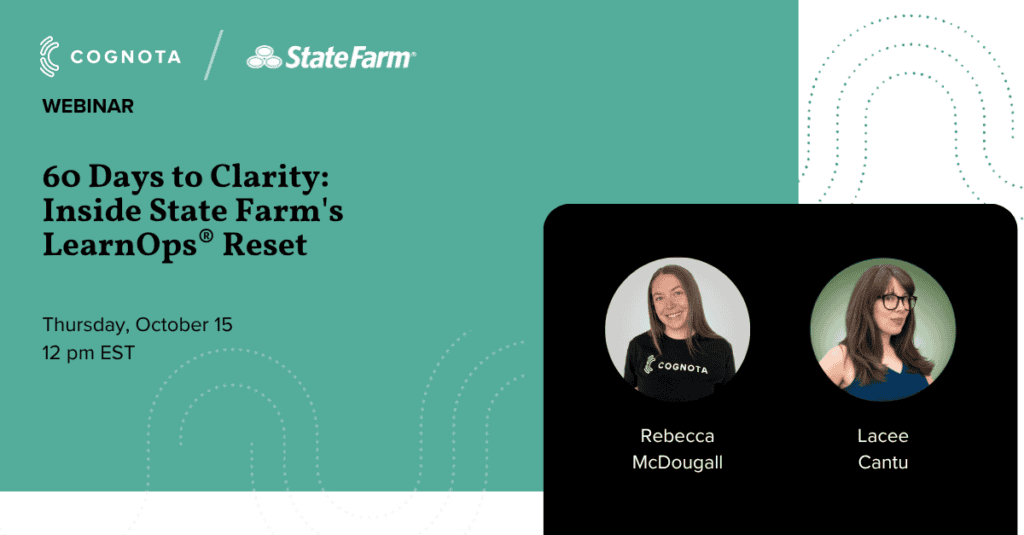
When Rebecca McDougall asked Lacee Cantu what life looked like at State Farm before Cognota, Lacee answered right away: “Lots of vibes.”
If you’ve ever planned L&D or Talent work on instinct and goodwill, you know exactly what she means. Lacee manages learning operations for the team that supports State Farm’s independent contractor agents, which is around 100 people serving more than 100,000 learners. On our October 15 webinar, she and Rebecca, Cognota’s VP of Customer Success & Education, walked through what changed when her team got all of that work into one place. Here’s what stuck with me.
Work nobody could see
Requests reached Lacee’s team through whoever the requester happened to know. An email, an IM, a phone call, or what she called “the mysterious channel,” where someone said to someone who said to someone, and then it got somewhere. Her department sits, as she put it, at the intersection of Main Street and 2nd Avenue: everyone drives through, so she has the best view of the organization, but no way to connect what she sees.
A department restructure made it impossible to look away. When the team inventoried everything they were doing and who was doing it, they found work that nobody knew existed and a surprising amount of duplication. Different requests, arriving through different doors, had produced conflicting training on the same topic. Because requests went to whoever had the right skills, she said, they also built a lot of PowerPoints.

One front door, rebuilt four times
The first thing the team set up was intake forms. Her own analysts and designers filled them out first, so they could build confidence in the process before asking business partners to use it. In the first 60 days they rebuilt the forms no fewer than four times. Lacee said the best part is that nothing is locked in: “There’s nothing in Cognota that we can’t redo or do differently.” Rebecca added that teams often stall trying to design the perfect version up front, and that iteration is the better habit.

Task bundles, minus the paperwork
A task bundle is a set of related tasks you apply to a project, with the sequence and dependencies already defined. Lacee’s team started from the types of things they build, asked their leads to write detailed standard processes for each, and then had project managers sit down with the leads to mark the critical handoffs: where the work moves from an instructional designer to a developer, say, or to a QA analyst. The bundles track only those handoffs. Everything inside a step stays in the documented process. She was firm that the goal was never to make the people doing the work spend more time logging than building.
The team was hesitant at first. Lacee spent 17 years in claims at State Farm, where everything is tracked down to the second, so she understood why. She kept the message simple: this is about balancing capacity and workload across the department, not watching any one person. Today, she said, the old pattern of 20% of the people doing 80% of the work has leveled out, and people say they can finally take the vacation or make the afternoon appointment.
When 100% is a red flag
Here was my favorite moment. Lacee’s team had hit every delivery target for six months, and she did not trust it.
“Nobody hits 100% of their project plans.” – Lacee Cantu, State Farm
They had been giving dates and then delivering well ahead of them. Moving the promised dates closer to the real timeline meant the team could plan for more work. They now land around 98% and miss a date once in a while, which she says makes her feel better, because things do go wrong. She credits some of the instinct to coaching high school football: no matter the score, nobody has a perfect game.
The people who didn’t feel the pain
Asked what she would do differently, Lacee talked about people. She and her team felt the problem every day and assumed everyone else did too. They didn’t. To get her executive on board she brought a giant spreadsheet of a year’s work with every collision highlighted, and a dollar amount on the time it was costing. Then they proposed using Cognota on a large enterprise-wide initiative that was already underway. That initiative is still running, and it has grown.
Rollout was harder than the pitch. They taught a few classes and expected everyone to love the tool. They didn’t, and the team spent a long time on change adoption afterward. Some leaders expected to open a dashboard and see everything, but her team uses Cognota mainly for the people doing the work, who now find answers for themselves instead of messaging a project manager. Her biggest lesson: bring people closer to the problem before you try to implement, and don’t expect a one-time launch to carry the change.
Where does your team sit?
Rebecca closed with Cognota’s LearnOps® Maturity Model, five levels from Reactive to Adaptive. In practice, she said, only 1% of teams have reached Adaptive, and most sit between Managed and Strategic. In the live poll, most people on the call placed themselves between Reactive and Managed, with a couple at Strategic.
Lacee’s team first scored between Reactive and Managed. They were probably more reactive than they admitted on the self-assessment. Today she places them solidly in Strategic and moving toward Predictive, and she credits the jump to finally seeing all of the work, which led them to stand up a strategic vertical that now looks at everything strategically. Her team also slid back a little when the pace of AI news hit. Her advice: don’t feel bad if that happens, it’s not your doing.
One more thing worth knowing: her team took the assessment about six months after implementation, with the department’s leaders in the room together, and she said that was when the light bulbs went on for them. Rebecca says teams now generally take it before they start, which gives you something concrete to show leadership.
Watch the recording
If you only have time for part of it, the two questions that came up in the chat and the Q&A, how Lacee made the case to her leaders and what a task bundle really is, are worth finding. If you’d like to talk through where your own team sits, we’re happy to.