A business leader asks for a new sales program, a compliance update lands with a fixed deadline, and three major initiatives are already in production. The question is not whether your team is busy. It is: when should learning teams outsource without losing strategic control of the work?
For enterprise L&D leaders, outsourcing is not a binary choice between building everything internally and handing work away. It is a capacity decision that should protect the work your team is uniquely positioned to own: business alignment, stakeholder relationships, performance strategy, governance, and measurement. External support can expand delivery capacity. It cannot replace operational discipline.
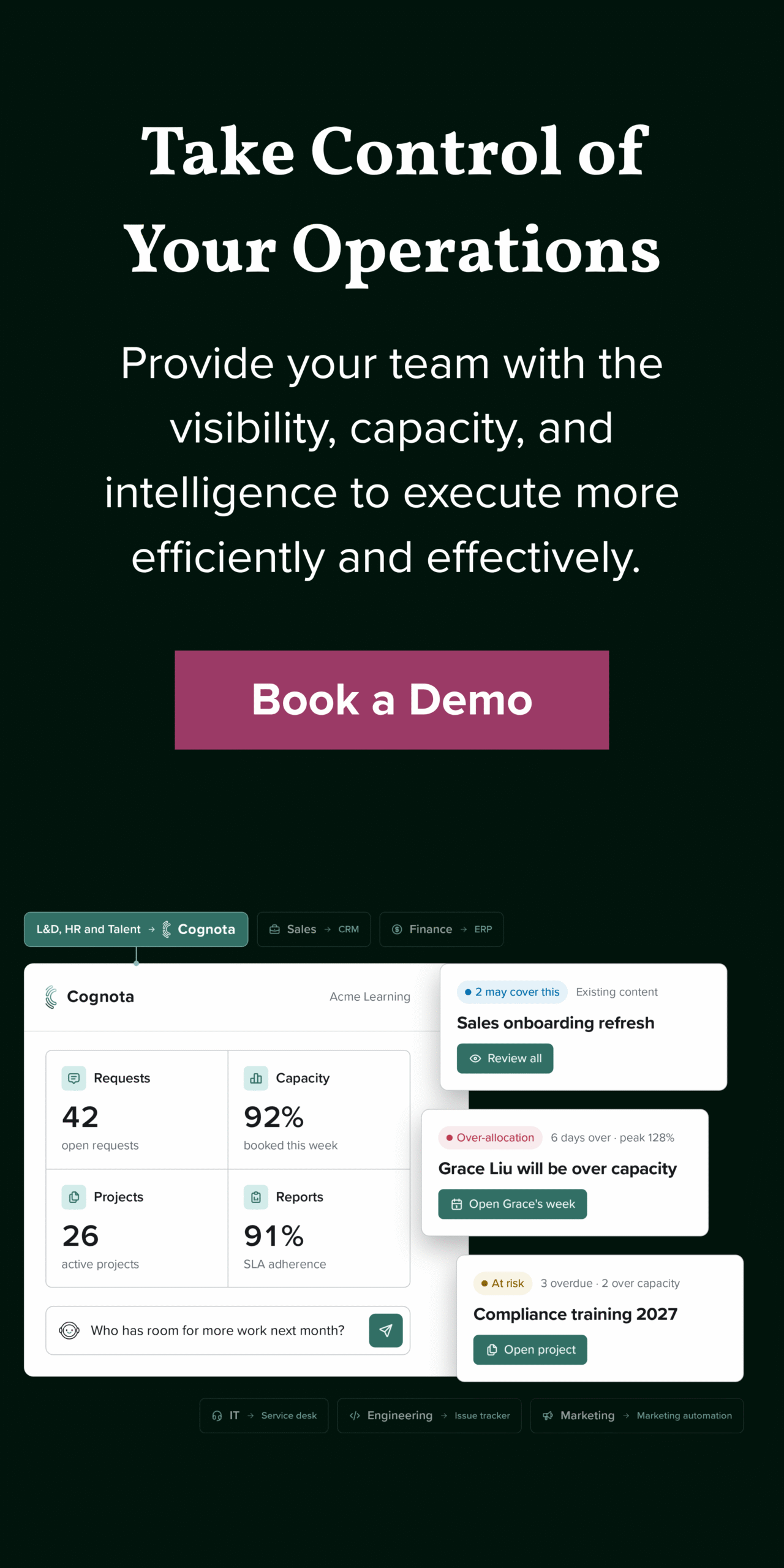
If demand is rising faster than your ability to prioritize, plan, and execute, it may be time to see how Cognota brings work intake, resource planning, and flexible specialist capacity into a more coordinated operating model. Seeing the LearnOps® platform in action can clarify where external support fits and where internal ownership must remain firm.
When should learning teams outsource?
Learning teams should outsource when the work is important but does not require permanent internal capability, when demand is volatile, or when a specialized skill is needed for a defined period. The strongest outsourcing decisions begin with a clear view of the demand portfolio, internal capacity, required expertise, and expected business outcome.
That distinction matters. A team that outsources because it lacks visibility into workloads may simply move a planning problem outside the organization. A team that outsources after making deliberate decisions about priority, capacity, and accountability can accelerate execution while keeping strategy in-house.
The LearnOps® framework offers a practical lens. Before bringing in outside support, teams should Align on the business need, Plan the work and resources, Execute with clear ownership, Measure outcomes, and Optimize future decisions. Outsourcing becomes far more effective when it operates inside this discipline rather than beside it.
The signals that external capacity is the right move
The clearest signal is a recurring mismatch between approved priorities and available capacity. If high-value work repeatedly waits because internal teams are consumed by production backlogs, outsourcing may be a better answer than asking employees to stretch further. The goal is not to keep every task internal. It is to ensure internal expertise is focused where it creates the most value.
A short-term demand spike is another strong case. Major system changes, product launches, regulatory deadlines, acquisitions, and enterprise transformation programs can create a volume of work that does not justify permanent hiring. In these situations, an on-demand team can help absorb peak demand while preserving the core team’s ability to run its ongoing portfolio.
Specialized expertise is also a valid reason to outsource. Some initiatives need a capability that is rare, technical, or needed only occasionally. Bringing in a specialist can improve quality and speed, particularly when the internal team would otherwise spend weeks trying to source, onboard, or develop a skill that is not central to its long-term mandate.
Finally, consider outsourcing when a delay has a meaningful business cost. If a learning initiative is directly tied to readiness, risk reduction, revenue enablement, or a critical change effort, the cost of waiting may exceed the cost of external capacity. That decision should be made with the business sponsor, not in isolation.
Outsource capacity, not accountability
The operational principle is simple: a partner can contribute expertise and production capacity, but the learning team remains accountable for the business outcome. Internal leaders should own the problem definition, success measures, stakeholder decisions, and final governance.
Without that boundary, outsourcing can create fragmented experiences and unclear ownership. Business stakeholders may not know who can make decisions. External contributors may receive incomplete context. And the internal team can lose sight of cost, status, and impact across a growing portfolio of work.
What should remain inside the learning team
Not every task should be outsourced, even during a capacity crunch. Work that requires deep knowledge of enterprise strategy, organizational culture, sensitive change dynamics, or long-term workforce priorities generally needs internal leadership.
Keep the relationship with business stakeholders close. Intake conversations often reveal that the requested learning solution is not the real need. A request for a course may actually point to a process gap, manager capability issue, unclear communications, or missing performance support. Internal teams are better positioned to challenge assumptions and connect learning investments to broader business priorities.
Portfolio governance should also remain internal. Someone must decide what gets funded, sequenced, paused, or declined. This is especially critical for teams moving beyond a Reactive or Managed operating model in the LearnOps® Maturity Model. Strategic and Predictive teams do not merely respond to demand. They use data to make trade-offs visible and invest capacity where it will matter most.
Measurement belongs close to the business as well. External specialists can support evaluation design or analysis, but internal leaders need to define what success looks like and carry the results into future planning. If a team cannot explain why an initiative was prioritized or what changed because of it, outsourcing will not solve the underlying credibility challenge.
Avoid outsourcing a broken operating model
A full pipeline is not automatically evidence that a team needs more people. It can also signal unclear intake, weak prioritization, duplicate work, or scope that expands without governance. Before engaging external support, leaders should ask whether they can answer a few basic questions: What work is in the pipeline? Who owns it? What skills and hours does it require? Which initiatives are tied to business priorities? Where are the bottlenecks?
If the answers require spreadsheets, inbox searches, and status meetings, the issue is not just capacity. It is operational visibility.
This is why the distinction between capacity and execution matters. More capacity helps only if work can be assigned, governed, and measured effectively. A marketplace of capable specialists is valuable, but it needs a clear operating layer around it. Otherwise, teams can unintentionally create a second shadow workflow for external work, complete with separate requests, invoices, approvals, and status reporting.
Research and commentary across the L&D field consistently point to this broader shift. Analysts such as Josh Bersin and Brandon Hall Group have emphasized the rising expectation for learning functions to demonstrate business impact, not simply activity. That expectation changes the outsourcing conversation. The question is no longer, “Can someone build this faster?” It becomes, “What is the best operating model to deliver this outcome with the capacity we have?”
How to make outsourcing work in practice
Start with a defined problem, not a generic request for help. Describe the business objective, intended audience, constraints, required expertise, decision makers, and measures of success. The more precise the scope, the easier it is to identify whether external support is appropriate and to avoid costly rework.
Then separate the work into strategic ownership and executional tasks. Your internal team might lead discovery, alignment, architecture, and stakeholder review while an external specialist contributes design, development, facilitation, content conversion, or targeted technical expertise. The division will vary by initiative, but it should be explicit before work begins.
Set governance that is proportional to the work. A small, contained project does not need excessive process. A business-critical initiative needs clear milestones, review points, change control, and visibility into spend and effort. The aim is not bureaucracy. It is informed control.
Finally, evaluate the engagement after delivery. Did external support reduce time to execution? Did it preserve internal focus on strategic work? Did the initiative meet its intended business outcome? Did the work reveal a capability that should be built internally over time? These answers help teams improve future make-or-buy decisions instead of treating every request as a one-off.
A more mature view of flexible capacity
High-performing learning organizations do not treat outsourcing as a sign of weakness or a permanent substitute for internal capability. They treat it as one lever in a broader capacity strategy. They know what work deserves internal ownership, where specialist support adds value, and how to maintain a single view of demand, resources, costs, and outcomes.
That is the shift from reactive resourcing to intentional LearnOps®. The right external support can help a learning team move faster when the business needs it most. But the real advantage comes from having the operational intelligence to decide when to use it, govern it well, and learn from the result.