For years, experienced instructional designers and content reviewers used an informal shortcut: they could read between the lines of a Subject Matter Expert draft and immediately identify where the information originated.
When an engineer submitted a rough training document, the source material left obvious footprints. A clunky, legalistic paragraph meant the SME copied and pasted directly from the latest compliance policy. A bulleted list packed with technical jargon pointed straight to the engineering team’s internal Jira ticket. Even informal shorthand or odd phrasing revealed which team built the procedure.
These were provenance signals: the natural breadcrumbs of origin left behind in human-written text.
They allowed L&D teams to review drafts quickly. You did not have to cross-examine every sentence because you could recognize the source on sight. You knew what to spot-check, what was authoritative, and what needed clarification.
Generative AI eliminates those signals.
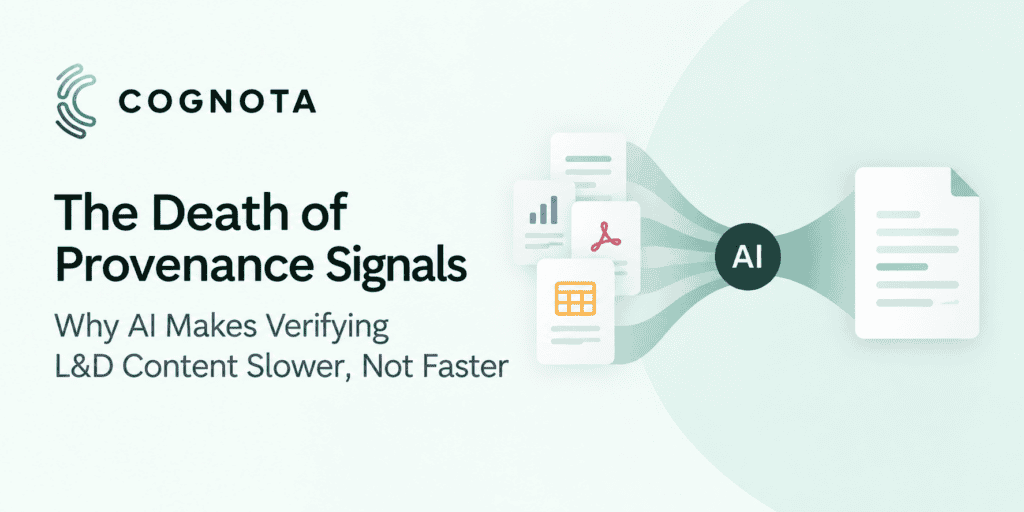
By running source materials through Large Language Models, SMEs submit drafts that read with uniform authority. Under the surface, the knowledge trail disappears. This dynamic explains why the loss of provenance signals is driving review times up across L&D teams, and how a LearnOps framework restores visibility and control.
The Blender Effect of Generative AI
Large Language Models do not track origin; they blend inputs together.
When an SME prompts an AI tool to turn three disparate documents into an onboarding module, the model synthesizes everything into a single, polished voice. It smooths out idiosyncratic vocabulary, paraphrases unique phrasing, and turns raw notes into standard business prose.
During that rewrite, the tool strips out every indicator of origin:
- Policy vs. Personal Habit: The output delivers formal compliance rules and an individual employee’s personal workarounds in the exact same confident tone.
- Current vs. Deprecated Knowledge: If an SME feeds an outdated 2021 document alongside a 2024 update, the model merges them without flagging inconsistencies.
- Internal Facts vs. Web Generalizations: The tool fills knowledge gaps with general internet training data that can contradict how your company operates.
To an executive skimming the draft, the material looks complete. To the reviewer responsible for operational accuracy, it is impossible to trace.

From Spot-Checking to Forensic Auditing: The Real Review Tax
When provenance signals disappear, reviewing content shifts from an editorial check to an investigation.
In a traditional workflow, an instructional designer or QA reviewer performed targeted spot-checks. If a section clearly mapped to a verified standard operating procedure, the reviewer confirmed the alignment and moved forward. The mental effort remained manageable.
Without provenance signals, reviewers cannot rely on pattern recognition. They get pushed into forensic auditing:
- The Origin Problem: Reviewers must determine whether a safety step came from an approved operational manual or if the model pulled a general recommendation from the open web.
- Sentence-by-Sentence Verification: Because any sentence could contain a subtle, realistic-sounding error, every statement requires manual cross-referencing.
- The Loss of Reviewer Trust: When reviewers cannot tell where information came from, confidence in the entire document drops. Approvals stall, comment threads multiply, and teams end up scheduling extra meetings just to verify basic facts.
The SME saves two hours by drafting with an AI prompt, but the review team spends four extra hours tracking down source documents to verify the text. The organization speeds up initial typing at the expense of actual delivery.
How LearnOps® Restores the Knowledge Supply Chain
You cannot solve a provenance problem by asking reviewers to read faster or by handing out generic prompt templates. Content production needs clear chain-of-custody protocols.
Within a LearnOps® framework, L&D teams establish operating rules that connect SME inputs directly to verified sources:
Enforce the “No Anchor, No Review” Intake Rule
Enforce the “No Anchor, No Review” Intake Rule
The fastest way to fix provenance issues is to reject unanchored submissions.
Set a clear intake rule: every draft an SME produces using AI synthesis must link directly to the underlying source material. If an SME submits a five-step troubleshooting guide, they must attach the technical documentation, recorded walkthrough, or system manual behind it.
Reviewers evaluate how the source maps to the output, rather than auditing raw text in a vacuum.
Track Source Metadata Directly in the Workflow
L&D teams should avoid managing content reviews across disconnected Google Docs, PDFs, or email threads.
By managing projects through a unified LearnOps platform, teams can attach source metadata directly to project tasks:
- Source Classification: Tag whether content draws from legal compliance policies, engineering architecture docs, or frontline interviews.
- Version Dates: Record the exact version date of the source document so reviewers can confirm accuracy before sign-off.
- Revision History: Keep an audit log of changes so instructional designers can separate SME edits from automated rewrites.
Shift SMEs from Content Writers to Context Curators
Companies rarely hire SMEs for their technical writing abilities; they rely on them for subject knowledge. AI tempts SMEs to generate pages of unverified text because drafting has become so easy.
L&D teams need to direct SME effort toward curation and validation.
Ask SMEs to supply raw materials (bulleted notes, screen recordings, process diagrams, or internal wiki links) and let instructional designers manage how AI structures that information. When instructional designers control the synthesis step, they maintain direct line-of-sight from the source document to the finished course.

Conclusion: Content Delivery Depends on Traceability
Much of the discussion around generative AI focuses purely on drafting speed: how quickly someone can fill a blank document.
Initial drafting is only the first step in the training lifecycle. If automated drafting generates untraceable assets that clog the review queue, delivery speed drops to zero.
Real efficiency in L&D requires clear provenance. By establishing LearnOps® guardrails that track information from source to learner, teams take advantage of AI tools without losing the accuracy and accountability their organizations require.