A priority launch moves up. A compliance requirement changes. A business unit needs a new capability program before the next quarter. The familiar question follows: should we build versus buy learning capacity? For enterprise learning leaders, this is not simply a resourcing decision. It is an operating decision that affects strategic control, speed of execution, budget discipline, and the credibility of L&D with the business.
The wrong answer is rarely choosing internal talent or external expertise. The problem is making that choice without a clear view of demand, available capacity, work complexity, and business value. When intake arrives through disconnected channels and work is managed in spreadsheets, learning teams tend to react to whoever escalates most effectively. That makes capacity feel perpetually scarce, even when the deeper issue is a lack of operational visibility.
A more disciplined approach starts by treating capacity as a portfolio decision. Internal teams should protect the work that requires institutional context and strategic ownership. External capacity should help absorb variable demand, bring in specialized skills, or accelerate work that cannot wait. The objective is not to outsource pressure. It is to create an operating model that lets the learning function deliver the right work at the right level of quality.
To see how a LearnOps® operating model can bring that visibility into daily planning and execution, see Cognota in action.
Build Versus Buy Learning Capacity Is a Strategic Choice
“Build” typically means using internal learning, instructional design, program management, and subject matter expertise to create and deliver an initiative. “Buy” means bringing in qualified external specialists or teams for defined work. In practice, most mature learning organizations need both. The strategic question is where each model creates the most value.
Build internally when the work is central to the organization’s strategy, culture, operating model, or proprietary knowledge. Leaders who understand internal systems, stakeholders, and business language can make better trade-offs. They are also better positioned to carry learning insights forward after a program launches. Leadership development tied to a company’s culture, enterprise-wide capability priorities, and complex change initiatives often benefit from strong internal ownership.
Buy when demand is temporary, highly specialized, or unusually urgent. A product launch, regulatory change, technology rollout, or sudden wave of requests may require skills that are not needed year-round. Hiring permanent roles for every spike in demand can leave teams carrying fixed costs after the immediate work has passed. External expertise can provide flexibility, but only if the work is well scoped and governed.
The distinction matters because capacity is not only a headcount number. It includes skills, available hours, decision-making authority, project management attention, review cycles, and access to subject matter experts. A team may have ten designers on paper and still lack capacity if each is waiting on approvals, navigating unclear priorities, or supporting too many concurrent initiatives.
Start With Demand, Not Available Headcount
Many teams make build-or-buy decisions after a request has already become urgent. At that point, choices narrow and costs rise. A stronger practice is to forecast demand against capacity before the work enters full production.
This requires a consistent intake process that captures more than a requested deliverable. Learning leaders need to understand the business problem, intended audience, target outcome, urgency, dependencies, estimated effort, and strategic alignment. A request for a course may be a performance support issue. A request labeled urgent may be important, but not actually time-sensitive. These distinctions determine whether work deserves scarce internal attention.
The Plan discipline in the LearnOps® Framework is especially relevant here. Planning is where teams translate business demand into realistic resource scenarios. It creates the evidence needed to say yes, no, later, or yes with external support. Without it, internal teams become a shared service queue with no defensible basis for prioritization.
Capacity planning should also account for the work that does not appear in project plans. Stakeholder meetings, quality assurance, revisions, governance reviews, and maintenance consume meaningful time. If leaders only plan for production hours, they will repeatedly overestimate available capacity and misread the need for external help.
Protect the Work Only Your Team Can Do
Internal capacity is most valuable when it is focused on work that benefits from proximity to the business. That includes setting learning strategy, aligning initiatives to enterprise priorities, defining success measures, managing senior stakeholders, and translating organizational context into a learning experience that fits.
This is not an argument that internal teams must personally produce every asset. It is an argument for retaining accountability. When L&D hands off both execution and strategic ownership, it can lose the ability to challenge weak requests, connect programs across business units, or explain how learning contributes to performance outcomes.
A useful test is simple: if the external partner completed the work and left tomorrow, would the organization retain the knowledge, governance, and decision logic needed to sustain it? If the answer is no, the work needs stronger internal ownership, even if external specialists contribute to execution.
External capacity works best when expectations are precise. Define the business outcome, decision rights, quality standards, milestones, review process, and acceptance criteria before work begins. Treating external contributors as a last-minute overflow solution without operational structure creates more coordination work for an already stretched team.
Use External Capacity for Flexibility, Not Avoidance
Buying capacity can create speed, but speed alone is not value. It can also conceal recurring operating problems. If a team relies on external support every quarter for the same predictable work, leaders should ask whether the issue is an enduring skills gap, poor demand forecasting, inefficient workflow, or a misalignment between the team’s mandate and staffing model.
There are cases where recurring external support is the right answer. A lean enterprise L&D team may intentionally maintain a smaller internal core while accessing specialized expertise as demand changes. That model can be financially and operationally sound. The key is that it is designed, measured, and governed – not improvised under pressure.
Josh Bersin has long emphasized the shift toward skills, agility, and business responsiveness in talent functions. For L&D leaders, that responsiveness depends on having a deliberate capacity strategy. A team cannot become more strategic simply by taking on more work. It becomes strategic by making visible choices about what it owns, what it enables, and what it sources.
Measure the Decision After the Work Is Done
A build-versus-buy decision should not end at project assignment. Leaders need to examine whether the model delivered the intended outcome. Did external support reduce time to launch without creating excessive rework? Did internal ownership improve stakeholder alignment? Did the initiative achieve its performance objective? Did actual effort match the estimate?
These questions connect the Execute and Measure disciplines of LearnOps®. Execution data shows where work slows down, where demand expands, and where resource bottlenecks recur. Measurement turns those observations into better future decisions. Over time, teams can identify which work types should remain internal, which are appropriate for an on-demand model, and which should be redesigned or stopped altogether.
This is also how learning organizations progress beyond reactive operations. In the LearnOps® Maturity Model, Reactive teams often make capacity choices at the point of crisis. Managed teams establish repeatable workflows. Strategic teams connect resourcing to business priorities. Predictive and Adaptive teams use operational data to anticipate demand and continuously refine the balance of internal and external capacity.
Create One Operating View of Capacity
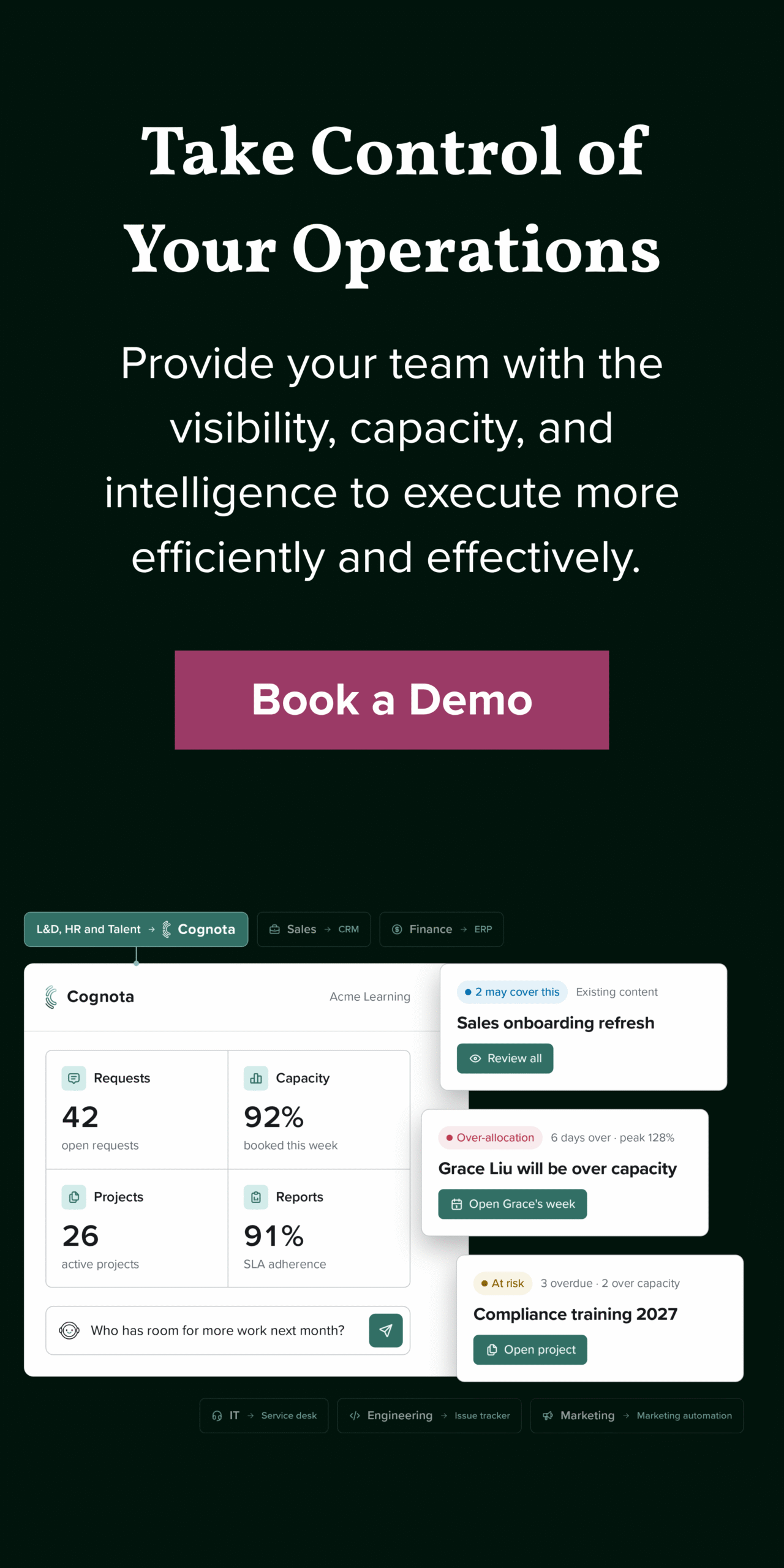
The best capacity decisions are made from a single view of work, resources, budgets, and priorities. Leaders should be able to see the full demand pipeline, current commitments, available skills, and delivery risks without assembling a manual report from multiple systems. That visibility supports better conversations with business partners because it replaces subjective claims of overload with a clear operational picture.
It also changes the relationship between L&D and external talent. Instead of searching for help only after deadlines are at risk, teams can build a reliable on-demand bench for defined capability needs. Cognota Assist™ Marketplace supports this model by connecting learning and talent teams with vetted specialists when additional execution capacity is needed, while the organization maintains governance over the work.
There is no universal formula for how much learning capacity to build or buy. The right balance depends on the volatility of demand, the strategic nature of the work, internal capability depth, and the cost of delay. But the decision becomes far more reliable when it is made through an operating model rather than a scramble.
The next time a major request arrives, resist the instinct to ask only who is available. Ask what business outcome is at stake, what capability is truly required, and what delivery model will leave the learning function stronger after the work is complete.