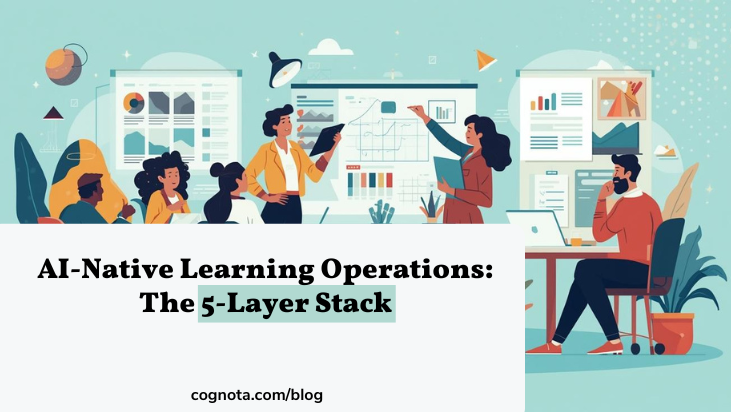
Understanding the 5-Layer AI Revolution
In recent discussions, NVIDIA CEO Jensen Huang introduced a framework that helps us see AI not just as a software update, but as a full-scale industrial shift. He calls it the “5-Layer Cake.”
If we only look at the top layer—the apps we interact with—we miss the massive infrastructure being built underneath. To drive actual performance and business outcomes, we need to understand how these layers connect.
The 5 Layers of the AI Cake
- Energy & Data: This is the foundation. AI is physical. Just as the hardware requires massive power to turn electricity into intelligence, a business requires clean, structured Data to fuel its AI. If your data is messy, your energy is wasted.
- Chips: These are the engines. They are specialized processors designed to handle many tasks at once, far beyond what traditional computers could do.
- Infrastructure: Jensen refers to these as “AI Factories.” This involves the networking and cooling systems that turn thousands of chips into one giant, unified computer.
- Models: This is the “brain” where reasoning happens. We are moving from a world of “retrieval” (looking up old info) to “inference” (reasoning in real-time).
- Applications: This is where the value reaches the user—from drug discovery to the tools you use for daily work.
The LearnOps Lens: Building the Connective Tissue
From a Learning Operations (LearnOps) perspective, as championed by Ryan Austin at Cognota, this “cake” represents a shift from being a “content factory” to being a strategic business function. The real challenge for L&D isn’t a lack of tools; it’s a lack of operational maturity.
When we apply this framework to the enterprise, the focus shifts from “order-taking” to building an integrated operating system:
- Process Before Automation: “You can’t automate chaos.” AI will only amplify what you already have. If your intake and planning are ad-hoc, AI will just make them chaotically fast. We must build repeatable, measurable processes at the lower layers before we can see real gains.
- Managing “Intelligence Uptime”: Instead of just fulfilling training requests, LearnOps uses data and AI to prioritize work based on business goals. This moves L&D from a reactive cost center to a proactive partner that ensures the company’s “intelligence” is always available and accurate.
- The “Operator” Stack: The future of LearnOps isn’t about disconnected bots; it’s about “AI Operators” that handle the manual parts of planning—like resource forecasting and ROI analysis—so humans can focus on steering the strategy.
Real-World Application: The Old Way vs. The AI-Native Way
To understand how to drill down deeper, look at how this changes a standard task like Technical Performance Support:
- The Old Way (Path of Least Resistance): You buy a new tool (Layer 5) and ask it to write a 10-question quiz based on a PDF manual. It’s fast, but it doesn’t move the needle on performance.
- The AI-Native Way (Intentional Scalability):
- Layer 1 (Data): You clean up your machine maintenance logs and safety records.
- Layer 4 (Model): You use a model that is grounded in your specific data to “reason” through problems.
- Layer 5 (Application): A technician in the field asks a question and receives a real-time, expert-filtered solution to a unique machine failure.
Scalability with Intention
Most organizations make the mistake of looking for a simple tool to fix their problems. They hand out licenses and hope for the best. True growth requires moving away from the path of least resistance and focusing on results.
Professional Integrity as a Filter As AI makes it easier to generate content, the role of the human expert becomes more important, not less. We must use our deep subject matter expertise as a filter. The goal isn’t just to produce more; it’s to use AI as an accelerator for quality. If we don’t apply our own standards to what the machines produce, we risk losing the trust and integrity that define our work.
The Shift from Tasks to Reasoning As the lower layers of the cake become more automated and efficient, the human role shifts. We are moving away from technical “how-to” tasks and toward high-level reasoning and complex decision-making.
Final Thought
AI is a massive infrastructure buildout. To stay relevant, we shouldn’t just look for the newest app. We should look at how we can use this entire “stack” to solve problems that were previously too expensive or too slow to tackle.
How is your team moving past the “tool” phase and into intentional, result-oriented AI use?