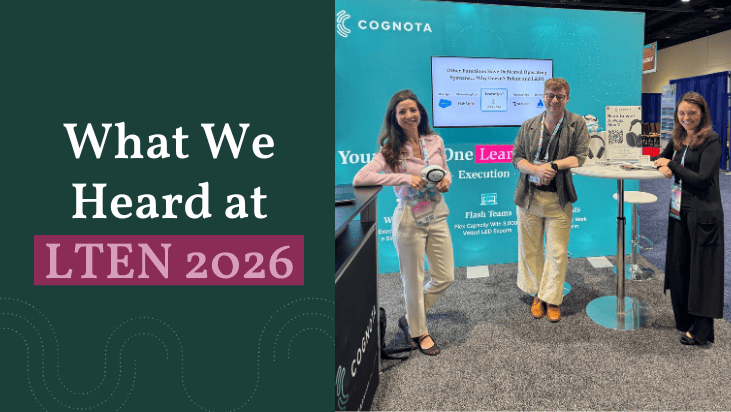
Every year, LTEN brings together some of the sharpest minds in life sciences learning and development — and this year’s conference in Kissimmee didn’t disappoint. Our team was on the ground all week, connecting with attendees, hosting a Learning Lab session, and listening carefully to what’s keeping L&D leaders up at night.
Here’s what stood out.
AI is the conversation — and no one has it figured out yet
Walk the floor, sit in a session, strike up a conversation — AI came up every single time. That’s not surprising. What was notable is how candid people were about where they actually stand: trying to figure it out. There’s no shortage of enthusiasm, but there’s real uncertainty about how to move forward in a way that makes sense for their teams.
That honesty is healthy. The organizations that will come out ahead aren’t the ones who rushed to deploy AI tools — they’re the ones who took the time to understand what problem they were actually solving.
Organizational change is the harder problem
Paired closely with AI in nearly every conversation was the topic of organizational change. Decisions are stalling. Not because people don’t see the value, but because the change management piece is genuinely hard — and it’s not being treated with the seriousness it deserves.
If your L&D team is sitting on a modernization initiative that keeps getting delayed, you’re in good company. The difference between teams that move and teams that stay stuck usually comes down to having a clear operational foundation before asking leadership to say yes.
Strategic takeaways landed better than tactical content
Attendees were noticeably energized by sessions that gave them something to think with — frameworks, perspectives, and strategic clarity — rather than step-by-step how-tos. That’s a signal worth paying attention to, especially as the field continues to evolve faster than any single playbook can keep up with.
The maturity model resonated
One thing that kept coming up in our booth conversations: the concept of a learning operations maturity model clicked for people. It gave them a way to locate themselves, understand where the gaps are, and have a more honest conversation internally about what “good” looks like — and what it actually takes to get there.
If you’re curious what that looks like in practice, request your free maturity assessment here.

A lot of people didn’t know LearnOps was a thing — and were glad to find out
This one was genuinely gratifying to hear. More than a few attendees stopped at our booth and said some version of: “I didn’t know a solution like this existed.” They knew they had an operational problem. They just didn’t know there was a category built around solving it.
If that sounds familiar — if you’ve been managing learning requests in spreadsheets, chasing project status in Slack, or struggling to show the business what your team actually produces — that’s exactly the problem LearnOps is built for.
A Little Fun to Close Out the Show
We also ran a giveaway this year — and the energy around it was a nice reminder that a little fun goes a long way on a conference floor. Congratulations to our winner, drawn on the final afternoon of the expo. If you stopped by our booth to enter, thank you — it was great meeting you.

What we’re taking back with us
LTEN 2026 confirmed something we already believed: L&D teams are under real pressure to operate more strategically, adopt AI thoughtfully, and demonstrate their value to the business. The appetite for a better way of working is there. The operational infrastructure to support it, in many organizations, still isn’t.
That’s the gap we exist to close.