If training requests arrive through email, priorities live in spreadsheets, and budget decisions happen in side conversations, governance is already breaking down. The best tools for training governance do not just help teams stay organized. They create the operating structure that lets enterprise L&D make sound decisions, manage risk, and connect learning work to business outcomes.
That matters more than ever for teams being asked to support transformation, compliance, leadership development, and workforce readiness with limited headcount. Governance is how learning functions move from reactive service delivery to disciplined operations. Without it, intake becomes inconsistent, resources get overcommitted, and measurement starts too late to be useful.
What training governance tools need to do
Training governance is not a single workflow or approval step. It is the system of decisions, controls, and visibility that keeps learning work aligned to business needs. In practice, that means tools should support five operational realities: intake, prioritization, planning, execution oversight, and measurement.
Most enterprise teams already have systems for content delivery and employee data. The gap is the layer that manages demand, workflow, ownership, and trade-offs across the learning portfolio. That is why governance tooling should be evaluated less like a content platform and more like operational infrastructure.
A useful way to assess maturity is through the LearnOps® lens: Align, Plan, Execute, Measure, Optimize. If a tool only helps with one phase, it may solve a local pain point without improving governance overall. Strong governance tools create continuity across the full lifecycle.
The best tools for training governance by function
There is no single stack that fits every enterprise. The right mix depends on your operating model, regulatory environment, and how centralized your learning team is. Still, most governance needs fall into a few clear categories.
1. Intake and demand management tools
Governance starts before a project is approved. If requests come in without business context, learner impact, urgency, or expected outcomes, the team is forced to make prioritization calls on incomplete information.
The best intake tools standardize how work enters the system. They capture the request source, target audience, business objective, dependencies, and required effort before the team commits resources. This creates a cleaner pipeline and reduces the common problem of high-visibility requests bypassing process.
For enterprise teams, this matters because demand is rarely the issue. Signal quality is. A good intake system improves capacity by filtering noise early and helps leadership make decisions based on comparable information.
2. Workflow and project governance platforms
Once work is approved, governance depends on execution discipline. Teams need visibility into stage gates, approvals, blockers, roles, and progress across multiple initiatives at once.
General project management tools can help at the task level, but training governance usually requires more structure. Learning work often involves SMEs, legal or compliance reviews, localization, vendor coordination, and launch dependencies that cut across functions. Governance platforms should make those workflows visible without forcing teams into manual status chasing.
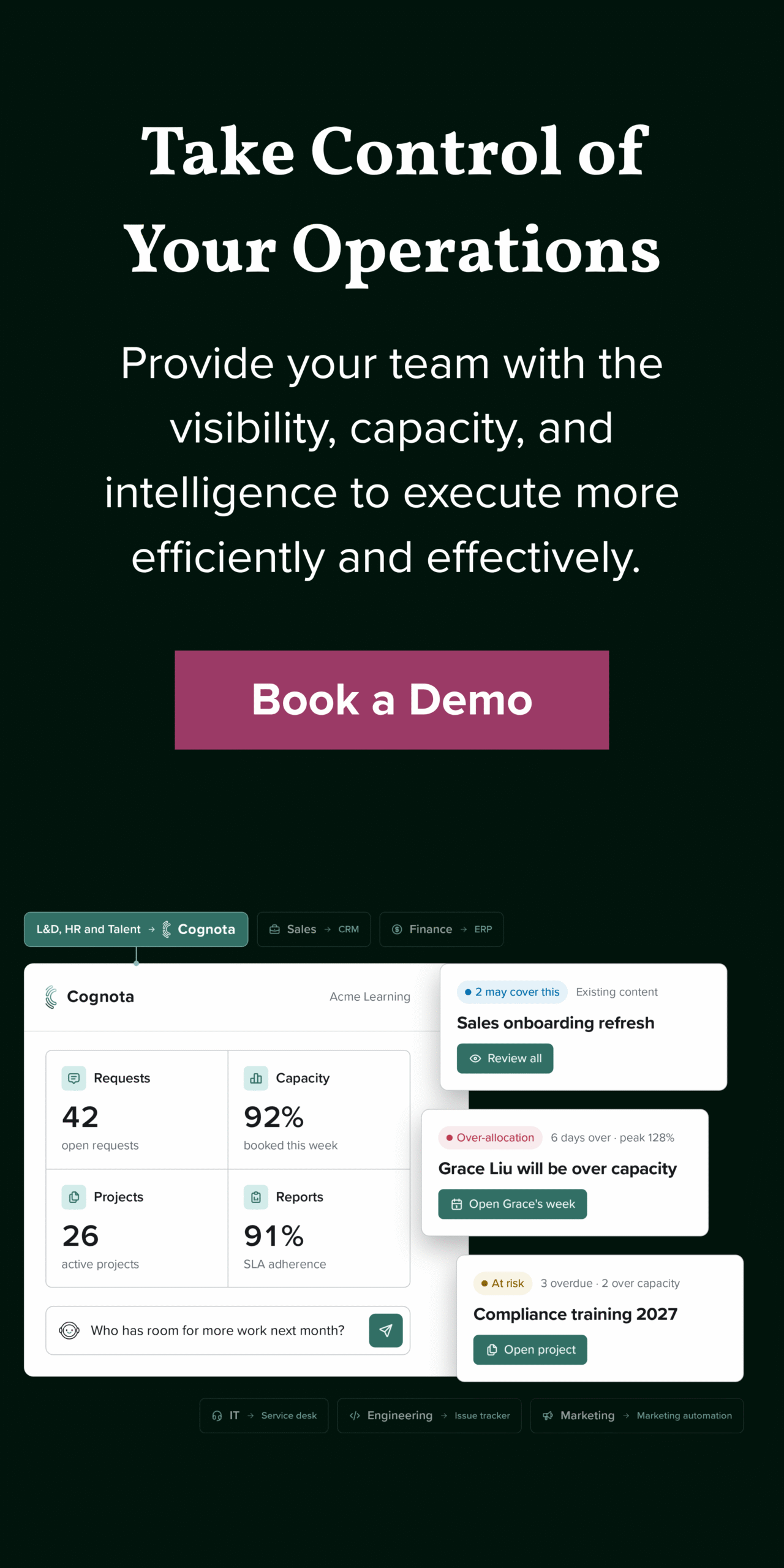
This is where a LearnOps® platform can play a distinct role. Cognota, for example, was built as the operational layer for enterprise learning teams, helping manage intake, workflows, planning, and measurement in one system. That matters when the goal is not just finishing projects, but governing the learning function as a business-critical operation.
3. Resource and capacity planning tools
Many governance issues look like prioritization problems when they are really capacity problems. Teams say yes to too much because they cannot see current workload, skill availability, or the downstream impact of one urgent request on ten existing commitments.
Resource planning tools give leaders a clearer view of team bandwidth across roles, projects, and time horizons. They help answer practical questions: Do we have enough design capacity next quarter? Which initiatives depend on the same specialist? What happens if compliance work spikes unexpectedly?
This is one of the biggest differences between managed and strategic learning operations. Reactive teams allocate work based on pressure. Mature teams allocate work based on evidence.
4. Budget and investment tracking tools
Governance is also financial. If learning leaders cannot track where money is committed, how spend maps to priorities, or which programs are drawing the most resources, strategic decision-making gets weaker fast.
Budget tracking tools should support more than expense visibility. They should connect investment decisions to initiatives, business units, and outcomes. In complex enterprises, that also means handling shared budgets, external partners, and changing forecasts without introducing a parallel finance process.
The trade-off here is flexibility versus control. Simple budgeting tools are easier for teams to adopt, but they may not provide the oversight executives need. More structured systems create discipline, though they require clearer ownership and governance rules.
5. Analytics and measurement tools
Measurement often gets treated as the last step in learning. From a governance standpoint, it should start much earlier. Leaders need visibility into demand trends, delivery performance, resource utilization, and program effectiveness if they want to improve decision quality over time.
The best measurement tools for governance help teams answer both operational and strategic questions. Operationally, are projects moving on time, and where are delays happening? Strategically, which learning investments support business priorities, and where is effort being absorbed without enough value?
This is where many teams feel the limits of fragmented systems. Data exists, but not in a form that supports management decisions. Governance improves when measurement is tied directly to planning and execution, not reviewed in isolation months later.
How to evaluate the best tools for training governance
Buying another point solution rarely fixes a governance problem on its own. Before selecting tools, it helps to diagnose where the operating model is breaking down.
If your team struggles with inconsistent requests, start with intake. If work is approved but stalls in reviews or handoffs, workflow visibility is the issue. If the team is constantly over capacity, planning matters more than adding more reporting. If leadership questions learning spend, then budget and measurement should move up the list.
It is also worth asking whether your current systems create disconnected versions of the truth. Many enterprise teams have one place for project updates, another for budget tracking, another for stakeholder requests, and another for outcomes. That fragmentation makes governance slower and weaker because no one sees the whole picture at once.
A practical benchmark is to assess your team against the LearnOps® Maturity Model. Teams at the Reactive or Managed stages often rely on heroic effort and informal coordination. Teams moving toward Strategic or Predictive maturity need tools that create standardization, visibility, and data-driven decision support. The right governance stack should help you move up that curve, not just make current chaos easier to tolerate.
What good governance tooling changes
When governance tools are working, the shift is noticeable. Intake becomes more disciplined. Prioritization conversations get easier because requests are easier to compare. Managers can see workload before committing to deadlines. Finance discussions become more grounded. Measurement becomes part of how the function operates, not an afterthought for year-end reviews.
Just as important, the learning team gains credibility. Stakeholders stop seeing L&D as a reactive service desk and start seeing it as an operationally mature partner that can align work to business needs, manage risk, and scale with control.
That does not mean every process should become rigid. Some organizations need tighter controls because of regulation or business complexity. Others need lighter governance so teams can move quickly. The point is not bureaucracy. The point is creating enough structure to make good decisions consistently.
The best tools for training governance support that balance. They give enterprise learning leaders the capacity to manage demand, the execution discipline to deliver reliably, and the intelligence to improve over time. If your team is still stitching governance together through meetings, spreadsheets, and manual follow-up, the problem is not effort. It is infrastructure. And once that becomes clear, better decisions tend to follow.