For decades, learning and development (L&D) teams relied on relatively predictable benchmarks to estimate course development. We all knew the classic formulas: standard e-learning might take 40 to 180 hours of development for every finished hour of instruction. We built our capacity plans, assigned our instructional designers, and marched to the beat of traditional project management drums.
Then, generative AI entered the room.
Suddenly, a draft for a module that once took three days to write can be generated in three minutes. An outline can be brainstormed in seconds. Visual assets can be conjured out of text prompts.
But here is the paradox: If AI makes everything faster, why does capacity planning feel harder than ever? How do we adjust our estimates when the tools are moving at warp speed, but human oversight, quality assurance, and deployment still operate on human time?
To solve this, we must shift our focus from rigid tracking to smart, systemic optimization, and reevaluate how we manage our entire operational pipeline from intake to outcome.
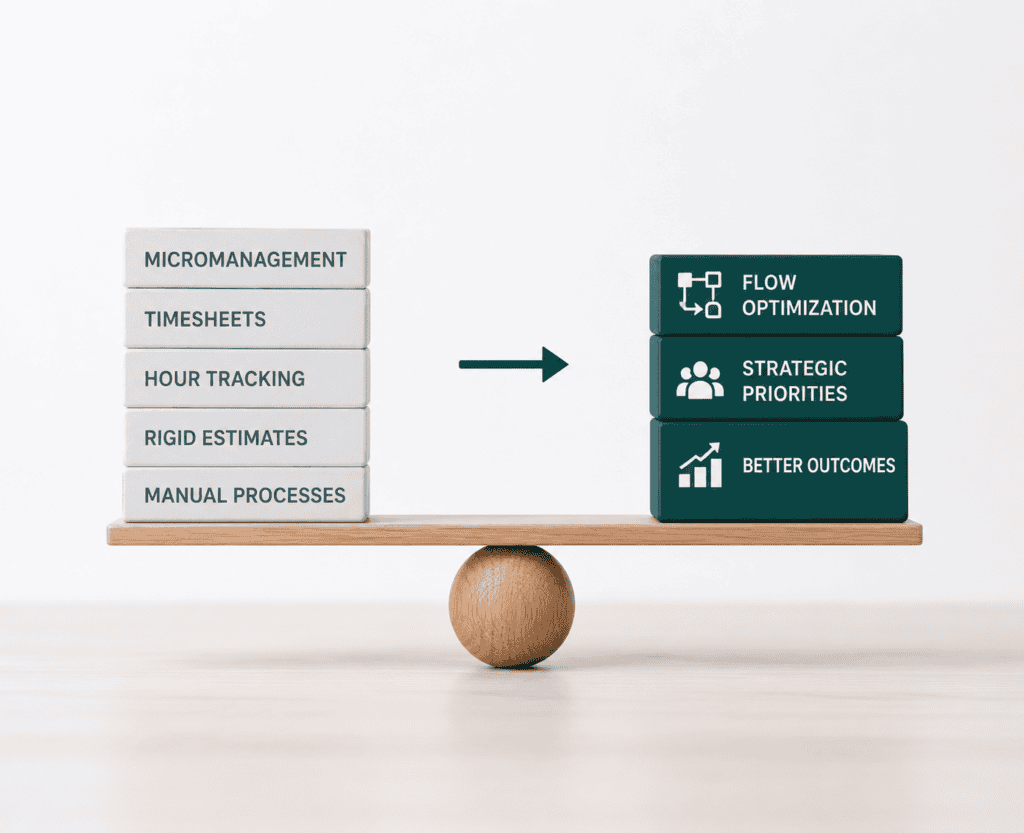
Shifting the Focus: From Micromanagement to Flow Optimization
In the past, capacity planning often drifted into the territory of micromanagement. Managers tracked hours spent per slide, scrutinized timesheets, and tried to force creative, intellectual work into rigid assembly-line metrics.
In the world of AI-augmented course development, micromanagement is not only counterproductive; it is impossible. AI does not just speed up tasks; it changes the nature of the tasks themselves. An instructional designer is no longer just a writer or a developer; they are an editor, a prompt engineer, a curator, and a systems thinker. If you try to micromanage their time based on old, pre-AI tasks, you will bottleneck their creativity and completely miss out on the true efficiencies of modern technology.
Instead, our focus must shift to Systemic Flow Optimization.
Optimization is not about squeezing every drop of effort out of an employee’s eight-hour day. It is about treating L&D as an integrated operational system rather than a transactional service queue. This means removing friction, managing the flow of work, and ensuring that our human talent is focused on high-value, high-impact activities (such as emotional design, strategic alignment, and complex problem-solving) while AI handles the heavy lifting of administrative drafting and formatting.
The Silent Capacity Killer: Intake and Demand Management
Before we can accurately estimate how long a project will take, we must look at how that project entered our pipeline in the first place. A common pitfall for L&D leaders is trying to optimize development times while ignoring a chaotic intake process.
If your team accepts every informal learning request via Teams, email, or a hallway conversation without strategic context, your capacity plan is doomed from the start.
To build a truly optimized capacity plan:
- Establish Intake Guardrails: Implement clear, structured intake processes that automatically qualify, categorize, and prioritize requests against business goals before they are assigned.
- Filter Out Low-Value Requests: Stop treating L&D as an order-taking department. Use data-driven intake criteria to push back on requests that do not drive performance, saving your team’s capacity for high-impact initiatives.
The Core Planning Questions for the AI Era
To build a reliable capacity plan that accounts for AI integration, we must answer two fundamental questions:
- How long does a task take?
- What needs to be planned and processed across our People, Tasks, and Time?
People: Orchestrating “Flash Teams” and Skills
In an AI-driven environment, we must evaluate our people not just by their job titles, but by their tech literacy, agility, and comfort with AI tools.
- Augmented Execution: Group your team by capability and provide ongoing upskilling. Encourage power users to share prompt libraries and templates to standardize human execution speeds.
- Dynamic Sourcing (Flash Teams): Do not limit your capacity planning to your fixed internal headcount. As demand fluctuates, design your operations to orchestrate flash teams: nimble structures that blend your core internal staff with AI agents and on-demand external talent to scale development up or down seamlessly.
Tasks: Modularizing the Workflow
We can no longer view course development as one monolithic block of work. We must break it down into modular, micro-tasks where AI has different levels of utility:
- Ideation & Outlining (High AI assistance)
- Drafting & Scripting (Medium-High AI assistance)
- Media Creation & Voiceover (Medium AI assistance)
- Subject Matter Expert (SME) Review & Alignment (Zero AI assistance: pure human effort)
- QA & Integration (Low AI assistance)
By estimating at the micro-task level, you can apply realistic AI speed multipliers to different phases of the project, leading to a much more accurate overall estimate.
Time: Transitioning from Task-Hours to Cycle Time
Because AI-assisted development is highly iterative, scheduling must be dynamic rather than static. Most importantly, we must shift our primary time metric.
- Measure Cycle Time, Not Just Project Hours: Cycle time is the total time it takes for a learning project to go from the initial intake request to active deployment and business impact. If AI helps an instructional designer write a script three days faster, but the subsequent SME review or stakeholder approval bottleneck takes three weeks, your overall capacity has not improved.
- Design Agile Sprints: Adopt an agile, sprint-based schedule with dedicated buffers for the integration hurdles, hallucinations, or technical troubleshooting that naturally come with an evolving AI tech stack.
In Part 2 of this series, we will transition from strategic philosophy to practical application. We will introduce a concrete mathematical formula for estimating AI-assisted course development, map out a “Review Complexity Matrix,” and look at a real-world before-and-after estimation scenario.