Throughout my career advising organizations on learning technology and interactive media, I have noticed a recurring pattern: L&D teams are incredibly passionate about designing great experiences, but they struggle to scale their operations and prove their business worth.
We live in a world where senior executives expect learning teams to drive digital transformation, build future-ready capabilities, and accelerate organizational growth. Yet, a massive execution gap persists. Too many L&D teams operate as reactive “order takers” rather than strategic business partners. They manage chaotic intakes, juggle disconnected tech stacks, and rely on “vanity metrics” like completion rates and smile sheets that simply don’t translate to the C-suite.
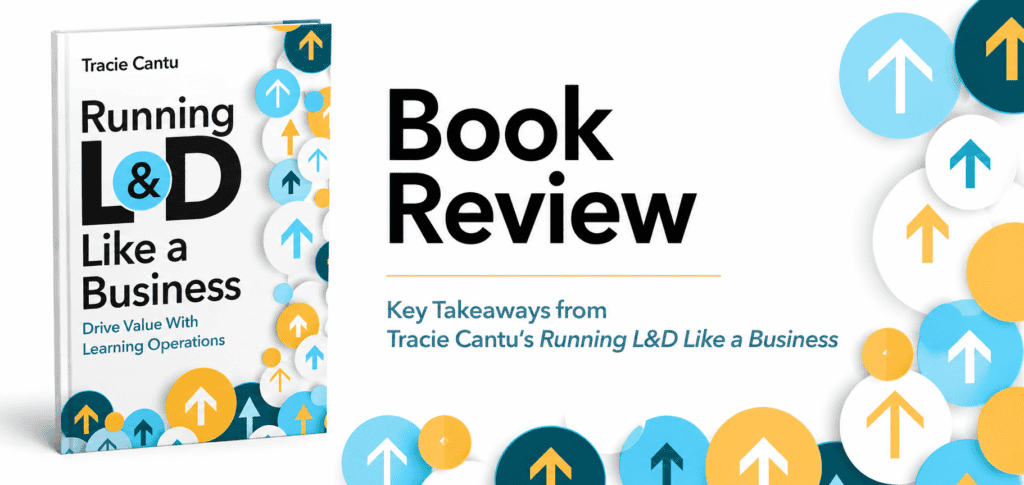
When my dear friend and colleague Tracie Cantu, CPTD, SHRM-SCP, sent me her new book, Running L&D Like a Business: Drive Value With Learning Operations (published by ATD Press), I knew the corporate learning space had finally received the blueprint it desperately needed.
Drawing from her experience leading learning operations at global powerhouses like Meta, Atlassian, and Whole Foods Market, Tracie has written the definitive operational manual for our industry. For the LearnOps community, this book is a tactical guide to scaling our workflows, professionalizing our systems, and cementing L&D’s seat at the executive table.
What is “Running L&D Like a Business” About?
Tracie’s core thesis is simple: If L&D wants to be treated like a business unit, it must run like one. Finance has budgets, Marketing has GTM tracks, and Operations has clear process maps. L&D needs its own blueprints. Tracie introduces the Learning Operations Business Model™, structured around four essential components:
- Business Alignment: Building what the business needs to achieve its strategic goals.
- Operational Efficiency: Delivering learning solutions faster, with less friction, and without sacrificing quality.
- High Customer Value: Proving how learning improves tangible business and talent outcomes (productivity, revenue, retention).
- Positive Consumer Experience: Designing learning experiences that naturally fit into the flow of daily work for employees.
Throughout the book, Tracie deconstructs how to shift from a reactive training provider to a proactive performance enabler through structured processes, smart governance, and data-informed prioritization.
Why This Book Matters for the LearnOps Community
As someone who advocates daily for bringing operational discipline and modern technology to corporate learning, I believe this book is a landmark text for the LearnOps movement. Here is why it belongs on your desk:
- It separates Customers from Consumers: Tracie brilliantly explains that the Business is the Customer (funding the work and expecting a return) and the Employee is the Consumer (engaging with the content). To earn the trust and budget to design exceptional experiences for employees, we must prioritize sequenced attention—meeting the strategic needs of the business first.
- It provides Turnkey operational tools: The book is a treasure trove of practical tools, including a Sample Service Level Agreement (SLA) Template, a Learning Portfolio Risk Rubric, a Learning Impact Maturity Model, and a Go-To-Market (GTM) Playbook for learning adoption.
- It defeats “Shiny Object Syndrome”: I constantly see teams rush to buy AI, VR, or new LXPs without a clear operational strategy. Tracie outlines a business-first evaluation framework to ensure emerging technologies are piloted, measured, and scaled only when they solve a validated business problem.
Industry Perspective: A Note from LearnOps Pioneer Ryan Austin
“This book meets busy L&D teams where they are and shows you exactly how to align with the business, ship great work faster, and tell a results story that leaders will believe.”
— Ryan Austin, CEO of Cognota & LearnOps Pioneer
My Tactical Takeaways: Operational and Tech Agility
As a technology strategist, I was particularly drawn to Tracie’s focus on scalability and rapid deployment.
In Chapter 3, she shares how she helped a multinational grocer centralize its LMS operations, consolidating 30 regional administrators into a single, high-performing team of three learning technologists—saving $2.3 million in labor costs in the first year alone. This is the power of standardizing core workflows.
She also highlights how to keep your learning portfolio agile through:
- The Tiered Learning Response Model: A 4-tier execution guide to help teams deliver at the right speed. Instead of defaulting to slow, expensive courses (Tier 4), we can leverage Tier 1 (instant self-service job aids or AI knowledge hubs) or Tier 2 (SME-led virtual Q&A sessions) to resolve immediate performance roadblocks.
- Agile Portfolio Management: Categorizing learning methodologies like financial investments. By balancing “Stable Investments” (like adaptive learning paths) with “Growth Investments” (like peer-led coaching) and “High-Return Investments” (like immersive VR safety simulations), we can maximize our operational impact.
Finally, her Learning Impact Maturity Model™ provides a clear, 5-level path to guide teams away from basic activity metrics and toward predictive, business-integrated insights. By integrating our learning data with sales, compliance, and HRIS databases, we finally get to speak to our C-suite in the financial terms they respect.
About the Author: Tracie Cantu, CPTD, SHRM-SCP
Tracie Cantu is a dynamic learning operation and learning technology leader with over 15 years of experience leading innovative Learning and Talent solutions. Her proven expertise in managing cross-functional teams and leading global enterprise-level projects at companies such as Atlassian, Meta, and Whole Foods Market shines through on every page of this book.
Currently, as the Chief Learning Strategist at Your CLO, Tracie partners with midsize and enterprise organizations to modernize their learning operations, optimize technology ecosystems, and implement scalable processes that drive measurable business impact.
- Website: Your CLO
- Book Landing Page: Running L&D Like a Business
The Verdict
Running L&D like a business is not a one-time project; it is an ongoing operational commitment. This book gives us the language, the framework, and the tools to make that commitment a reality.
If you’re ready to stop training reactively and start delivering real business value, this book is your strategic road map.
Get your copy and download the exclusive tools today at: yourclo.net/running-l-d-like-a-business