
An enterprise LearnOps platform review should not begin with a feature inventory. It should begin with the operating pressure your team is carrying: more requests, more stakeholders, tighter budgets, limited capacity, and rising expectations to show business impact. The question is not whether a platform can organize tasks. It is whether it helps learning and talent teams run as a disciplined business function.
For enterprise teams, that distinction matters. A collection of disconnected systems may support individual activities, but it rarely gives leaders a clear view of demand, priorities, resource commitments, costs, outcomes, and operational risk. The result is a learning function that works hard while remaining reactive.
A strong LearnOps® platform creates the operational layer that connects strategy to execution. It gives leaders the visibility and control to make better decisions before capacity is consumed, budgets are committed, or priorities drift.
What an Enterprise LearnOps Platform Review Should Assess
The most useful review criteria follow the work your team must perform, not a vendor’s navigation menu. Cognota’s LearnOps® Framework offers a practical lens: Align, Plan, Execute, Measure, and Optimize. Together, these disciplines reveal whether a platform supports operational maturity or simply adds another place for work to live.
Alignment: Can the team prioritize the right work?
Learning teams often receive requests through email, meetings, spreadsheets, and informal conversations. That makes demand difficult to compare and even harder to govern. A platform should bring intake into a consistent process, capturing the business need, intended audience, strategic priority, expected outcome, timing, and required effort.
The real test is whether leaders can use that information to make trade-offs. Can they distinguish urgent requests from important ones? Can they see which initiatives support enterprise priorities and which may need to wait? Can stakeholders understand why a request was approved, deferred, or redirected?
This is where operational discipline begins. Without structured alignment, even capable teams spend too much time negotiating priorities after work has already started.
Planning: Does it make capacity and cost visible?
Capacity is one of the most consequential variables in enterprise learning operations, yet it is often managed by intuition. Leaders may know their teams are busy, but not which roles are overloaded, what work is delayed, or what new demand would displace.
A serious platform should support resource planning across people, skills, time, and budget. It should help leaders model the impact of competing priorities before committing to delivery. That means looking beyond project dates to understand available capacity, planned utilization, external spend, and the consequences of shifting scope.
This is particularly valuable for teams supporting multiple business units or managing a portfolio of high-visibility initiatives. The ability to say, “We can take this on, but here is what it changes,” turns L&D from an order-taking function into a strategic partner.
Execution: Can work move with accountability?
Project work does not fail only because teams lack effort. It fails when ownership is unclear, approvals stall, dependencies remain hidden, and stakeholders cannot see progress until there is a problem.
Evaluate how the platform supports the actual flow of work. It should provide governance without forcing teams into unnecessary process. Leaders need visibility into initiative status, milestones, approvals, risks, and handoffs. Contributors need clarity on what they own and what is required next.
The trade-off is important. Highly prescriptive workflows can create friction for teams with varied work types. Too little structure, however, leaves every project manager to invent their own process. Look for configurable operational standards that create consistency while allowing the right level of flexibility.
Measurement: Does it connect activity to business value?
Completion counts and satisfaction scores can be useful signals, but they do not answer the executive question: What did this investment enable?
An enterprise LearnOps platform should help teams define intended outcomes early, then connect initiative-level data to the measures that matter for the business. Depending on the work, that could include performance improvement, speed to proficiency, risk reduction, quality, retention, revenue enablement, or adoption of a business change.
The key is not claiming that every initiative can be measured with perfect precision. Complex organizations rarely work that way. The objective is to establish a credible, consistent measurement practice that improves decision-making over time. Leaders should be able to see where investment is producing evidence of value, where assumptions need to be tested, and where resources should be redirected.
Optimization: Does it help the operation improve over time?
Operational excellence is not a one-time redesign. Demand changes, business priorities move, and teams learn which processes create value versus overhead. A platform should make those patterns visible.
Look for the ability to identify bottlenecks, recurring delays, demand trends, capacity gaps, budget variance, and portfolio-level performance. These insights allow leaders to improve the operating model, not just manage the current queue of work.
Optimization is also where intelligence becomes meaningful. AI-powered support can reduce administrative effort and surface relevant operational insights, but only if it works from structured, trusted information. AI without sound processes can accelerate confusion. AI connected to disciplined intake, planning, execution, and measurement can help teams spend more time on judgment and stakeholder partnership.
Evaluate Fit Through Operational Maturity
Not every organization needs the same level of process. A team operating in a Reactive maturity stage may first need a reliable way to capture demand and gain visibility into active work. A Managed team may need greater consistency in planning and governance. Strategic, Predictive, and Adaptive teams are more likely to prioritize portfolio intelligence, scenario planning, and continuous optimization.
The LearnOps® Maturity Model is useful because it avoids a false choice between “doing nothing” and pursuing an idealized future state. It assesses progress across Strategy and Impact as well as Efficiency and Effectiveness. A platform should meet your team where it is while giving it a credible path forward.
During evaluation, ask leaders and practitioners the same questions: Where does work become invisible? Which decisions are made without reliable data? What creates the most rework? Where do we lose time waiting for answers, approvals, or capacity? The quality of those answers will tell you more than a generic requirements list.
Questions to Bring Into the Review Process
A productive evaluation should test real operating scenarios. Ask how the platform would handle a high-priority request that arrives mid-quarter, when the team is already committed. Ask how a leader would see the full portfolio, identify constrained roles, and understand the budget implications of approving new work.
Also ask what happens after delivery. Can the team document intended outcomes, gather relevant evidence, and use what it learns to shape future prioritization? Can stakeholders see progress without creating separate status reports? Can the operating model remain consistent as teams, regions, and business needs expand?
These questions move the conversation away from isolated capabilities and toward the business case for better operations.
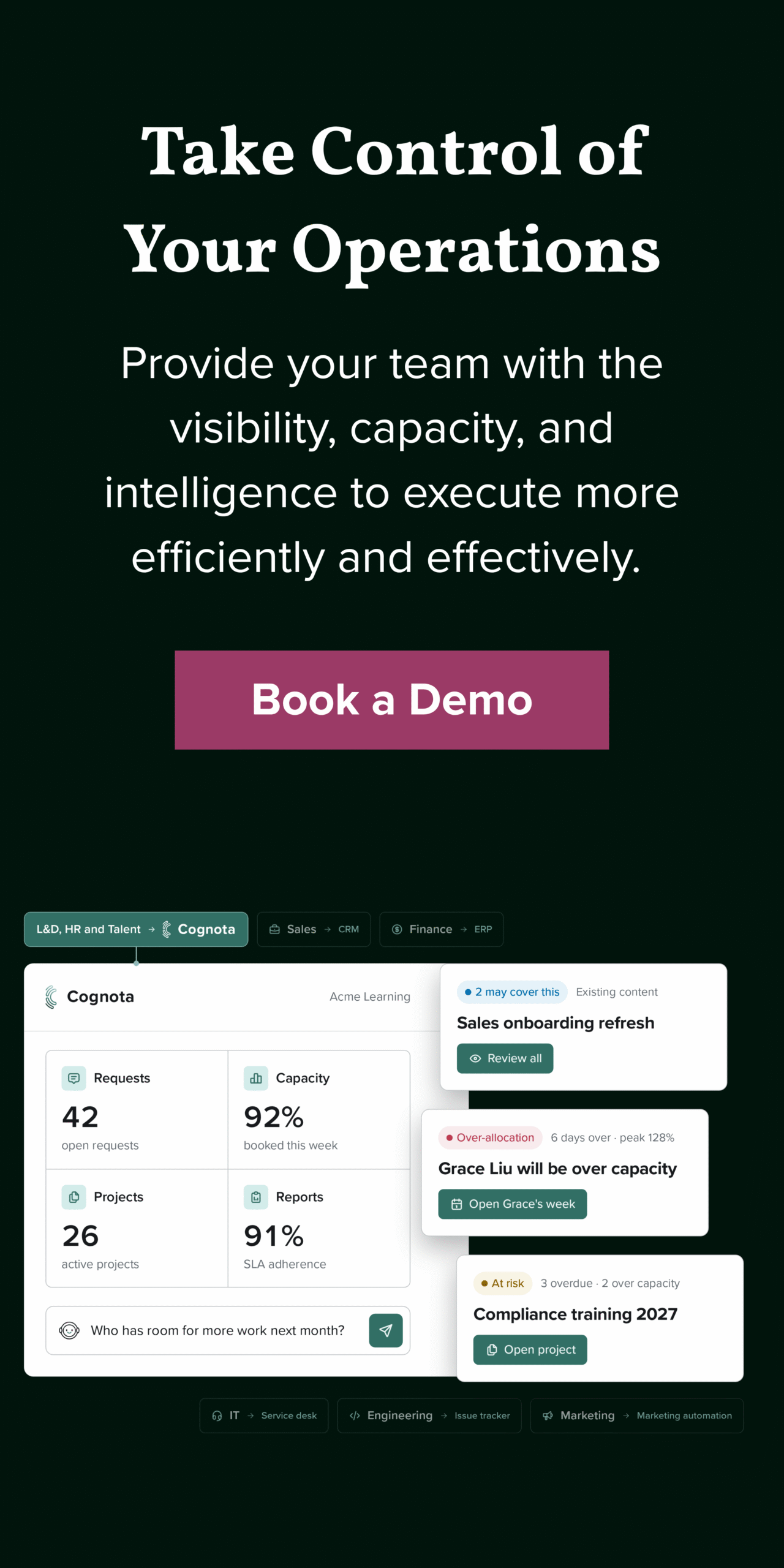
Cognota was built around this need: helping enterprise learning and talent teams align work to strategy, plan with confidence, execute with governance, measure what matters, and continuously improve. The value is not merely having one more system. It is creating the infrastructure for Capacity, Execution, and Intelligence to work together.
The best platform decision is the one that gives your team a clearer operating rhythm. When priorities are visible, capacity is understood, work is governed, and outcomes inform the next decision, learning can operate with the credibility and control the business expects.