
It’s late on a Thursday afternoon, and an email—or a frantic Teams message—lands in your inbox from a business unit leader. “We need a 30-minute e-learning module on our updated compliance process. And we need it launched by next Friday.”
Your team is already redlined. Your instructional designers are working late, your media developers are juggling three different product launches, and your project backlog is a mile long. But because L&D has historically been positioned as a support service, you smile, say “we’ll make it work,” and pull up your budget spreadsheet.
You calculate the obvious things: external contractor hours, maybe a couple of stock asset licenses, and a rough estimate of internal design time. You hand over the number, get a quick sign-off, and tell your team to stretch a little thinner.
But after 30 years in the enterprise learning space, I’ve had to learn a painful lesson the hard way: That number we put on the spreadsheet isn’t the true cost of training. It’s barely even the tip of the iceberg.
When I talk to Cognota’s CEO, Ryan Austin, we often discuss this disconnect between L&D teams and the C-suite. From the boardroom perspective, executives aren’t just looking at what a project costs in cash. They are looking at resource allocation, overall operational efficiency, and opportunity cost.
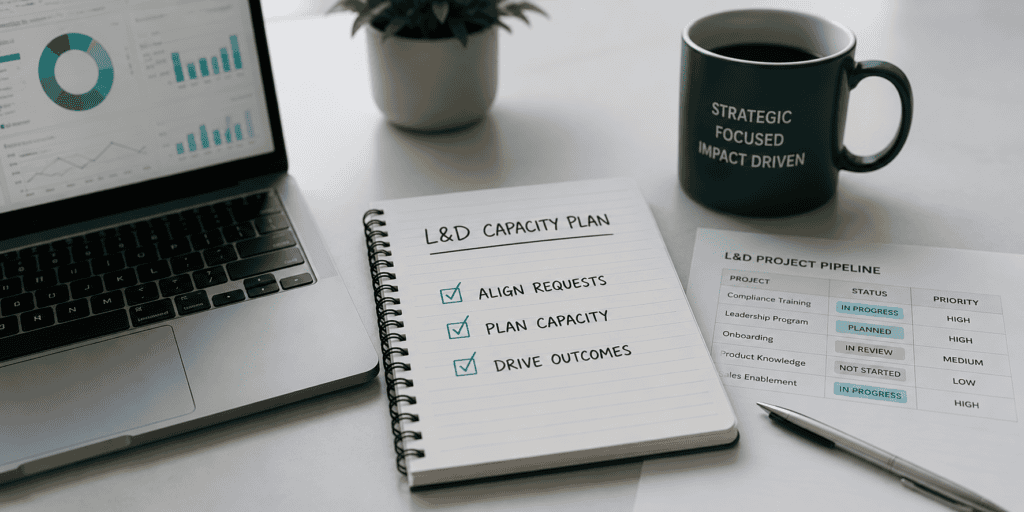
The true cost of training is a direct reflection of your L&D capacity—and more importantly, where that capacity is being drained. When we fail to map our team’s actual bandwidth to strategic business outcomes, we pay a massive, invisible tax in the form of team burnout, missed deadlines, wasted effort on low-value projects, and constant operational firefighting.
To move L&D from a reactive cost center to a strategic business partner, we must stop treating our team’s capacity as an infinite resource and start treating it as a finite strategic currency.
The Danger of the “Service Queue” (Or: Why We Can’t Just Say Yes)
For decades, L&D has operated like a drive-thru lane. A stakeholder drives up, places an order, and we scramble to package it and hand it out the window.
This order-taker model is a silent margin killer. Because most enterprise learning teams don’t have a single, unified system to track active workloads, incoming requests, and true resource availability, we manage by “vibes.” We feel busy, everyone is stressed, but we don’t have the hard data to prove why we can’t take on another project.
When you run your department out of a black box, three costly things happen:
- The squeakiest wheel wins: A minor, low-impact training request from an influential executive gets the same red-carpet treatment and design resources as a massive, high-priority sales enablement program that directly impacts quarterly revenue.
- The “SME Chase” drains your clock: Your designers waste weeks waiting for Subject Matter Experts to review storyboards or rebuilding assets from scratch because the initial requirements changed mid-stream. To a CFO, this kind of undocumented rework is pure capital waste.
- Your best people quit: Your top-performing designers get saddled with 120% of the workload because they are the ones who “get things done,” while other team members sit under-utilized because no one has a bird’s-eye view of who is doing what.
The true cost of this operational chaos isn’t just a delayed course launch. It’s the opportunity cost of the high-impact projects your team could have delivered if their capacity hadn’t been eaten up by manual admin work, chasing feedback, and building slide decks that only ten people will ever open.
Redefining “True Cost” Through LearnOps
At Cognota, we talk a lot about LearnOps® (Learning Operations). When Ryan founded this category, the goal wasn’t to add more corporate jargon to the mix. It was to give L&D leaders the same operational framework and respect that DevOps gave to software engineers or RevOps gave to sales teams.
Under a LearnOps model, capacity planning is how you calculate the real cost of doing business. When you map capacity directly to business outcomes, “true cost” breaks down into three distinct areas:
- The Opportunity Cost of Misalignment: If your highly compensated instructional designers are spending 15 hours a week chasing down project approvals or formatting PowerPoint slides, the true cost of that administrative work is the missed business performance your team could have driven if they were focused on reducing employee ramp time or accelerating customer onboarding.
- The Operational Friction Cost: Every hour spent digging through old emails, hunting for assets in shared drives, or manually updating status reports is an hour stolen from actual development.
- The Resource Constraint Cost: When a business-critical request comes in, you need to know today if you have the internal bandwidth to handle it, or if you need to scale up with external contractors. Making that call late—or guessing wrong—means paying premium, last-minute vendor rates or missing the business window entirely.
How to Stop Playing Catch-Up: A 5-Step Reality Check
Transitioning from a reactive “order-taker” to a strategic partner requires shifting how you manage your pipeline. Here is how we break down that transition in the real world:
- Align: Protect the Front Door
Stop letting anyone with a budget code submit a training request without a business case. If a stakeholder can’t tell you the exact business metric they want to move (e.g., reducing support tickets, improving compliance pass rates, boosting sales win-rates), the project shouldn’t get past the intake phase.
- Plan: Stop Planning in Best-Case Scenarios
Excel spreadsheets are where realistic project timelines go to die. You need dynamic visibility into your team’s actual, real-world hours. If your instructional designers are already booked at 90% for the next month, you need the data to show stakeholders: “We can build this for you, but to meet your target date, we either need to push back the onboarding project, or secure $12,000 to bring in external help.”
- Execute: Kill the Administrative Overhead
If your designers are spending more time managing their projects than designing learning experiences, your workflows are broken. Standardize your review templates, set firm limits on feedback rounds (no more “one last quick change” from a stakeholder three weeks past the deadline), and automate your project tracking.
- Measure: Speak the Boardroom’s Language
CFOs don’t care about learner completion rates or smile sheets. To get their respect—and their budget—you must present operational metrics:
- What is our team’s average capacity utilization?
- How much of our capacity is spent on high-value strategic work vs. routine maintenance?
- What is our average project cycle time, and where do projects get stuck?
- Optimize: Learn to Flex
Once you have operational data, you aren’t guessing anymore. When the business pivots or a new product launch gets fast-tracked, you can confidently reallocate resources, deprioritize low-value work, or instantly scale your capacity using flexible talent networks (like Cognota’s Flash Teams) without blowing up your internal team.
Changing the Dynamic
When you master your team’s capacity, the way you interact with the executive suite changes completely.
The next time a business leader drops a last-minute request on your desk and asks, “How much is this going to cost?” you won’t have to give a vague estimate or promise to “make it work” by burning out your team.
Instead, you can look them in the eye and say:
“To get this done by your deadline, it’ll take 150 hours of design and development time. Right now, our team is fully allocated to the sales enablement rollout. We can prioritize your project, but it means we’ll have to delay that rollout by two weeks, or we can bring in external contractor support for $10,000 to run both simultaneously. Which route makes the most sense for our quarterly goals?”
That isn’t just managing training. That is running a highly mature, data-driven operational function. By mastering capacity, you don’t just protect your people—you prove to your CEO, your CFO, and your board exactly how L&D capacity drives business outcomes.
Are you tired of managing your learning team via spreadsheets and Teams? Join the conversation in the LearnOps Community, where thousands of L&D leaders are sharing templates, workflow strategies, and real-world advice on how to professionalize the business of learning.