If you lead a corporate learning team, you know the feeling of pilot paralysis.
Over the last few years, almost every L&D department has tested AI tools. We have prompted chatbots to write learning objectives, generated course outlines, and tested video avatars. Yet, if you look at how learning teams run behind the scenes, nothing has really changed. Backlogs are still overflowing, training requests arrive randomly across Slack and email, and business leaders still ask: “What is L&D actually delivering for the business?”
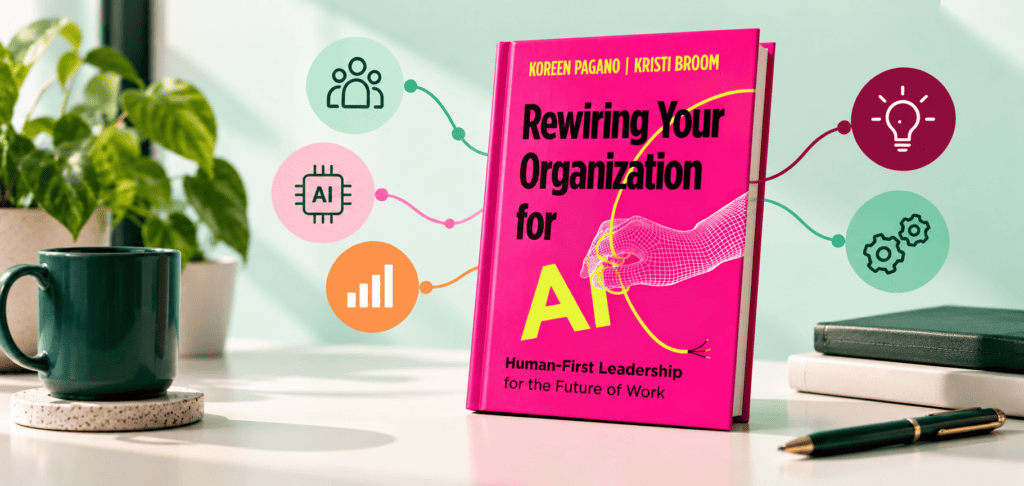
That disconnect is why Koreen Pagano and Kristi Broom’s new book, Rewiring Your Organization for AI: Human-First Leadership for the Future of Work (ATD Press), hits the mark.
Instead of treating AI like another software subscription, Pagano, and Broom focus on the real issue: AI is an operational transformation, not a tech experiment.
Koreen Pagano brings deep experience in learning systems and skills strategy from her leadership roles at Lynda.com, LinkedIn, and Degreed. Kristi Broom brings practical ground-level wisdom as an executive coach who guides leaders through change and burnout. Together, they outline how to lead an organization where people, tools, and AI agents collaborate smoothly.
Here are the four key takeaways every learning leader should take from their book.
1. Eliminate the “Coordination Tax”
In Chapter 1, the authors examine how 20th-century management models shaped our workplaces. For over a century, organizations added management layers to coordinate specialized work, route information, monitor performance, develop people, and protect culture.
When managers spend most of their week chasing status updates, forwarding emails, and aligning calendars, your organization is paying what the authors call a coordination tax.
AI changes the math entirely. Routine information routing, first-pass data synthesis, and task tracking can now happen automatically. The goal is not cutting staff. The goal is stripping away administrative busywork so leaders can focus on what only humans can do: coaching, relational intelligence, ethical judgment, and strategic consulting.
The LearnOps® Takeaway: Most L&D teams lose weeks every quarter to manual coordination. When you manage your team through a unified Learning Operations platform, project intake, status tracking, and resource allocation happen in one transparent system. You stop asking managers to act as human traffic cops.

2. Plan for the “Supervision Tax” in Hybrid Teams
As Pagano and Broom point out, today’s workforce is made up of three distinct parts: people, AI tools, and AI agents.
When teams begin using AI agents to produce training outlines, slide decks, or code, production speeds up. However, the work does not simply disappear. It moves from production to validation.
If you do not plan for the time it takes an experienced designer to check, verify, and govern AI-generated assets, human review becomes a massive, unaddressed bottleneck. Oversight does not scale at the speed of algorithms.
The LearnOps® Takeaway: You cannot scale AI without clear guardrails. A mature LearnOps® process establishes formal task allocation:
- AI tasks: First-draft generation, transcription, data sorting, and formatting.
- Human tasks: Contextual analysis, stakeholder relationships, empathy, and final validation.
- Capacity planning: Building human review hours directly into project timelines so staff are not blindsided by review backlogs.
3. Flatter Organizations Require Centralized Intake
In Chapter 7 (“Leading When Your VPs Disappear”), the authors look at how corporate org charts are flattening. As middle management layers thin out, business leaders frequently bypass normal channels to demand urgent, unvetted training directly from frontline instructional designers.
Pagano and Broom offer a critical warning: When an organization flattens, informal ways of working collapse.
If your team relies on ad-hoc requests and hallway conversations, you will quickly become overwhelmed order-takers.
The LearnOps® Takeaway: A flatter enterprise requires a structured front door. With centralized intake and demand planning, learning teams can:
- Capture all business requests in a single queue.
- Require stakeholders to identify business goals and measurable outcomes before work begins.
- Check actual team capacity across internal staff, contractors, and tools before committing resources.
- Fight Change Fatigue and Protect Well-Being
Most technology books ignore the human toll of rapid innovation. Pagano and Broom devote Chapter 11 to the reality of change fatigue and burnout.
L&D teams have operated at maximum speed for years. Throwing dozens of disconnected AI tools into messy, undefined processes only spikes anxiety. Trust is an operational requirement. If your team feels like AI is being used to monitor them or stretch them beyond reasonable workloads, adoption stalls.
The LearnOps® Takeaway:
LearnOps® is about creating predictable, sustainable operations. When leaders have full visibility into team capacity, they can protect their people from scope creep, balance workloads, and create the psychological safety needed to experiment with AI responsibly.

The Bottom Line
Pagano and Broom make a simple point: You cannot run a modern AI strategy on spreadsheets and good intentions.
AI will not fix broken processes on its own. If you want your team to stop chasing small pilots and start delivering measurable business value, you need an operational foundation designed for the future of work.
Join Us Live: LearnOps® Community Coffee Chat
Want to dive deeper into these ideas directly with the authors?
Join us for our upcoming LearnOps® Community Coffee Chat: Human-First AI in Enterprise L&D: A Fireside Chat with Koreen Pagano and Kristi Broom.
- Date: Thursday, November 12
- Time: 2:30pm – 3:30pm CST
- Register here: Reserve your spot on the LearnOps® Event Page
Grab a coffee, bring your questions about AI workflows and team capacity, and join the conversation.