A learning budget can look disciplined on a spreadsheet and still produce scattered work. A leadership program gets approved outside the planning cycle. A compliance request arrives with a fixed deadline. A business unit brings in an external partner because no one can see internal capacity. This is where learning spend optimization begins: not with cutting costs, but with making better decisions about where people, budget, and external expertise will create the most value.
For L&D leaders, the challenge is rarely a lack of data. It is that demand, project work, vendor commitments, resource capacity, and results live in different places. Without a connected operational view, spend decisions become reactive. The team can explain what it purchased, but not always why that investment took priority or what business outcome it supported.
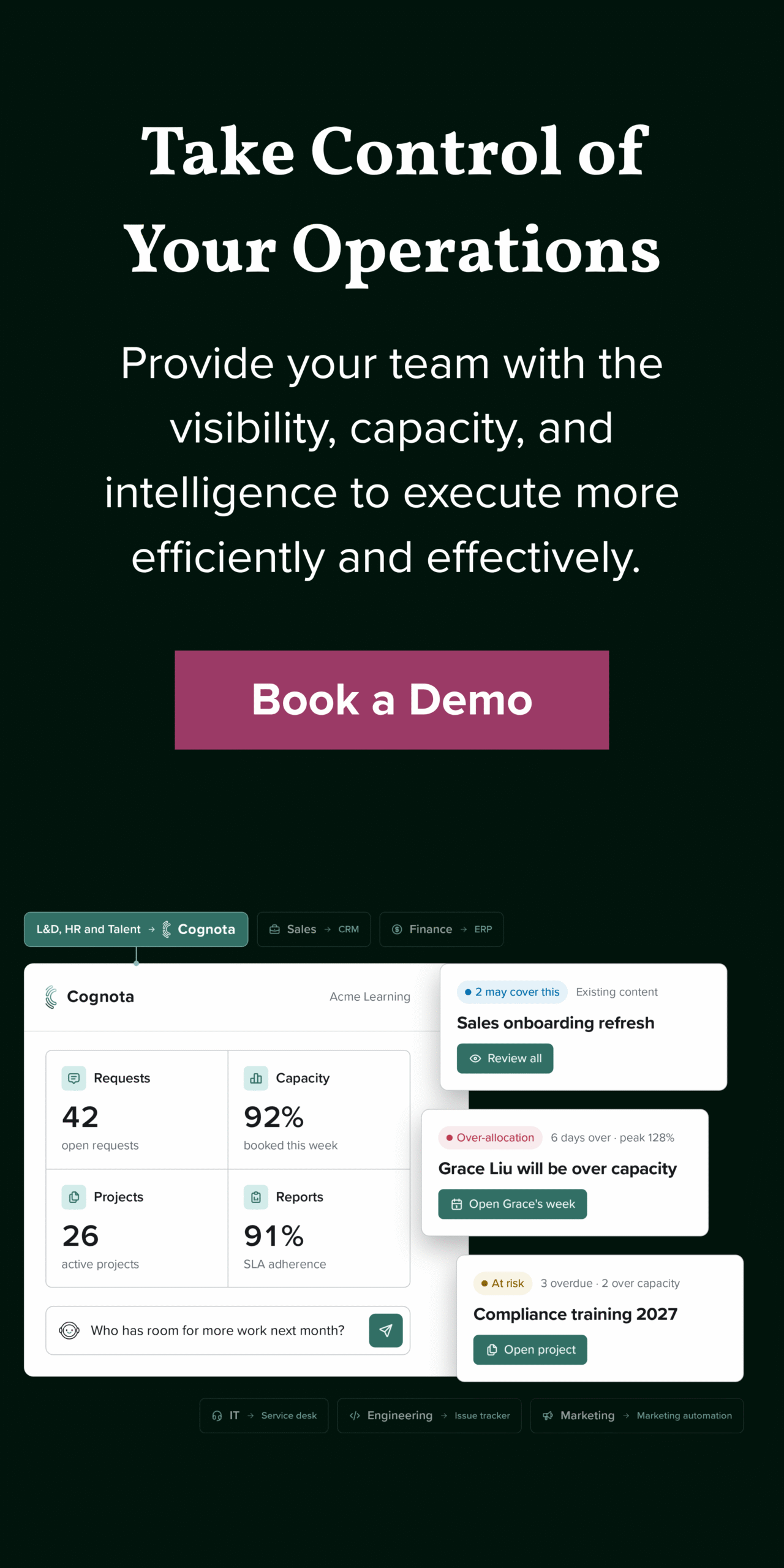
See Cognota in action to see how one operating system can connect requests, priorities, capacity, cost, and delivery risk for your People teams.
Why learning spend optimization is an operating issue
Many teams approach spending as a procurement exercise: negotiate rates, review invoices, and limit unplanned purchases. Those practices matter, but they only address part of the problem. The more consequential question is whether each investment is aligned to the work the business needs most.
A team may negotiate an excellent rate for a program that has limited relevance to current business priorities. Another team may pay more for specialized expertise and avoid delaying a critical launch, leadership transition, or regulatory requirement. Neither choice is inherently right or wrong. The context matters: urgency, audience, internal capability, delivery risk, and the expected value of the work all change the decision.
The 2026 Brandon Hall Group and Cognota joint research found that 83% of teams use three to eight tools to manage operations, while 69% want to consolidate. That fragmentation has a direct cost. When leaders cannot see the full demand pipeline alongside budgets and team capacity, they cannot reliably distinguish a strategic investment from a costly workaround.
Start with visibility, not budget cuts
The first job is to establish a credible picture of current spend. That means going beyond a general ledger category such as “learning services.” L&D needs to see spending in the context of the work it enables.
Connect each commitment to a business priority, requesting stakeholder, target audience, delivery owner, delivery date, and expected outcome. Include internal delivery costs as well as external invoices. Internal capacity is not free simply because it does not appear as a vendor line item. When a team diverts instructional design or program management capacity from a high-impact initiative, the opportunity cost is real.
This view often exposes patterns that finance data alone cannot show. Perhaps multiple business units are buying similar leadership content independently. Perhaps a small number of urgent requests consume disproportionate external spend because intake happens too late for the team to plan. Or perhaps the team is holding budget for projects that no longer have a business sponsor.
Visibility is not surveillance. It gives leaders the evidence to have better conversations with stakeholders: what are we funding, what are we deferring, and what trade-off are we making?
Create one front door for demand
Spend optimization becomes difficult when requests bypass the planning process. An executive asks for a program by email, a manager engages a vendor directly, or an urgent initiative appears after quarterly priorities are already set. Each individual decision can feel reasonable. Collectively, they create an unpredictable portfolio.
A single intake process gives L&D a consistent way to assess work before costs are committed. The request should capture the business problem, intended audience, deadline, sponsor, measures of success, and whether internal delivery is feasible. This does not need to slow down urgent work. It gives the team a way to identify urgency early and make its trade-offs visible.
For example, a request with a hard compliance deadline may deserve accelerated approval and external support. A request framed as “we need a course” may need more discovery before a vendor is selected. The point is not to force every request through the same response. It is to apply the same decision criteria.
Use the Align, Plan, Execute, Measure, Optimize framework
High-performing teams treat learning spend as part of an operating rhythm, not a once-a-year budgeting event. Cognota’s operations framework offers a practical structure for this work.
Align spending with enterprise priorities and agreed business measures. If a request cannot be connected to a priority, it may still be worthwhile, but leaders should be explicit about why it belongs in the portfolio.
Plan the work by comparing demand with budget and capacity for alignment, quality, and impact. This is where teams decide what to build internally, what to source externally, what to sequence later, and what to stop.
Execute with clear ownership, approvals, milestones, and vendor expectations. Weak governance creates hidden costs through rework, late changes, duplicate purchases, and unclear accountability.
Measure both delivery performance and business relevance. Track spend against plan, but also look at on-time delivery, stakeholder satisfaction, adoption, and the measures agreed at intake. A program that comes in under budget but fails to meet its intended need is not optimized.
Optimize by using those signals in the next planning cycle. This is where spending data becomes operational intelligence rather than a historical record.
Make build, buy, and reuse decisions deliberately
External expertise is often the right answer, especially when speed, specialized knowledge, or temporary capacity is required. The mistake is treating every external purchase as a stand-alone decision.
Before committing budget, compare three paths: build internally, buy external support, or reuse and adapt an existing asset or program. The best path depends on the strategic importance of the work and how often the organization will need the capability.
If a program supports a long-term enterprise capability, internal ownership may justify a larger upfront investment. If the need is narrow, time-sensitive, or highly specialized, a vetted external expert may be the more responsible choice. Reuse can be efficient, but only when the existing solution fits the audience and business context. Reusing irrelevant content simply moves waste from the budget line to learner time and stakeholder confidence.
The goal is not to maximize internal production or minimize vendor use. It is to put the right resource against the right work with a clear reason.
Measure the cost of delay alongside the cost of delivery
Teams often evaluate a proposal by its price tag alone. But delay can be more expensive than delivery. If a revenue-critical product launch, major process change, or required capability initiative slips because L&D lacks capacity, the organization absorbs consequences that are not visible in the learning budget.
This is why capacity planning must be tied to impact. A full team is not necessarily an effective team if its capacity is absorbed by low-priority work. Leaders need a view of what the team is working on, what is waiting, where delivery risk is growing, and which commitments would benefit from outside support.
The same 2026 research found that teams with a dedicated operations lead reported 34% faster delivery, 28% lower costs, and 39% higher stakeholder satisfaction. Those figures are directional, not a promise for every organization. They do show what becomes possible when someone owns the operating discipline around demand, decisions, and follow-through.
Move from reactive spending to operational maturity
Learning spend optimization looks different at different levels of maturity. Reactive teams mainly respond to incoming requests and reconcile spend after decisions are made. Managed teams introduce consistent intake, approvals, and budget tracking. Strategic teams connect their portfolio to business priorities and use capacity data to plan delivery.
Predictive and Adaptive teams go further. They use historical patterns and current signals to anticipate demand, identify delivery risk earlier, and adjust investments as priorities shift. Only 1% to 6% of teams reach the Adaptive stage, which should be encouraging rather than discouraging. Progress does not require perfection. It requires a repeatable operating model and the willingness to improve one decision cycle at a time.
The practical next step is to bring demand, budget, capacity, and outcomes into the same conversation. When L&D can show what it is funding, what it is protecting, and what it is choosing not to do, learning spend becomes a leadership decision rather than a back-office debate.