The AI honeymoon in Learning and Development (L&D) is officially over.
Over the past two years, organizations rushed to secure enterprise generative AI licenses, pilot rapid-authoring tools, and experiment with automated video avatars. L&D leaders proudly declared their departments “AI-enabled” to the C-suite. But if you look past the initial press releases and pilot projects, a quiet operational crisis is unfolding.
The hard truth? Handing your instructional designers a ChatGPT license is not an AI strategy. It is operational anarchy.
To transform AI from an ad-hoc productivity hack into a reliable corporate asset, we must stop talking about tool acquisition and start talking about workflow operationalization. That is where LearnOps comes in. If we want to survive the post-implementation bottleneck, we must shift our entire philosophy: L&D is a system, not an on-demand service desk.

The Chaos of “SOP Sprawl” (And Why Generic PM Tools Fail)
When an L&D department rolls out AI without central governance, it creates a phenomenon we call SOP (Standard Operating Procedure) Sprawl.
Imagine a typical 10-person L&D team today:
- Designer A uses ChatGPT-4o with a highly specific, closely guarded prompt sequence to write course outlines.
- Designer B uses Claude 3.5 Sonnet to draft scripts, but doesn’t know how to feed it context, resulting in a robotic tone.
- Designer C is copy-pasting proprietary corporate data into a free, public LLM because they don’t understand the security parameters.
- The Media Developer is using a separate AI video tool that doesn’t align with corporate brand guidelines.
This ad-hoc approach introduces several severe operational risks:
- Wildly Inconsistent Quality: The caliber of your training output should not depend on an individual designer’s prompting skills.
- Brand and Voice Dilution: AI models write in generic, overly formal “corporate-speak” unless strictly guided. Without centralized guardrails, your brand’s unique voice is completely erased.
- Version Control Nightmare: Because AI accelerates content generation by 10x, teams are suddenly drowning in unvetted drafts, localized prompt files, and fragmented source documents.
- Compliance and Security Exposure: Feeding proprietary intellectual property, employee data, or pre-release product specs into public models risks massive compliance violations.
Many organizations try to solve this chaos by tracking these tasks in generalist project management tools like Jira, Asana, or Monday.com. But generic PM tools are where AI efficiency goes to die. These systems are completely blind to the specialized metadata of L&D operations. They cannot track instructional design hours versus administration, they cannot score training-request business priority, and they certainly cannot manage a centralized, auditable prompt registry mapped directly to your learning assets.
If you don’t control the pipeline with a purpose-built operating system, the pipeline controls you. To scale safely, we must build a system where humans and machines collaborate systematically.

The Framework: The Human-AI-Human (HAH) Workflow
To eliminate SOP sprawl and protect quality, mature L&D departments are abandoning free-for-all prompting in favor of the Human-AI-Human (HAH) Framework. This process-driven model ensures that human strategic intent and quality control sandwich the efficiency gains of automated generation.
Phase 1: Human Strategy and Guardrails (The First “H”)
Before a single prompt is typed, the human designer must define the business objective, the audience profile, and the constraints of the project. You cannot ask AI to solve a performance problem you haven’t diagnosed.
- Operational Action: Establish “Intake-to-Prompt” templates. Translate standard stakeholder requests into highly targeted context packages that can be fed directly into your approved AI models.
- Example in Action: Instead of copying a massive, raw product manual into an LLM and saying “write a course,” an instructional designer uses a structured intake template. They explicitly define the performance gap (e.g., “sales reps are failing to handle objection X”), isolate the exact chapters of the manual relevant to that gap, and set the target tone (e.g., “direct, consultative, energetic”). This highly curated “context package” is what gets fed to the AI.
Phase 2: AI-Accelerated Generation (The “A”)
With the parameters locked in, the AI handles the heavy lifting of drafting, formatting, translating, and structuring. This is the engine room of efficiency—shrinking tasks that once took days down to minutes.
- Operational Action: Maintain a centralized, tested prompt registry. Every team member should use the same vetted, high-performing prompts for standard deliverables like learning objectives or assessment questions.
- Example in Action: The designer pulls the vetted “Scenario-Based Practice Prompt” from the department’s centralized registry. By feeding the AI the context package from Phase 1, the LLM processes the instructions and outputs three highly relevant, branching customer objection scenarios in under 60 seconds—a task that would normally take a designer a full afternoon to write from scratch.
Phase 3: Human Review and Refinement (The Second “H”)
Raw AI output should never reach a learner or a business stakeholder. A skilled instructional designer must review the draft for pedagogical soundness, tone, factual accuracy, and alignment with corporate culture.
- Operational Action: Build mandatory “Human-in-the-Loop” checkpoints directly into your project management system. Treat AI-generated content as a rough first draft that requires structural editing and Subject Matter Expert (SME) verification before moving to production.
- Example in Action: The designer reviews the AI-generated scenarios. They instantly spot an “AI hallucination”—the tool referenced a software feature that isn’t actually supported in the product update. The designer fixes the technical error, injects real corporate vocabulary, and runs the draft by a Product Manager for quick verification. The human-in-the-loop ensures complete compliance while preserving a 70% reduction in production time.
Building the LearnOps Infrastructure for AI
Operationalizing AI isn’t just about drawing a neat workflow diagram; it requires aligning your technology, your people, and your performance metrics. Here is how to build an operational infrastructure that supports AI-at-scale:
- Build a Centralized Prompt and Asset Registry
Do not let your team store their best prompts on local sticky notes or private documents. Treat prompts as corporate intellectual property. Build a shared, version-controlled repository of vetted prompts mapped to specific deliverables. As AI models update, your prompt registry should be optimized and maintained.
- Capture “Invisible Labor Leakage” and Reclaim Capacity
The true promise of AI is speed, but speed is meaningless if you can’t measure it. Many L&D teams are victims of invisible labor leakage—hours lost to administrative setups, manual scheduling, and searching for raw assets in messy folders.
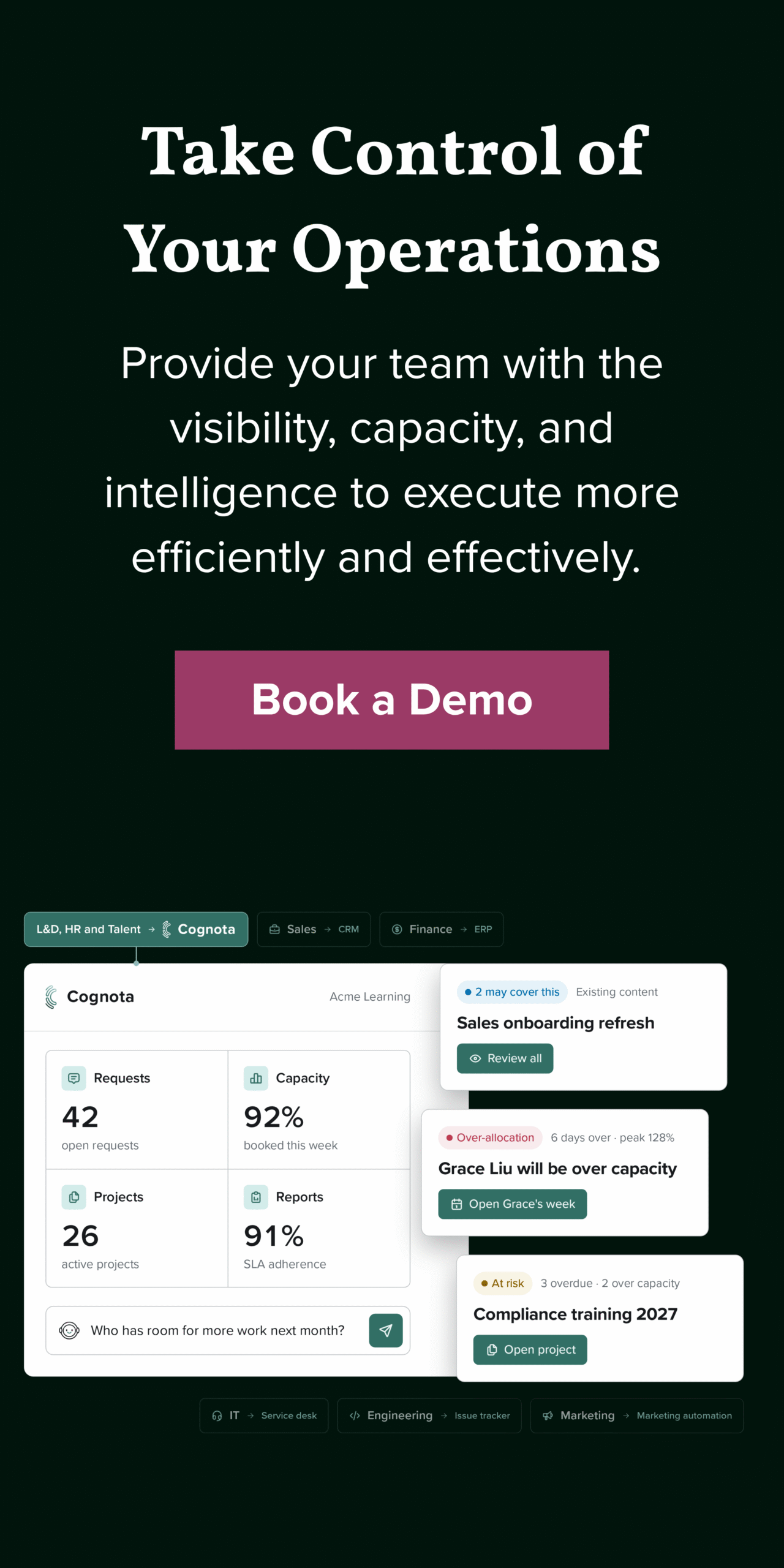
By managing your workflows through a dedicated LearnOps platform like Cognota, you can track the exact capacity reclaimed by AI. If a course development cycle drops from 40 hours to 10 hours, you have unlocked 30 hours of capacity.
Do not let those hours get swallowed by admin work. Instead, leverage this data to prove operational ROI and feed a high-agility hybrid staffing model: pairing a lean core team of instructional designers with on-demand flex talent and automated workflows to pivot instantly as business needs shift.
- Shift from “Writers” to “Editors-in-Chief”
To run an AI-powered L&D shop, your instructional designers need to adapt. They must shift from primary content creators to critical editors who can spot “hallucinations,” evaluate instructional design integrity, and align AI-generated outlines with complex business objectives. This is an operational shift in skillset, requiring targeted upskilling in data literacy and information architecture.
The Ultimate AI Strategy is Operational Excellence
The competitive advantage of AI is no longer the technology itself. Anyone can buy a license to an LLM. The true differentiator is how efficiently your team uses that technology to drive business outcomes.
If your L&D department is struggling to move past the initial pilot phase, stop looking for new AI tools and start looking at your operational workflows.
Standardize your processes, implement human-in-the-loop guardrails, and track your reclaimed capacity. By prioritizing LearnOps over simple tool acquisition, you can bridge the post-implementation bottleneck, shift your metrics to workforce enablement KPIs, and turn your L&D department into a highly efficient, strategic business machine.