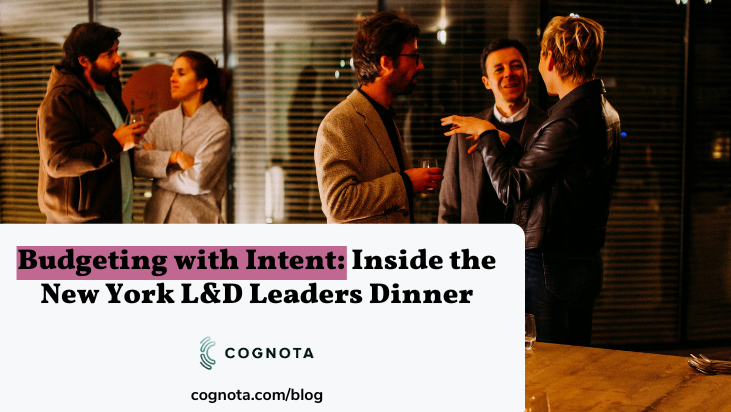
In the heart of Manhattan’s Penn District—just steps from Madison Square Garden—Cognota and TiER1 Performance welcomed a select group of senior Learning and Talent leaders to The Dynamo Room for an intimate evening of conversation, connection, and reflection.
The private dinner was centered around one key question on every CLO’s mind as 2025 winds down:
How can learning teams budget with intent for 2026—aligning every dollar to impact, strategy, and the future of work?
As the fall skyline lit up outside, guests gathered over a multi-course meal to explore how operational tools and people-centered strategies intersect to shape smarter, more agile learning operations.
Why Budgeting with Intent Matters Now
Across industries, L&D teams are facing a dual challenge: budgets are tightening, but expectations for measurable impact continue to rise. Leaders are being asked to do more than simply manage spend—they must connect investments directly to business value, forecast with precision, and prove the ROI of learning.
This shift requires a new kind of budgeting: one that’s not reactive, but intentional.
Intentional budgeting means starting with strategy—not spreadsheets. It’s about ensuring that every request, resource, and program ladder up to business goals, and that leaders can clearly articulate how learning drives growth, efficiency, and readiness for change.
That’s exactly what the evening’s conversation explored—guided through three structured themes that mirrored the dinner itself: Where Intent Starts, Connecting Budgets to Strategy, and Future-Ready Budgeting.
Appetizer Theme: Where Intent Starts
As guests raised their glasses and shared first impressions, the opening question set the tone for the evening:
“As you look toward 2026, what’s driving your budgeting conversations—efficiency, growth, or proving impact—and how do you ensure those discussions start with a clear business intent?”
This question sparked lively reflection on what’s shaping the next wave of learning investments.
Many leaders agreed that efficiency continues to be a dominant theme, especially in the wake of economic headwinds and leaner organizational structures. But efficiency alone, several noted, can’t be the north star—it must be balanced with growth and strategic enablement.
One L&D executive put it succinctly:
“Efficiency helps us survive. Intent helps us grow.”
Participants discussed how early alignment with finance and business stakeholders is key to reframing learning as an investment in capability, not a cost center. Several shared how they’re using LearnOps frameworks to bring more structure to those discussions—mapping learning objectives directly to operational and performance goals.
Others reflected on how AI and analytics are giving L&D leaders new leverage. Instead of relying on anecdotal evidence, teams can now show data-backed forecasts of learning demand, capacity, and business alignment—making their budget requests far more credible and compelling.
Main Course Theme: Connecting Budgets to Strategy
As the main course was served—steak, chicken, and plenty of conversation—the evening transitioned to its core topic:
“How are you linking your learning and talent investments to strategic business priorities, and what processes, systems, or partnerships help you make that connection visible and measurable throughout the year?”
This question surfaced one of the most consistent pain points in enterprise learning today: visibility.
While most teams have strategic learning goals, few have a clear operational process for connecting those goals to business metrics across the year. Attendees shared that they often find themselves reacting to ad-hoc requests or executive priorities that shift mid-year—leading to fragmented plans and underutilized budgets.
A Director of Learning shared:
“We start the year aligned to the strategy, but by Q3, we’re fighting fires. The intent is there—it’s just buried under the noise.”
Here, Cognota’s LearnOps® approach and TiER1 Performance’s human-centered strategy frameworks came together. The two organizations showcased how operational visibility and strategic storytelling can coexist to create stronger, data-driven narratives around learning’s value.
-
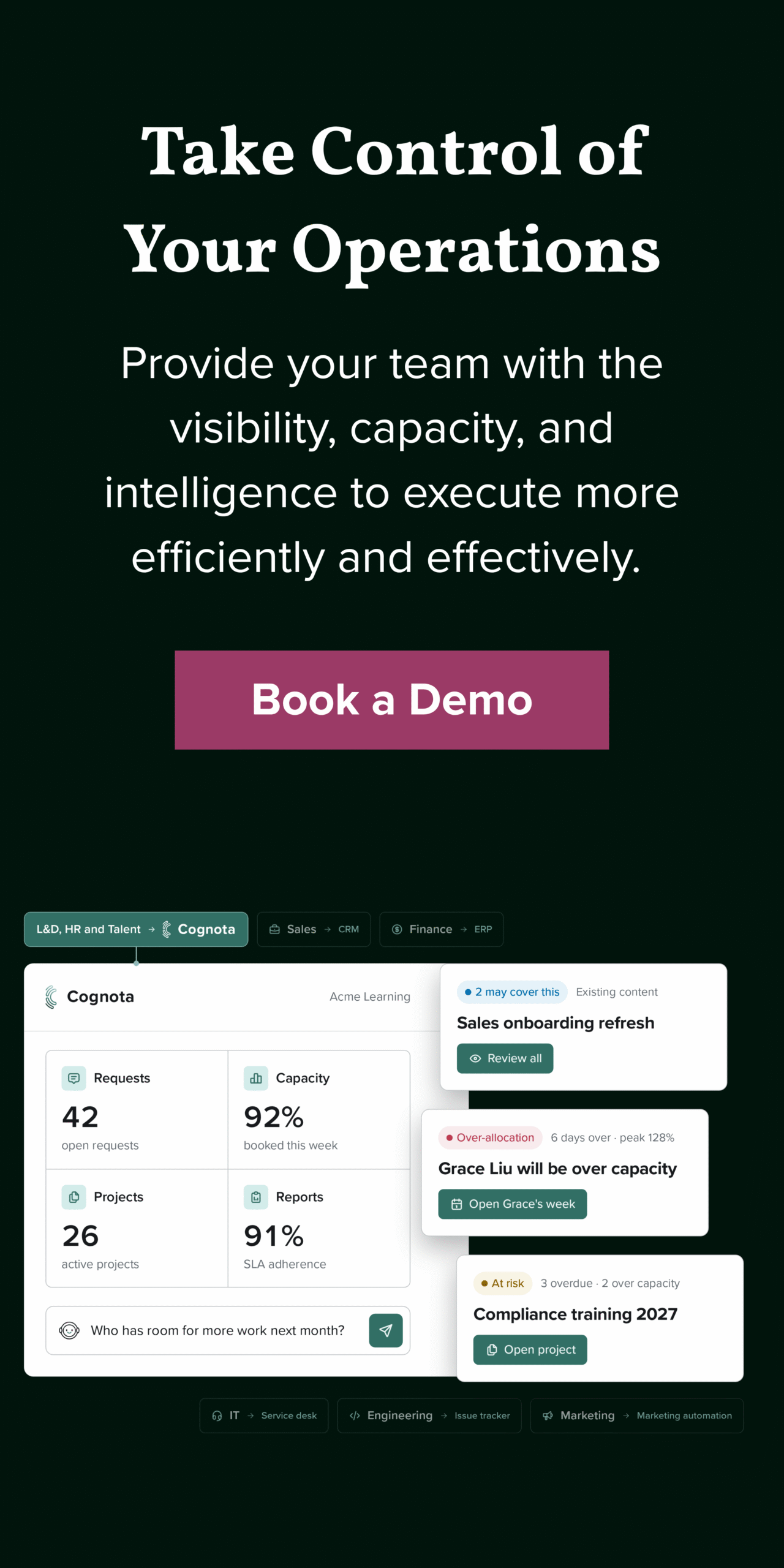
Cognota provides the infrastructure—the operating system for L&D—to standardize intake, manage capacity, and connect every project to a business goal.
-
TiER1 Performance complements that with the people and culture side—helping leaders clarify purpose, define measurable outcomes, and tell the story of learning impact across the organization.
Together, they demonstrated how learning teams can move from reactive to strategic by building processes that tie budgets, plans, and outcomes together in a single, transparent system.
Several guests discussed how they’re beginning to adopt goal-based planning models, linking every program request to a corporate OKR or KPI. This not only clarifies why learning initiatives exist—it also helps teams defend and sustain budgets during mid-year reviews.
As one attendee noted:
“If you can trace every line item to a business metric, your budget becomes a business case, not a wish list.”
Dessert Theme: Future-Ready Budgeting
Dessert brought both sweetness and optimism to the table, as the conversation turned toward what’s next:
“If you could redesign your budgeting process for 2026 to make it more agile and intentional, what would change—and how might data, collaboration, or AI help get you there?”
The responses painted a clear picture of the future-ready learning organization.
Across the board, leaders envisioned a budgeting process that’s:
-
Dynamic, not annual.
Instead of a once-a-year exercise, budgets should adapt in real time based on learning demand, workforce shifts, and business priorities. -
Collaborative, not siloed.
Learning, finance, HR, and operations teams need shared visibility into plans, so resources can be reallocated quickly as needs evolve. -
Data-driven, not intuition-based.
With systems like Cognota, teams can use data from intake, capacity, and impact tracking to continuously optimize spend. -
AI-assisted, not manually reactive.
Several attendees were eager to explore how AI Operators—an emerging concept in LearnOps—could automate elements of budget forecasting, project prioritization, and ROI prediction.
One participant captured the spirit of the discussion perfectly:
“We need to move from ‘defending’ the budget to designing the budget—intentionally, collaboratively, and with evidence.”
The Power of Partnership: Cognota + TiER1 Performance
The dinner wasn’t just about ideas—it was about collaboration.
Cognota and TiER1 Performance have long shared a commitment to helping organizations operationalize learning in ways that are both structured and human-centered. While Cognota brings the technology backbone for LearnOps, TiER1 brings the strategic frameworks that empower teams to act with purpose.
Together, they represent the convergence of operational excellence and behavioral insight—a combination that’s increasingly essential as learning teams evolve from service providers to strategic partners.
This partnership was reflected throughout the evening, as both teams facilitated conversations that encouraged not just networking, but genuine peer learning. Attendees appreciated the chance to speak candidly about challenges they rarely get to discuss in larger conferences or virtual forums—everything from negotiating budget increases to communicating learning’s impact in boardroom language.
The result? An environment that felt less like a corporate event and more like a roundtable of trusted advisors working toward a shared vision for the future of L&D.
Themes That Emerged
Across the three courses, several key themes surfaced that reflect where high-performing L&D teams are headed in 2026:
-
Intentional Alignment is Non-Negotiable.
Learning teams can no longer operate on assumptions about business priorities. They must actively partner with finance and strategy leaders to align early and often. -
Operational Visibility Drives Credibility.
When L&D can show where time, people, and dollars are going—and what they’re achieving—it changes the conversation from cost to contribution. -
Data Turns Insight into Action.
Tracking capacity, utilization, and outcomes allows leaders to make smarter, faster budget decisions that reflect real demand. -
Partnerships Expand Possibility.
By combining operational systems (Cognota) and strategic activation (TiER1 Performance), learning teams can bridge the gap between planning and performance. -
AI Will Be a Game-Changer.
From predictive analytics to automated intake prioritization, AI is beginning to redefine how budgets are built, monitored, and justified.
Final Reflections
The evening at The Dynamo Room reminded everyone that transformation doesn’t happen in isolation—it happens through shared intent.
Budgeting, when done right, isn’t about cutting costs or chasing approvals. It’s about defining what matters, measuring what counts, and mobilizing resources to make a meaningful difference in how organizations learn and perform.
And as 2026 approaches, that intent will be the differentiator between learning teams that simply adapt—and those that lead.
Ready to Improve Your Learning Operations and Budgets for 2026?
Discover how Cognota helps learning teams operationalize intent—connecting strategy, budgets, and impact in one platform.
Book a customized consultation to see how LearnOps can transform how your team plans, executes, and measures learning.