
A learning leader gets a request for a major product launch program, a compliance update, and a manager capability initiative in the same week. The immediate question is rarely whether the organization has an LMS. The real question is who will prioritize the work, scope it, assign capacity, manage approvals, control the budget, and show leadership what business outcome the investment produced. That is where the LMS versus LearnOps conversation becomes useful.
For enterprise L&D teams, this is not an either-or decision. An LMS is the delivery layer. LearnOps is the operations layer that helps learning and talent teams run the work behind the learning strategy with greater discipline. Treating them as interchangeable creates a familiar problem: a capable delivery system surrounded by spreadsheets, inboxes, disconnected project plans, and difficult conversations about workload and value.
If your team is feeling that gap, see Cognota in action to understand what an operational layer can look like across the learning function.
LMS versus LearnOps: Different layers, different decisions
The simplest distinction is also the most important. An LMS supports the delivery of learning. LearnOps® provides the operating model and infrastructure for managing how learning work gets aligned, planned, executed, measured, and improved.
That difference changes the questions each system is designed to answer. A delivery layer helps an organization make learning available to its people. An operations layer helps L&D leaders decide which requests deserve investment, whether the team has capacity to deliver them, where work is getting delayed, and whether completed initiatives are contributing to the outcomes the business expects.
Many teams discover this distinction only after growth exposes operational strain. A small team can often compensate for fragmented processes through individual effort and institutional knowledge. At enterprise scale, that approach breaks down. Requests multiply, stakeholders expect visibility, specialist capacity becomes harder to manage, and leadership wants a credible line between learning activity and business performance.
The answer is not to discard the LMS. It is to recognize that delivery does not govern demand, resources, workflow, or impact on its own.
Why the operational gap keeps widening
Learning teams are being asked to operate more like strategic business functions while often working with processes built for reactive service delivery. The gap shows up in ordinary moments: intake requests arrive with incomplete business context, teams begin work before priorities are confirmed, subject matter experts become bottlenecks, and budget decisions are made without a shared view of demand or resource allocation.
These are not minor administrative inconveniences. They shape capacity and execution. When leaders cannot see the full portfolio of work, they cannot confidently decide what to start, pause, outsource, or stop. When workflows live across disconnected tools, project status becomes a manual reporting exercise. When measurement begins only after launch, the team may have missed its chance to define the intended business result.
This is why “we already have an LMS” is often a reasonable statement that does not resolve the underlying issue. Most mature enterprises do have a delivery layer. What they may lack is an operational system that connects strategy to day-to-day execution.
LearnOps begins before work begins
LearnOps is not another name for learning administration. It is a disciplined way to operate a learning and talent function as a measurable business partner. Cognota’s LearnOps® Framework organizes that work across five connected disciplines: Align, Plan, Execute, Measure, and Optimize.
Align learning demand to business priorities
Alignment starts with intake, but it cannot end with collecting requests. Teams need a consistent way to understand the business problem, intended audience, strategic priority, expected outcome, sponsor, and level of effort before committing resources.
Without that structure, the loudest request can become the next project. With it, L&D leaders can have a more productive conversation: What problem are we solving? Is learning the right intervention? What happens if this work is delayed? How will the business recognize progress?
This is where an operations layer creates executive credibility. It gives learning teams a practical mechanism for turning broad demand into a prioritized portfolio rather than an unmanaged queue.
Plan for real capacity, not assumed capacity
Capacity is more than headcount. It includes the availability of instructional designers, program managers, subject matter experts, reviewers, learning technologists, and external specialists. It also includes the time consumed by unplanned work, revisions, approvals, and competing initiatives.
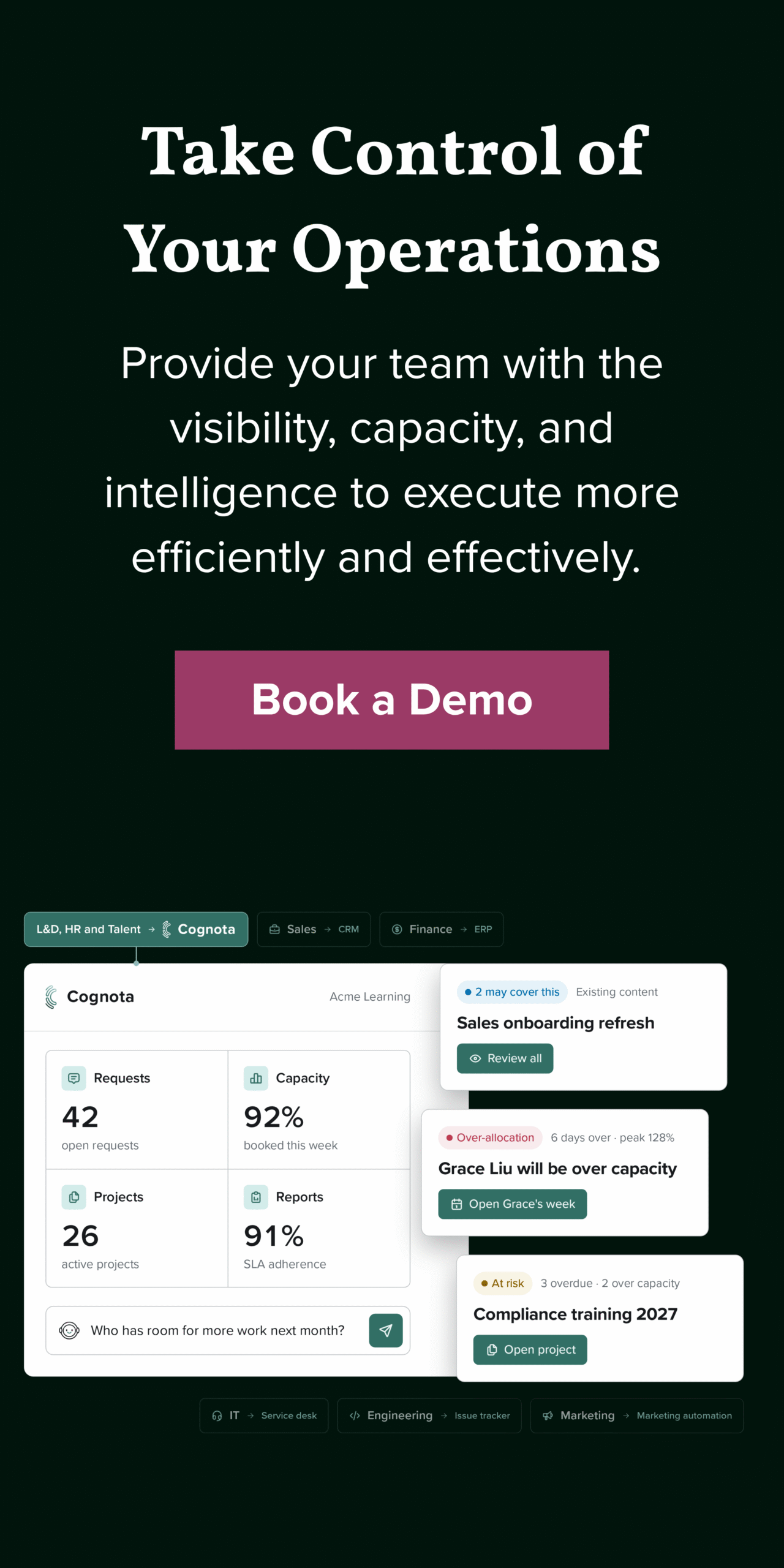
An LMS cannot answer whether the team has sufficient capacity for the next quarter’s commitments. LearnOps can create a clearer operating view of resource demand, allocation, budgets, and project dependencies. That visibility helps leaders make trade-offs early, when options still exist.
Sometimes the right decision is to move a lower-priority request. Sometimes it is to rebalance internal work. Sometimes a team needs specialized capacity for a defined period. The value is not pretending every request can be delivered. The value is making those choices deliberately and with evidence.
Execute with governance that does not slow work down
Governance has a reputation for creating friction because it is often added after teams have already lost control of the work. Done well, it does the opposite. Clear workflow stages, ownership, approvals, and project visibility reduce the time spent chasing updates or reconstructing decisions.
For a learning leader, this means fewer surprises. For stakeholders, it means a more transparent experience from request through delivery. For the team, it means less context switching and fewer urgent escalations caused by unclear expectations.
The operational goal is not bureaucracy. It is reliable execution at scale.
Measurement is where the distinction becomes strategic
Enterprise learning teams have long been pressured to prove value. Yet many are still forced to assemble basic portfolio data manually before they can begin a meaningful conversation about impact. That is a systems problem, not an effort problem.
A LearnOps approach connects measurement to the work from the start. Teams can establish intended outcomes during intake, track execution against those commitments, and use results to improve future prioritization. The measures will vary by initiative. A sales enablement effort, a risk-focused program, and a leadership initiative should not be judged by identical criteria.
What matters is consistency between the business need, the planned intervention, and the evidence used to assess progress. This gives L&D leaders a stronger basis for discussing ROI without making simplistic promises about causation.
Industry analysts including Josh Bersin have consistently emphasized the shift from learning as a course-centered function to learning as a capability-building business discipline. LearnOps supports that shift by making the operational work visible. It turns scattered activity into a portfolio that leaders can manage, measure, and improve.
When an LMS may be enough, and when it is not
Not every organization needs the same level of operational infrastructure. A smaller, stable learning environment with limited demand, few stakeholders, and straightforward work may be able to manage with lightweight processes. Adding another system without a clear operational need can create avoidable change management.
The case for LearnOps becomes stronger when the team faces competing enterprise requests, inconsistent intake, limited visibility into project health, recurring capacity constraints, complex approval paths, or pressure to demonstrate business alignment. It is especially relevant when L&D is expected to serve as a strategic partner but still operates through manual coordination.
The LearnOps® Maturity Model offers a useful diagnostic lens. Teams at the Reactive stage are often focused on responding to demand as it arrives. Managed teams begin standardizing work. Strategic teams connect learning investments to business priorities. Predictive and Adaptive teams use operational intelligence to anticipate demand, improve decisions, and continuously refine performance.
The purpose of maturity is not to label a team as behind. It is to identify the next operational capability that will produce the greatest improvement. A team does not need to solve everything at once. It needs a clear path from reactive execution to more intentional, measurable operations.
Build the stack around the work that matters
The most effective enterprise learning technology strategy is not about choosing a single system to do everything. It is about giving each layer a clear role and ensuring the work between those layers is not left to manual effort.
An LMS remains valuable as a delivery layer. LearnOps addresses the operational reality around it: intake, prioritization, workflow, resource planning, budget visibility, project governance, measurement, and continuous optimization. Together, they allow learning teams to spend less energy managing complexity and more energy building the capabilities the business needs.
For L&D leaders, the next question is not whether they have enough technology. It is whether their current operating model gives them the capacity, execution, and intelligence to deliver on the commitments already in front of them. Seeing Cognota in action can help make that question more concrete.