Workforce transformation is often discussed as a talent challenge: build new skills, prepare leaders, adopt new technology, and help employees adapt. For enterprise learning leaders, the harder truth is operational. Transformation breaks down when the team responsible for enabling change cannot see demand clearly, prioritize work against strategy, or prove which investments are moving performance.
That pressure is familiar in financial services, healthcare, life sciences, energy, and other complex industries. Requests arrive from every direction. Business leaders want faster execution. Budgets are scrutinized. Internal capacity is limited. Yet L&D is expected to create the conditions for change while operating through disconnected processes and incomplete data.
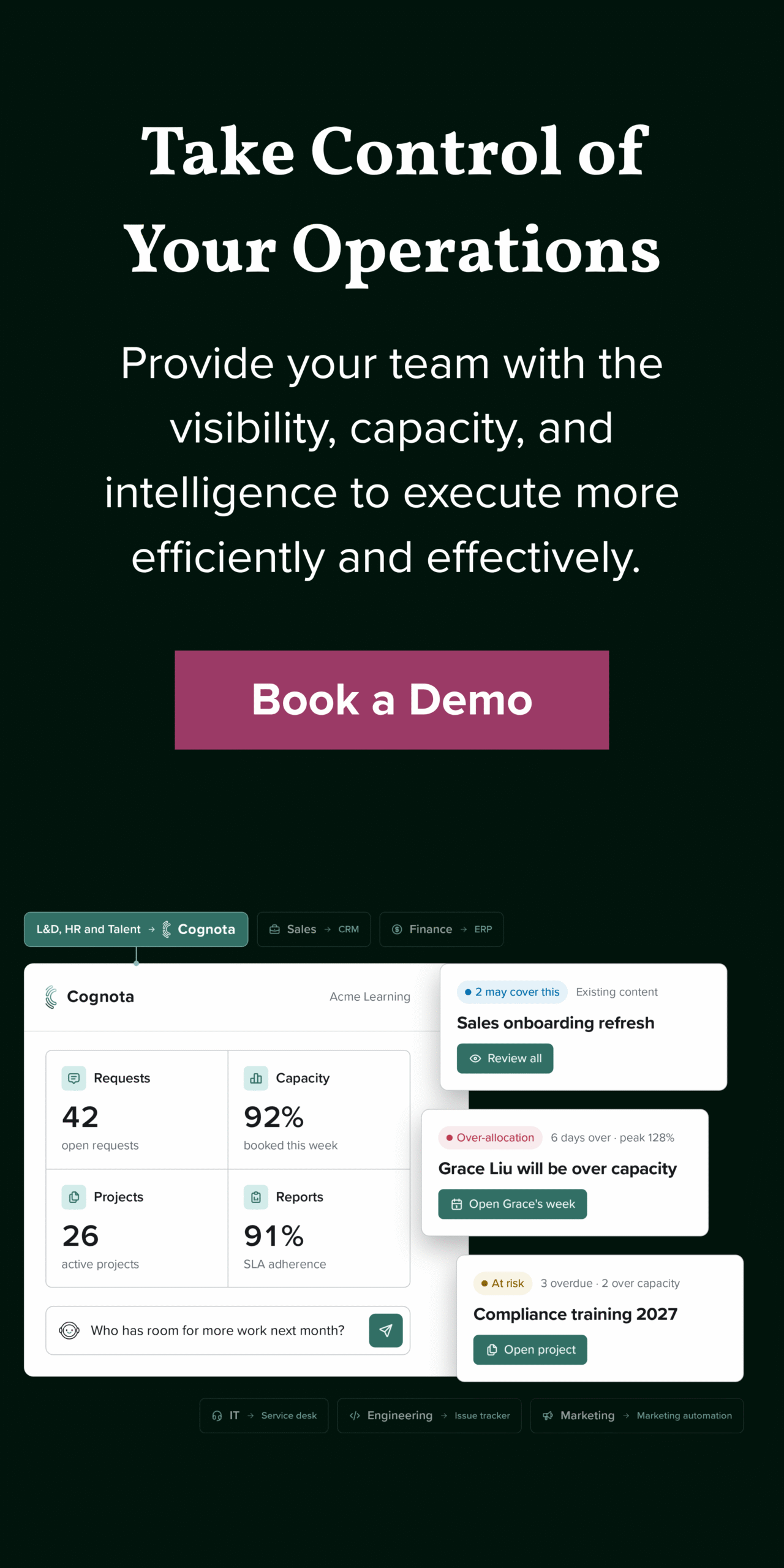
The response cannot be to simply produce more learning. It must be to run learning and talent work as a disciplined business operation. If your team needs a clearer view of how that operating model works in practice, see Cognota in action through a LearnOps platform introduction.
Why workforce transformation becomes an operating challenge
A transformation agenda may begin with a strategic goal, such as improving frontline performance, building data fluency, or preparing managers for a new operating model. It becomes difficult the moment that goal turns into dozens of requests, dependencies, stakeholders, approvals, projects, and competing deadlines.
Without a common operating layer, teams tend to default to intake by email, planning in spreadsheets, status updates in meetings, and measurement after the fact. Each practice may be workable in isolation. Together, they make it hard to answer executive questions: Which initiatives are tied to priority outcomes? Where is capacity constrained? What work should be delayed? What business impact did the investment create?
This is why workforce transformation is not solved by content volume or a new learning campaign alone. It requires the ability to translate business priorities into a managed portfolio of work. L&D needs visibility before work starts, control while work is underway, and evidence after it is delivered.
The five disciplines behind transformation at scale
Cognota’s LearnOps® Framework provides a practical way to view this work: Align, Plan, Execute, Measure, and Optimize. These are not sequential phases that happen once. They are connected disciplines that let a learning organization respond to change without becoming reactive.
Align learning work to business priorities
Alignment starts with a simple but demanding question: what business problem are we trying to influence? A request for a leadership program, product education, or compliance initiative is not yet a strategic case. The team needs agreement on the audience, desired performance change, sponsor, urgency, and success measures.
When intake is structured around these details, L&D can distinguish essential work from merely urgent work. That does not mean every request should be rejected if it lacks a perfect business case. Some work is mandatory, and some emerging needs require speed. But leaders should be explicit about the trade-off rather than allowing the loudest stakeholder to set the roadmap.
Plan capacity before committing resources
Transformation plans often fail because organizations confuse demand with a plan. A list of requested initiatives says nothing about whether the team has the instructional design, program management, subject-matter expertise, review capacity, or budget to deliver them.
Capacity planning makes those constraints visible early. It gives leaders a basis for sequencing work, reallocating internal effort, or bringing in specialized support when demand exceeds available capability. The objective is not perfect forecasting. It is making better commitments with the information available.
For a team managing enterprise-scale change, this is a material shift. Instead of discovering overload after deadlines slip, leaders can show stakeholders the consequence of adding work and make prioritization a shared decision.
Execute with governance, not bureaucracy
Governance is sometimes mistaken for extra administration. Done poorly, it is. Done well, it reduces rework by establishing who owns decisions, what must be approved, where work stands, and what risks need attention.
Transformation initiatives cross functions. A business sponsor may own the outcome, L&D may own the enablement approach, talent leaders may shape audience strategy, and subject-matter experts may validate the work. Clear workflows keep these groups moving without forcing the learning team to chase every status update manually.
The right amount of governance depends on the initiative. A high-risk regulatory change deserves more controls than a small internal capability pilot. Operational maturity means applying rigor where it protects the outcome, not treating every project as identical.
Measure what decision-makers need to know
Measurement should begin at intake, not at project close. If leaders cannot agree on what success looks like before work starts, proving value later becomes an exercise in retrofitting metrics.
For some initiatives, completion and participation data may be useful signals. For others, they are insufficient. A workforce transformation effort may need to connect learning activity to adoption, proficiency, quality, manager effectiveness, time to readiness, or other performance indicators that matter to the business.
Attribution is rarely simple. Performance is shaped by systems, incentives, leadership behavior, process design, and market conditions, not learning alone. That is precisely why L&D should be disciplined about the claims it makes. Strong measurement does not promise certainty where none exists. It creates credible evidence for better investment decisions.
Optimize the operating model continuously
The final discipline is where mature teams separate themselves. They use demand, delivery, capacity, and outcome data to improve how they work. They identify recurring bottlenecks, recurring request types, underused expertise, and initiatives that consume disproportionate effort without sufficient strategic value.
Optimization may lead to standardizing a common workflow, changing how work is scoped, shifting resources to a higher-priority portfolio, or engaging on-demand specialists for a concentrated period of demand. The point is not efficiency for its own sake. It is creating more capacity for work that changes business performance.
Diagnose maturity before prescribing change
Not every learning team needs the same intervention. The LearnOps® Maturity Model describes a progression from Reactive to Managed, Strategic, Predictive, and Adaptive across two dimensions: Strategy and Impact, and Efficiency and Effectiveness.
A reactive team may be highly committed and deeply knowledgeable, yet spend most of its energy responding to unplanned work. A managed team may have stronger processes but limited insight into portfolio-level performance. Strategic teams connect priorities, investments, and outcomes more consistently. Predictive and adaptive teams use operational intelligence to anticipate needs and continuously adjust how resources are deployed.
The goal is not to label a team as behind. It is to establish an honest baseline. A team at the managed stage should not be pressured to operate like an adaptive organization overnight. It should focus on the few operational changes that create the next level of control and credibility.
What leaders should do now
Start by examining the work already in motion. Can your team identify which initiatives are connected to executive priorities, who owns each decision, what capacity is committed, and how success will be assessed? If the answer requires several files, inbox searches, and meetings, the issue is not a lack of effort. It is an operating-model gap.
Next, bring business stakeholders into the prioritization conversation. L&D should not silently absorb every request and then be judged for being overextended. Make demand, trade-offs, and resource constraints visible enough that sponsors can participate in choices.
Finally, treat operational intelligence as a strategic capability. When learning leaders can show where work is going, what it costs in capacity, and what outcomes it supports, they earn a more influential role in workforce decisions.
Workforce transformation is ultimately a test of whether an organization can turn strategy into changed behavior at scale. Learning and talent teams are central to that work. Give them the capacity, execution discipline, and intelligence to lead it.