Learning budgets rarely disappear in one dramatic cut. More often, they erode through urgent requests, duplicate work, underused vendor commitments, and projects approved without a clear view of capacity or business value. The best L&D cost control methods address those operational leaks without turning learning into a blunt cost-cutting exercise.
For enterprise L&D leaders, the objective is not simply to spend less. It is to direct available investment toward work that supports strategic priorities, protects internal capacity, and produces evidence leaders can use. That requires a disciplined operating model, not another round of budget scrutiny after the money is gone.
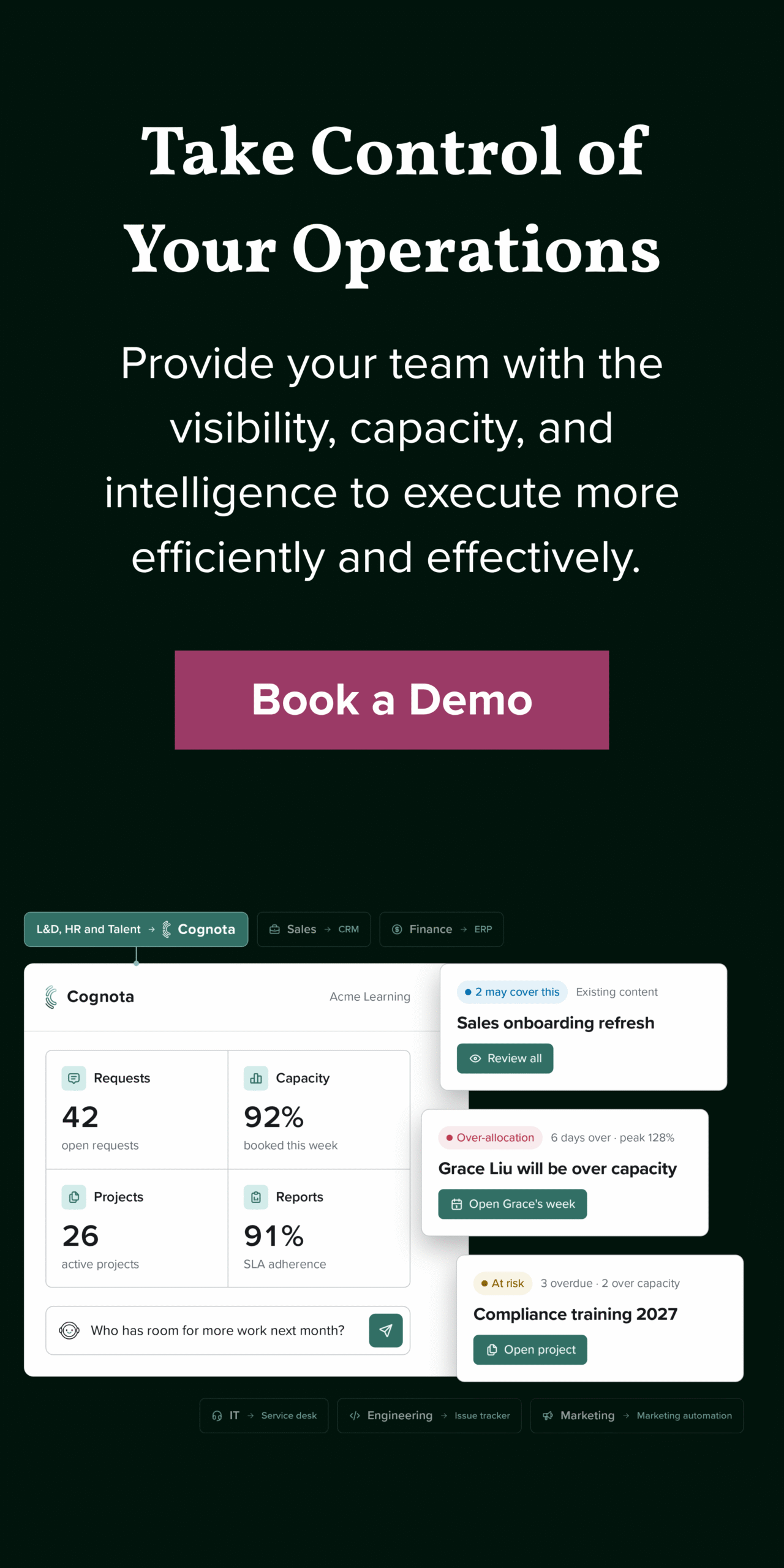
If your team needs a clearer operational view of demand, resources, budgets, and outcomes, see Cognota in action to understand how a LearnOps® approach can create that visibility.
Why traditional L&D cost cutting falls short
Across large organizations, learning spend is often distributed across business units, external partners, platforms, content, and internal labor. Finance may see total spend, while learning leaders see individual projects. Neither view alone reveals whether the portfolio is aligned, whether work is duplicative, or whether the team has accepted more demand than it can deliver effectively.
This is why blanket budget reductions create avoidable risk. Cutting development funds may protect a quarterly target while delaying a critical product launch, compliance initiative, or leadership transition. Reducing external support may appear efficient while pushing an already constrained team into burnout and missed deadlines.
The better question is: which investments create measurable business value, and which operating practices are creating unnecessary cost? The answer changes by organization, but the most effective controls are consistent. They strengthen alignment, planning, execution, measurement, and optimization – the five disciplines of LearnOps®.
1. Create one intake process for all learning demand
Unstructured intake is expensive. When requests arrive through email, chat, meetings, and executive escalations, teams lose the ability to compare demand objectively. Similar programs get commissioned separately. High-priority work competes with loud requests. Scope changes are approved informally and absorbed by the team.
A common intake process gives every request a baseline: the business problem, intended audience, urgency, desired outcome, sponsor, budget owner, required date, and expected effort. It does not need to make every request difficult. It needs to make trade-offs visible.
For example, a sales enablement request with a fixed launch date may warrant rapid action. A broad request for a new manager curriculum may need discovery before development begins. Treating both requests as equally urgent is how backlogs grow and costs become opaque.
2. Prioritize by business value, not request volume
The most vocal stakeholder should not determine the learning portfolio. Prioritization needs criteria that connect work to enterprise outcomes: regulatory exposure, revenue impact, operational performance, workforce change, customer experience, or strategic capability building.
Use a simple scoring model that weighs expected value against effort, risk, audience reach, and time sensitivity. The goal is not false precision. It is a defensible conversation about what the team will do now, defer, redesign, or decline.
This is one of the best L&D cost control methods because it prevents low-value work from consuming high-value capacity. When leaders can see the full demand portfolio and its trade-offs, they are more likely to make intentional investment decisions rather than demand exceptions.
3. Plan capacity before approving the work
Many learning teams track project deadlines but cannot see the resource demand behind them. That leaves internal designers, program managers, facilitators, and subject matter experts carrying hidden workloads until deadlines begin to slip.
Capacity planning turns labor from an assumed free resource into a managed investment. Estimate the roles and hours required, account for current commitments, and identify where demand exceeds available supply. This enables leaders to make a choice early: move the deadline, reduce scope, pause lower-value work, or add targeted support.
There is a trade-off here. Detailed planning can feel slower at the start, particularly for teams accustomed to moving immediately from request to production. But a lightweight capacity view is far less costly than discovering three weeks before launch that the same people are assigned to six critical initiatives.
4. Control scope changes with project governance
Scope creep is not always caused by poor discipline. In enterprise environments, priorities shift, stakeholders learn more, and requirements evolve. The problem is not change itself. The problem is accepting change without recording its effect on cost, timing, resources, and expected outcomes.
Establish a clear change process for material additions. If a stakeholder asks to add new audiences, languages, modalities, assessments, or approval layers, the team should be able to show the operational consequence. The response can be yes, but it should be a visible yes with a revised plan.
Project governance also creates valuable data over time. If certain request types consistently expand beyond initial estimates, that is a planning signal. Leaders can improve intake questions, clarify sponsorship expectations, or reserve contingency capacity for predictable change.
5. Make external spend a capacity decision
External specialists can be the right answer when demand spikes, niche expertise is required, or a time-sensitive initiative cannot wait. The cost-control mistake is treating outside support as either an automatic default or a spending failure.
Instead, compare external investment with the full cost of internal delivery. Internal work has an opportunity cost: every hour assigned to one project is unavailable for another. A specialized partner may reduce rework or protect a strategic deadline. Conversely, recurring external work may indicate a capability that should be developed internally.
The strongest approach uses a flexible mix. Maintain core internal ownership of strategy and governance, then add on-demand expertise when the business case is clear. This protects capacity without permanently increasing fixed costs.
6. Track budget commitments, not just invoices
By the time invoices arrive, many spending decisions are already locked in. Effective cost control starts with committed spend: approved statements of work, planned contractor hours, software renewals, content purchases, and anticipated project costs.
Give portfolio owners a current view of budget allocated, committed, spent, and remaining. Segment the view by business unit, initiative, or strategic priority where useful. This makes it easier to spot an initiative that is consuming more than planned before it becomes a year-end surprise.
Budget data becomes more useful when it sits beside capacity and project status. A program may be under budget but late because it lacks internal resources. Another may be on schedule but over budget because requirements changed. Those are different management decisions, and teams need the context to make them.
7. Measure the value of the portfolio, not only completion
Completion rates and satisfaction scores have a place, but they rarely justify major investment on their own. Enterprise leaders need a clearer line between learning work and the business outcomes it was designed to influence.
Define success measures during intake, before delivery begins. Depending on the initiative, that might mean reduced errors, faster time to proficiency, improved manager effectiveness, adoption of a new process, stronger sales performance, or lower compliance risk. Not every program can support a direct financial calculation, and pretending otherwise weakens credibility. But every significant initiative should have an agreed rationale for investment and a plan to assess whether it delivered.
This is where mature learning operations separate activity from impact. A team operating reactively reports what it produced. A team moving toward Strategic, Predictive, and Adaptive maturity can show where it invested, why it chose that work, and what it learned from the results.
Cost control is an operating discipline
The pressure to reduce L&D spend is real, especially when enterprise leaders are being asked to do more with fewer resources. But the answer is not to reduce every line item equally. It is to build the operational intelligence to stop funding work that does not matter, protect the initiatives that do, and use capacity with intention.
When intake, prioritization, resource planning, governance, budgets, and measurement work together, cost control becomes a source of confidence rather than constraint. Your team gains the evidence to say yes to the right work, no to the wrong work, and not yet when demand exceeds the organization’s ability to deliver well.