Learning leaders rarely struggle because their teams lack expertise. They struggle because every request arrives as urgent, priorities shift without a shared decision process, and the work is spread across email, spreadsheets, project tools, and meetings. An enterprise learning operating model guide should solve that practical problem: how the team decides what to do, who owns it, what capacity goes toward, and how leadership sees the result.
For enterprise L&D teams, an operating model is not an org chart or a quarterly planning exercise. It is the repeatable system that connects business demand to learning delivery, budget decisions, delivery risk, and measurable outcomes. Without it, even talented teams become a reactive service desk. With it, they can direct capacity toward alignment, quality, and business impact.
The gap is widespread. In the 2026 Brandon Hall Group and Cognota Joint Research Report, 83% of teams reported using three to eight tools to manage operations, while 69% said they want to consolidate. That is not simply a technology issue. It is evidence that many teams lack one operating layer for the work around learning.
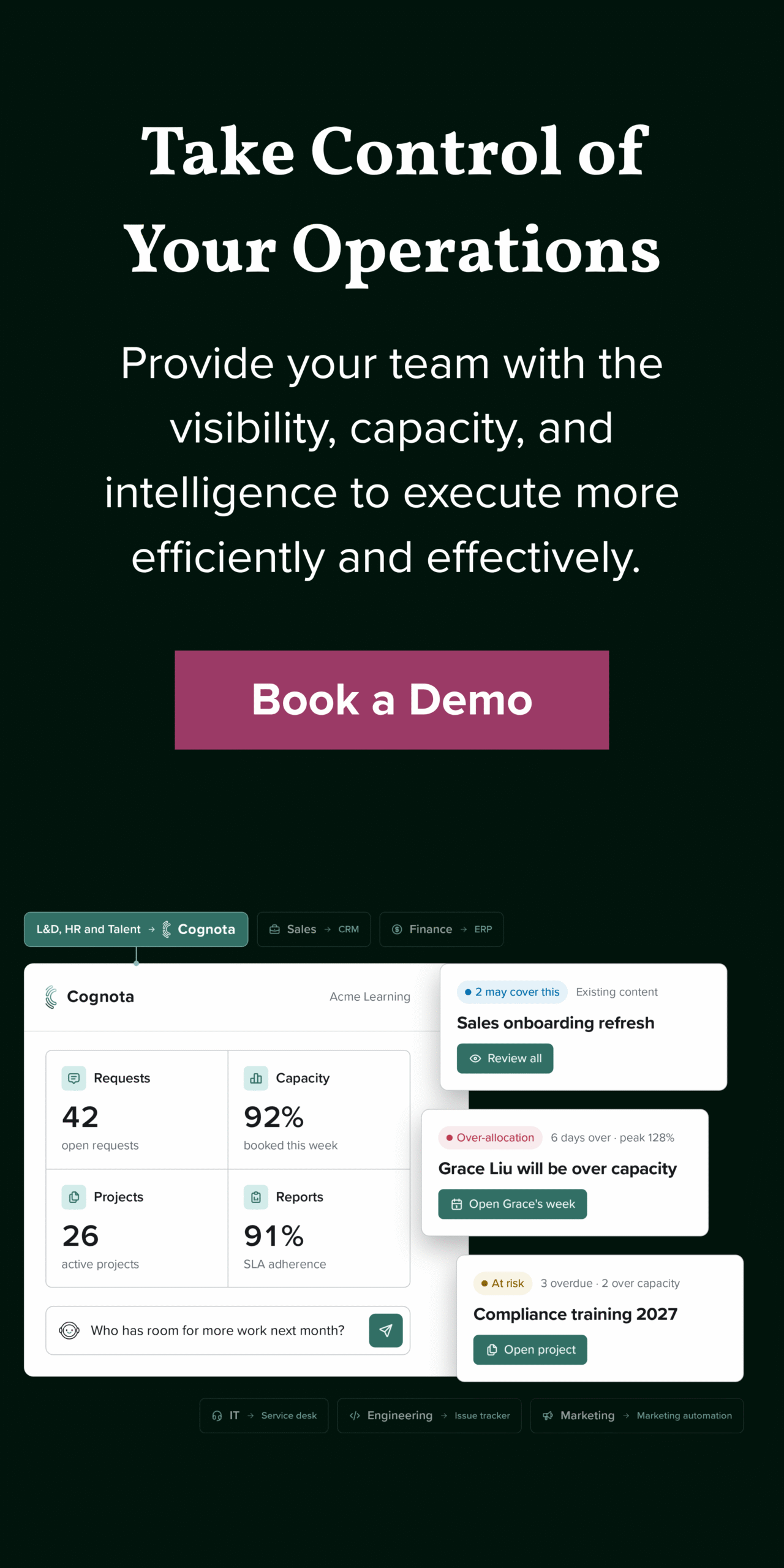
If you want to see what that operating layer can look like across intake, priorities, capacity, and cost, see Cognota in action through a personalized platform introduction.
What an enterprise learning operating model actually does
A strong operating model creates a clear path from a business need to a decision. It establishes a single front door for requests, common criteria for prioritization, visible ownership, and a shared view of commitments. It also makes trade-offs explicit. If the team accepts a new compliance initiative, leaders can see what planned work moves, what expertise is required, and whether outside support is needed.
This matters most in complex enterprises where learning demand comes from many directions: business units, HR, risk, sales enablement, leadership teams, and transformation programs. If each stakeholder has a different route into the team, the loudest request often wins. The operating model replaces volume and urgency with agreed rules.
It should not be confused with a system of record or a delivery platform. Those systems have their place. The operating model sits between business demand and delivery, giving People teams the visibility to lead and the signals to execute.
Build the model around five operating disciplines
Cognota’s operations framework follows five connected disciplines: Align, Plan, Execute, Measure, and Optimize. The sequence matters. Measurement cannot compensate for work that was never aligned to a business priority, and better execution cannot solve a plan that ignores available capacity.
Align work to business priorities
Alignment starts before a request is approved. Every request should capture enough context to support a decision: the business problem, audience, expected outcome, sponsor, deadline, risk of delay, and dependencies. A request for “manager training” is not yet a decision-ready demand. Is the issue new-manager readiness, inconsistent performance conversations, a regulatory requirement, or a leadership pipeline concern? The answer changes the work.
Leaders also need a governing forum with authority to resolve conflicts. That does not mean every request requires an executive committee. Routine work can follow predefined rules, while high-cost, high-risk, or cross-functional work receives more formal review. The right level of governance depends on the enterprise’s risk profile and pace of change.
Plan capacity, spend, and delivery risk together
Capacity planning is often reduced to a headcount calculation. That misses the point. The question is not only whether the team has hours available. It is whether those hours are going toward the highest-impact work and whether the team has the right mix of design, program management, subject matter expertise, technology support, and stakeholder access.
A useful plan shows committed work, unallocated capacity, planned spend, and delivery risk in the same view. This lets leaders make choices early. They may sequence initiatives differently, simplify a request, shift work to a specialist, or use vetted external expertise for a time-sensitive need. The Assist™ Marketplace, for example, gives teams access to more than 3,000 vetted learning, talent, HR, and AI consultants when a capability gap would otherwise delay a priority.
Planning must account for uncertainty. A financial services organization facing a fixed regulatory deadline needs tighter contingency planning than a team developing an internal leadership experience with a flexible launch window. One model does not fit every portfolio, but every portfolio benefits from making assumptions visible.
Execute with clear roles and decision rights
Execution breaks down when ownership is implied rather than defined. Stakeholders assume L&D owns content accuracy. L&D assumes the business owns validation. A project manager may be accountable for the timeline but unable to secure decisions. The result is late rework that appears as a delivery problem, even though it began as a governance problem.
Define who requests, approves, funds, designs, reviews, and accepts each initiative. Then use consistent workflow rules for status updates, changes in scope, approvals, and escalations. This is especially important when AI contributes to work. Teams need one set of rules for people and AI, including where human review is required and who is accountable for the final decision.
A practical operating model does not burden teams with process for its own sake. It reduces the administrative work that keeps experienced practitioners from solving meaningful performance and capability problems.
Measure outcomes, not just activity
Completion rates, attendance, and satisfaction scores can be useful signals, but they are rarely sufficient evidence of value. Start with the outcome named in the request. If the initiative supports a new product launch, look for indicators related to readiness, adoption, sales confidence, or time to proficiency. If it supports manager effectiveness, agree on the behavior or business measure that should change and the owner responsible for validating it.
Not every initiative needs a complex evaluation design. The measurement approach should match the investment, risk, and strategic importance of the work. A small, recurring program may require light-touch feedback and operational data. A major transformation initiative may require baseline measures, stakeholder checkpoints, and a defined method for connecting learning to business results.
The operating model should also measure its own performance. Teams with a dedicated operations lead reported 34% faster delivery, 28% lower costs, and 39% higher stakeholder satisfaction in the 2026 Brandon Hall Group and Cognota Joint Research Report. Those findings do not guarantee the same result in every enterprise, but they reinforce a clear principle: operational ownership changes what a team can see and improve.
Optimize using the signals you already have
Optimization is where an operating model becomes a management system rather than a set of documented processes. Review demand patterns, bottlenecks, missed dates, rework, cost variance, and stakeholder feedback on a regular cadence. Then ask what is driving the signal.
For example, rising request volume may indicate a growing need for capability building. It may also reveal vague intake criteria, duplicate requests, or business partners using L&D as the default answer to non-learning problems. A missed deadline may point to insufficient capacity, but it could also reflect late sponsor decisions or unclear approval rights. The goal is not to report more data. It is to make better decisions from it.
Diagnose your current maturity before redesigning everything
The LearnOps® Maturity Model offers a practical way to assess where the team is today: Reactive, Managed, Strategic, Predictive, or Adaptive. Most teams begin in Reactive or Managed stages, where work is delivered through individual effort and local processes. That is not a failure. It is a realistic starting point for teams carrying heavy demand with fragmented tools.
Strategic teams connect their portfolio to enterprise priorities and manage capacity deliberately. Predictive teams use operational data to anticipate risk and demand. Adaptive teams continuously adjust decisions based on trusted signals across the workflow. Only 1% to 6% of teams reach the Adaptive stage, so it should be an aspiration, not a requirement for credibility.
The right next move depends on the gap. A reactive team should not begin with advanced forecasting. It may first need one intake process, a visible portfolio, and a regular prioritization meeting. A strategic team may be ready to improve cost visibility, scenario planning, or outcome measurement. Maturity improves through disciplined progress, not a wholesale redesign that overwhelms the people doing the work.
Make the operating model real in daily work
An operating model only earns trust when it helps people make decisions on a Tuesday afternoon. Start with a small number of non-negotiables: one path for requests, clear prioritization criteria, visible ownership, and a recurring portfolio review. Build from there as the team gains confidence in the data and the process.
The most effective learning leaders do not use operations to make their teams less human. They use it to protect the team from avoidable chaos and create more room for the work that changes performance. When demand, capacity, budget, and outcomes are visible in one place, L&D can stop defending activity and start leading the conversations that shape business growth.