If your learning team is under pressure to prove impact, move faster, and support more business change with the same headcount, the LMS vs learning operations debate is not academic. It is a budgeting, governance, and execution question. Many enterprise teams already have an LMS, yet still struggle with intake bottlenecks, unclear priorities, missed deadlines, and limited visibility into capacity and ROI. That is the gap learning operations is built to close.
Why the LMS vs learning operations conversation keeps coming up
For years, the LMS was treated as the center of the learning tech stack. That made sense when the primary challenge was delivering courses, tracking completions, and maintaining compliance records. But enterprise learning has expanded well beyond course administration.
Today, L&D teams are expected to support onboarding, manager effectiveness, change initiatives, leadership development, frontline enablement, skills strategies, and business transformation. The work behind those programs includes stakeholder intake, scoping, approvals, project management, vendor coordination, budget planning, resource allocation, and measurement. None of that disappears because content lives in an LMS.
This is where confusion starts. Leaders look at process problems and assume they have a usage problem with their LMS. In reality, they often have an operating model problem. The LMS is doing what it was designed to do. It is just not designed to run the business of learning.
What an LMS does well
An LMS is the delivery layer. It helps teams distribute training, manage enrollment, track learner activity, document completions, and support reporting tied to participation. In regulated industries like healthcare, financial services, insurance, and energy, that matters a great deal.
When the need is assigning training at scale, maintaining audit readiness, or providing learners with a place to access required content, an LMS is essential. It creates consistency in delivery and gives the organization a system of record for training activity.
That said, the LMS works best once decisions have already been made. Someone has approved the request. Someone has prioritized the initiative. Someone has staffed the work, managed the timeline, aligned stakeholders, and funded the effort. Those upstream and cross-functional decisions usually happen somewhere else, often across email, spreadsheets, meetings, and disconnected project tools.
What learning operations actually covers
Learning operations is the management system for how learning gets planned, executed, governed, and improved. It is the operating layer that sits between business demand and learning delivery.
In practical terms, learning operations includes how requests enter the team, how work is prioritized, how resources are assigned, how budgets are managed, how projects move through governance, and how outcomes are measured against business goals. It creates the structure that allows a learning function to act like an enterprise operation rather than a reactive service desk.
This distinction matters because most L&D pain points are operational before they are instructional. If leaders cannot see demand, they cannot prioritize. If they cannot see capacity, they overcommit. If they cannot track budgets and timelines, they cannot manage execution. If they cannot connect work to outcomes, they struggle to defend investment.
An LMS does not solve those issues because it was never meant to.
LMS vs learning operations: the clearest way to think about it
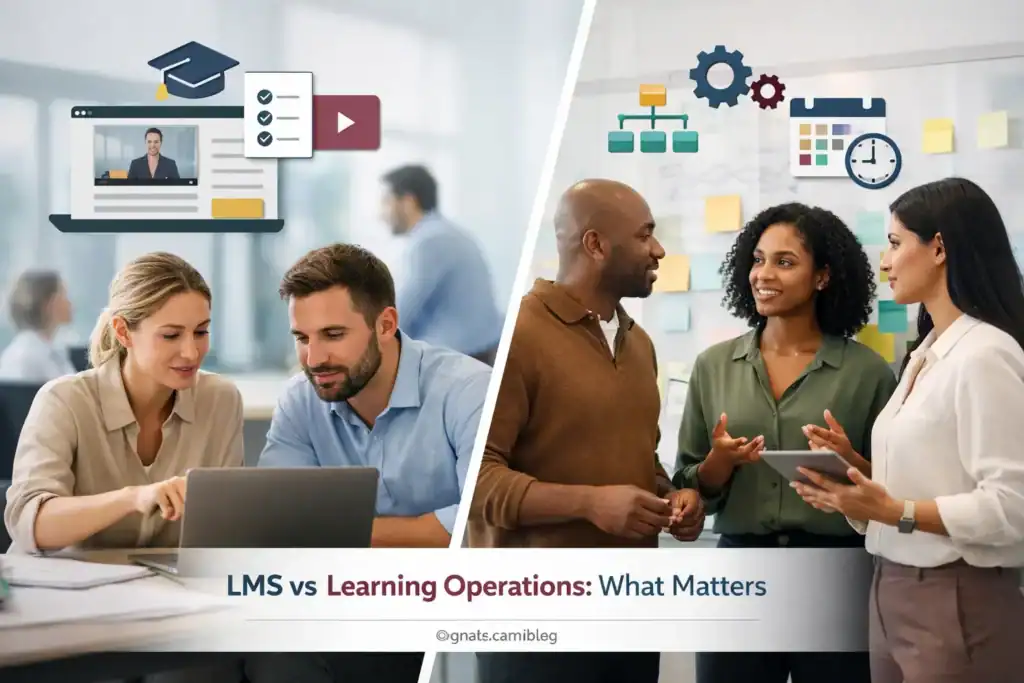
The simplest way to frame LMS vs learning operations is this: one manages learning delivery, the other manages learning execution.
The LMS answers questions like: Who completed the training? What content was assigned? When was it delivered? Learning operations answers a different set of questions: Why are we doing this initiative? Who approved it? What is the scope? Do we have the capacity to deliver it? What budget is attached? Is it on track? Did it create business value?
Enterprise teams need both, but they should not expect them to do the same job.
That is the core objection many learning leaders have to work through internally. “We already have an LMS” sounds reasonable until you map the actual workflow of the team. Once you do, it becomes obvious that the LMS covers only one portion of the lifecycle. The rest of the work is operational, and if it is unmanaged, performance suffers no matter how strong the content strategy is.
Where enterprise teams feel the gap first
In smaller organizations, informal coordination can carry a team for a while. In larger enterprises, that breaks down fast. Volume increases. Stakeholders multiply. Compliance requirements tighten. Business leaders expect clearer prioritization and faster turnaround. Suddenly the team needs governance, not just goodwill.
The first signs are usually familiar. Intake requests come in from everywhere. Teams cannot confidently say what is in flight, what is blocked, or what should come next. Budget conversations happen too late. Vendor work is hard to track. Leaders ask for metrics beyond completions, and the team scrambles to assemble a story from disconnected systems.
At that point, investing only in the delivery layer creates diminishing returns. You may improve the learner experience while leaving the operating model unchanged. That helps at the margins, but it does not create execution intelligence.
Why this matters more now
Learning teams are being asked to do more with fewer resources. That is not a temporary talking point. It is the operating reality across enterprise L&D. Headcount is constrained, transformation work is growing, and expectations from the business are rising.
Under those conditions, efficiency is not enough. Teams need better decision-making. They need to know which requests align to business strategy, which work should be outsourced or flexed, where bottlenecks sit, and which initiatives are worth scaling. That requires a different level of operational maturity.
Learning operations creates that maturity by making work visible, measurable, and manageable. It gives leadership a way to move from reactive execution to disciplined planning. And it helps the learning function speak the language executives care about: capacity, cost, speed, risk, and return.
When an LMS is enough, and when it is not
If your environment is relatively simple, your training demand is predictable, and your main requirement is course delivery and completion tracking, an LMS may be enough for now. That is especially true if your team has low project complexity and limited stakeholder variation.
But once your learning function supports multiple business units, high-volume request intake, complex governance, or a mix of internal and external delivery resources, the operational layer becomes far more important. The more strategic the work, the less likely an LMS alone will support it.
This is especially true in regulated and matrixed enterprises. In those environments, learning is rarely just about publishing content. It is about coordinating people, processes, approvals, budgets, and outcomes across many stakeholders. That is an operations challenge.
The better question is not LMS or learning operations
The strongest enterprise strategy is not choosing one over the other. It is understanding how they work together.
An LMS should remain the system that supports delivery, access, and completion tracking. Learning operations should become the system that governs intake, planning, workflow, resourcing, budget management, and performance measurement. When both layers are in place, the learning function can execute with more control and report with more credibility.
That is why the category shift matters. LearnOps reframes the learning team as an operation with inputs, constraints, workflows, and measurable outputs. It gives leaders a model for aligning learning to business strategy instead of treating every request as equal.
For organizations that have reached the limits of spreadsheet-driven coordination, this shift is often the difference between appearing busy and demonstrating value.
A practical test for your team
If you want to assess where you stand, look beyond the learner experience and ask operational questions. Can you see all incoming demand in one place? Can you prioritize work based on business value? Do you know your team’s real capacity before committing to timelines? Can you track budget, vendor usage, and project status without manual reconciliation? Can you show how major initiatives contribute to business outcomes, not just completions?
If the answer is no to several of those questions, the issue is probably not your LMS. It is your operating model.
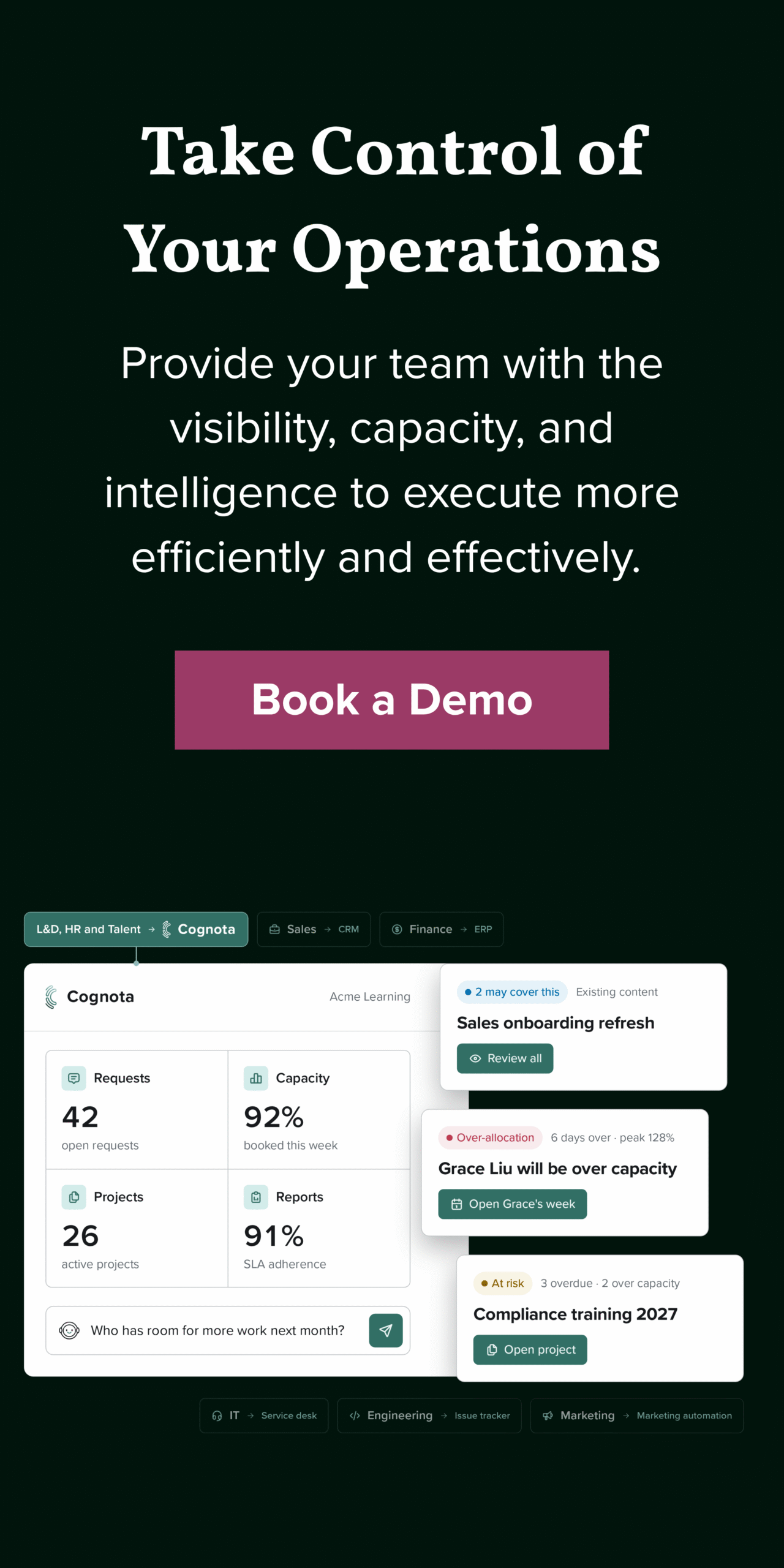
That is where platforms built for learning operations come in. Cognota, for example, is designed to serve as the operational backbone for enterprise learning teams, sitting between HR systems and the LMS to manage the work that determines whether learning can scale effectively.
The most useful shift for learning leaders is this: stop asking whether the LMS should do more, and start asking what kind of operating system your team needs to perform like a business-critical function. When the pressure is high and resources are tight, that question tends to produce much better answers.