A growing enterprise does not simply need more learning. It needs a learning operation that can absorb more requests, more stakeholders, and more strategic change without turning every priority into an emergency. That is the real challenge behind how to scale learning teams: increasing capacity while protecting quality, accountability, and business alignment.
For many L&D leaders, demand grows faster than headcount. A new product launch needs enablement. A regulatory change requires role-based learning. Leaders want manager development, AI adoption support, and clearer evidence of impact. The team responds by working harder, but heroic effort is not a scaling strategy. It creates bottlenecks, hides trade-offs, and makes it harder to show leadership where resources are actually going.
Scaling requires an operating model, not just additional people or another point solution. The strongest teams build capacity, execution, and intelligence together.
Start by defining what scale means for your team
Scale is not synonymous with volume. A team can produce more learning assets and still become less effective if work arrives without prioritization, projects lack ownership, or leaders cannot see how resources connect to outcomes.
Start with the questions that expose the real constraint. Is demand exceeding available design and delivery capacity? Are business partners submitting incomplete requests? Are projects delayed because approvals happen informally? Is the team unable to distinguish high-value work from low-value work? Or is the issue measurement, where the team has activity data but no credible view of business impact?
The answer matters because each problem calls for a different intervention. Hiring may help a genuine capacity shortfall. It will not fix an intake process that allows every request to become urgent. Automation can reduce administrative work, but it cannot decide which initiatives deserve investment.
The LearnOps® Maturity Model offers a practical diagnostic lens. Reactive teams tend to manage work through inboxes, meetings, and individual effort. Managed teams establish repeatable processes. Strategic teams connect priorities and investments to business goals. Predictive and Adaptive teams use operational and performance intelligence to anticipate demand and continuously improve. The goal is not to jump levels overnight. It is to identify the discipline that will remove the next meaningful constraint.
How to scale learning teams through demand governance
Most learning teams do not have a demand problem. They have a visibility and prioritization problem.
When requests arrive through email, chat, and executive conversations, the work pipeline becomes fragmented. The loudest stakeholder can receive attention before the most consequential business need. Team members spend time clarifying scope after work has begun, and leaders have no dependable way to explain why one initiative moved ahead of another.
A structured intake process changes that dynamic. It should capture the business problem, target audience, desired outcome, sponsor, timing, dependencies, and level of effort required. This is not bureaucracy for its own sake. It gives the learning team enough information to make an informed decision before committing scarce resources.
Then establish a consistent prioritization process. Consider strategic alignment, risk, audience reach, expected business value, effort, and deadline credibility. Not every request needs a complex scoring model. But every request should be evaluated against the same criteria, with decisions visible to the people affected by them.
This creates an essential leadership behavior: saying not now, not this way, or not with current capacity. A mature learning operation does not treat those responses as failures. It treats them as responsible resource management.
Plan capacity before projects become commitments
Capacity planning is where scale becomes tangible. Leaders need to know not only how many projects are active, but what work each initiative requires and whether the right people have time to do it.
That means moving beyond a list of projects. Break work into meaningful phases such as discovery, design, development, review, launch, and measurement. Account for the roles involved, including learning strategists, instructional designers, subject matter experts, program managers, and reviewers. Include non-project work as well: stakeholder meetings, maintenance, governance, reporting, and unexpected requests all consume capacity.
The trade-off is clear. Highly detailed plans can become difficult to maintain, while overly broad plans fail to reveal risk. Most enterprise teams benefit from planning at a level that supports resourcing decisions without asking people to track every hour of their week.
Capacity planning also makes one of the most difficult conversations easier: whether to build internally, defer work, simplify scope, or bring in specialized support. External capacity can be valuable when demand spikes or a project requires expertise the team does not need year-round. It should extend an intentional plan, not mask a permanently overloaded operation.
Standardize execution without forcing every project into the same mold
Learning work is inherently variable. A high-risk compliance initiative should not follow the exact same path as a small manager resource. Yet teams still need a common operating rhythm.
Define the stages that every initiative must pass through, the decisions required at each stage, and who owns them. Clarify when stakeholders provide input, when they approve, and what happens when scope changes. This creates governance that is visible without becoming burdensome.
The LearnOps® framework is useful here because it treats execution as one discipline within a connected system: Align, Plan, Execute, Measure, and Optimize. Teams often focus on execution because it is where work is most visible. But execution improves dramatically when alignment and planning happen before production begins.
Standardization should focus on the repeatable mechanics of work, not the creative judgment within it. Teams need room to tailor experiences to audience needs and business context. They do not need to reinvent how a request is approved, how a project owner is assigned, or how risks are escalated.
Build a measurement system leaders can use
Scaling without measurement only scales uncertainty. If leadership sees completion activity but cannot see how learning investment supports a business priority, L&D remains vulnerable when budgets tighten.
Start with a line of sight from each initiative to the outcome it is intended to influence. Depending on the work, that may be faster proficiency, reduced error rates, stronger manager capability, improved adoption of a business change, or reduced operational risk. Learning is rarely the only factor affecting those outcomes, so avoid overstating causality. The objective is credible contribution, supported by evidence.
Operational metrics matter, too. Track demand volume, cycle time, workload distribution, project status, budget use, rework, and stakeholder response times. These measures show whether the operating model is becoming more efficient and where friction persists.
The most useful dashboards serve two audiences. Executives need a concise view of investments, priorities, risks, and outcomes. Learning leaders need enough detail to rebalance work, improve processes, and intervene before delivery issues become business issues.
Use technology as the operations layer
Fragmented tools are a hidden tax on learning teams. When intake, planning, project tracking, financial visibility, and reporting live in separate places, people spend too much time reconciling information and too little time making decisions.
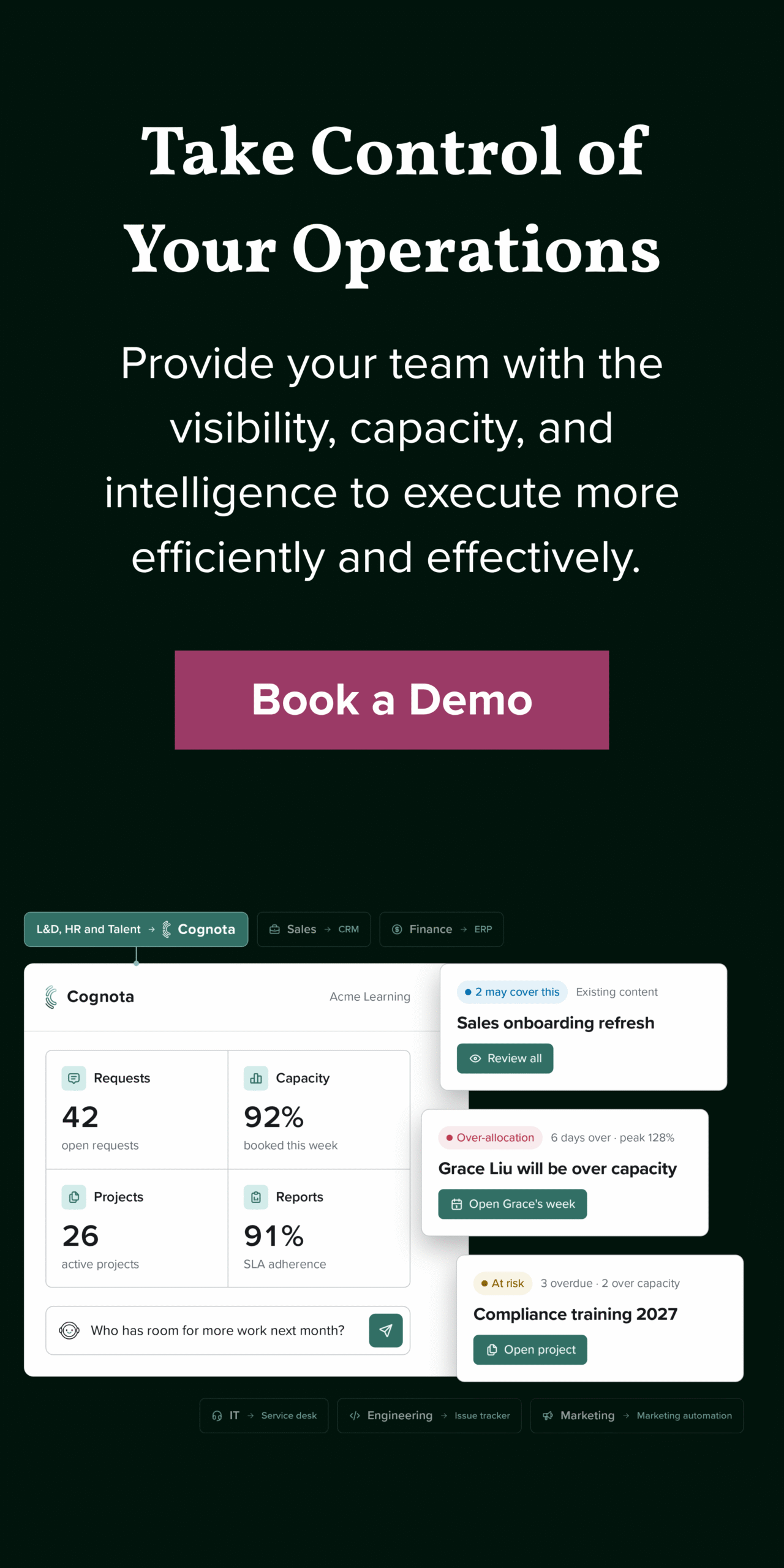
The right operational infrastructure creates a shared source of truth for demand, work, capacity, and performance. It should help teams govern the work around learning, rather than adding another destination that requires manual upkeep. Cognota is designed for this role as a LearnOps® platform, bringing the operational disciplines of enterprise learning into one connected environment.
Technology alone will not create maturity. If priorities are unclear, a platform will expose that problem rather than solve it. That visibility is valuable. It gives leaders a factual starting point for improving how the team aligns, plans, executes, measures, and optimizes.
Treat scaling as a leadership practice
The teams that scale well do not wait for a breaking point to change how they operate. They make demand visible, protect capacity, set clear decision rights, and use evidence to improve the next cycle of work.
The practical next step is to identify one recurring source of friction that consumes disproportionate time. It may be unqualified intake, unclear ownership, overloaded specialists, or weak outcome measurement. Fixing that constraint will not solve everything at once. It will create the operational confidence your team needs to take on the next level of demand with purpose rather than panic.