A learning program can have high completion rates and still be underutilized. If the same teams repeatedly request support while priority populations do not engage, or if valuable content sits unused while new work keeps entering the queue, utilization is telling you something completion data cannot.
Knowing how to measure learning utilization gives L&D leaders a clearer view of whether learning investments are reaching the right audiences, using the right level of capacity, and supporting business priorities. It moves the conversation beyond activity counts to operational decisions: What should we scale, redesign, retire, or stop building?
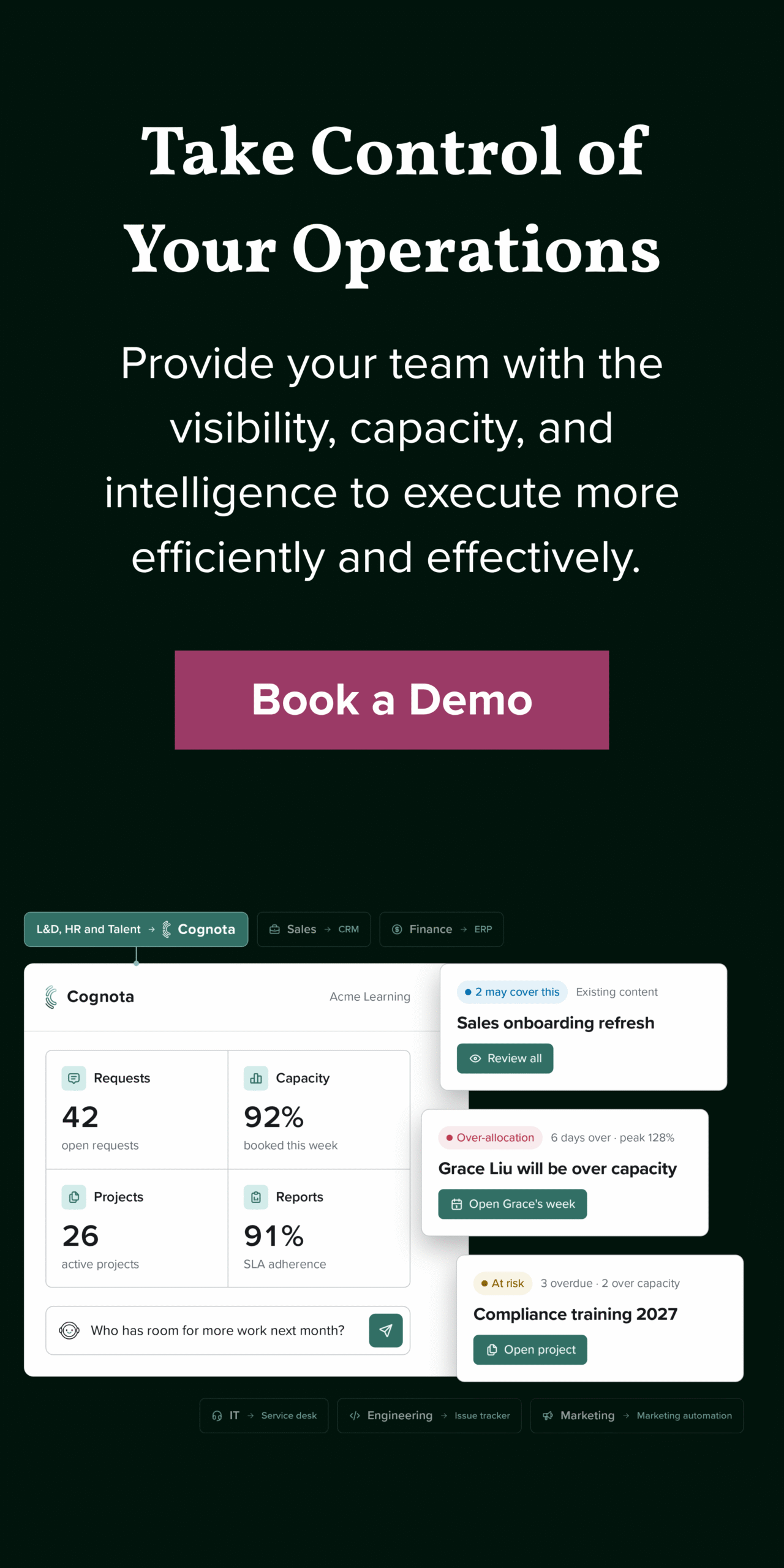
For enterprise learning teams managing competing demands, utilization is a Measure discipline within the LearnOps® framework. It is also a bridge to Optimize. When leaders can see where learning demand, delivery, and application diverge, they can direct capacity toward work that produces greater business value. To see how Cognota brings this operational view into one workflow, see Cognota in action.
Define learning utilization before you measure it
Learning utilization is not one metric. It is the degree to which learning resources are used by their intended audiences and put to work in support of a defined business need.
That definition includes two related but distinct questions. First, are employees using the learning experience? Second, is the learning organization using its own people, budget, vendors, and production capacity effectively? A program may have strong learner utilization but require disproportionate effort to maintain. Conversely, a leanly produced program may be poorly adopted because it was not aligned to a real performance need.
Measure both perspectives. Otherwise, teams risk optimizing for the easiest signal – enrollments or completions – while missing the operational constraints that limit impact.
A practical utilization rate begins with a clear denominator:
Learning utilization rate = number of intended users who meaningfully engaged / number of intended users with a relevant need and access
The phrase “meaningfully engaged” matters. For a required policy module, it may mean completion by a deadline. For a manager enablement series, it may mean attending a session, practicing a new skill, and using it in a defined workflow. For a performance support asset, it may mean repeat use at the point of need. The right definition depends on the initiative’s purpose.
Measure utilization across four dimensions
A single percentage cannot explain whether learning is working. Enterprise teams need a small set of connected measures that reveal adoption, relevance, operational efficiency, and application.
1. Audience reach and adoption
Start with the intended audience, not the broadest population available. Segment by role, business unit, geography, manager level, tenure, or risk group when those differences affect the need for learning.
Track enrollment, attendance, starts, completions, repeat participation, and time to engagement. These metrics show whether the program reached the people it was designed to serve. They are particularly useful for identifying friction: a low enrollment rate may signal weak manager sponsorship or poor targeting, while a high enrollment rate paired with low completion may indicate a scheduling or experience problem.
Do not treat participation as proof of value. It is evidence of access and initial relevance, not performance change.
2. Consumption quality and relevance
Utilization improves when employees can find learning when it is useful and see why it applies to their work. Look at engagement depth rather than only course starts. Depending on the experience, that may include session attendance, assessment attempts, practice completion, use of supporting assets, return visits, or progression through a learning path.
Qualitative signals belong here too. Ask learners and managers whether the learning addressed a real work challenge, whether the level was appropriate, and what prevented use. Short, structured feedback collected near the experience is more actionable than an annual satisfaction score.
This is where a common trade-off emerges. Highly targeted learning may serve a smaller audience but have greater relevance and stronger application. Broad programs can generate impressive reach but offer limited value if they are too generic. Utilization should be judged against the strategic intent of the initiative, not against a universal benchmark.
3. Capacity and cost utilization
Learning utilization also applies to the operating model behind the experience. Leaders should understand how much demand is entering the function, what work is being accepted, and where capacity is being consumed.
Measure planned versus actual effort across discovery, design, development, facilitation, quality review, and program management. Compare resource allocation with portfolio priority, budget consumption, cycle time, rework, and work in progress. These measures reveal whether the team is spending its limited capacity on the work that matters most.
For example, a learning team may discover that a small number of custom requests consume most design capacity while serving narrow audiences. That does not automatically mean those requests should be declined. Some may support high-risk or high-value business outcomes. But the trade-off becomes visible, allowing leaders to make a deliberate portfolio decision instead of reacting to the loudest request.
4. Application and business contribution
The strongest utilization measures show whether people apply learning in the workflow it was meant to improve. Define the expected behavior before the initiative launches, then gather evidence from managers, operational data, observation, quality measures, or performance indicators.
The evidence should match the initiative. A sales enablement program may examine use of a new conversation framework and changes in opportunity quality. A healthcare learning initiative may focus on adherence to a process and reduced errors. A leadership program may look for improved coaching cadence, internal mobility, or team engagement.
Avoid claiming direct causation when multiple factors influence business results. Instead, use a credible contribution story: the priority, the intervention, the adoption level, the observed behavior change, and the related business signal. This gives executive stakeholders a more honest and useful view of learning’s role.
Build a measurement plan at intake
Utilization is hardest to measure after delivery, when the target audience and success criteria were never clearly documented. The right time to establish measurement is when a request enters the learning portfolio.
For each initiative, capture the business problem, intended audience, desired behavior, expected reach, delivery approach, owner, and baseline data. Then agree on the few measures that will determine whether the work should be expanded, improved, sustained, or retired.
This approach strengthens the Align and Plan disciplines of LearnOps®. It forces a productive conversation before capacity is committed: Is learning the right response? Who specifically needs it? What will change if it works? What evidence can the business reasonably provide?
Gartner and other leading workplace research firms have consistently emphasized the need for learning leaders to connect development activity to changing business needs and skills. The operational implication is straightforward: measurement cannot be an end-of-project reporting exercise. It must be designed into prioritization, resource planning, and execution.
Create a utilization scorecard leaders can use
A useful scorecard does not overwhelm stakeholders with every available data point. It makes patterns visible and supports decisions. Review it monthly or quarterly at the portfolio level, and use initiative-level views for high-priority work.
Include at least these four areas:
- Demand and alignment: request volume, strategic alignment, target audience size, and priority level.
- Learner adoption: reach, enrollment, completion, time to engagement, and participation by key segment.
- Operating efficiency: planned versus actual effort, budget use, cycle time, rework, and capacity allocation.
- Application and outcomes: behavior adoption, manager validation, operational indicators, and the confidence level of the evidence.
Use thresholds carefully. A 70% completion rate may be concerning for a required compliance experience and perfectly reasonable for optional development aimed at a specialized audience. Trend lines, audience segments, and comparisons to the initiative’s original assumptions are usually more valuable than a universal target.
Turn underutilization into an operating decision
Underutilization is not simply a communications problem. It may reflect misaligned demand, unclear audience definition, weak manager reinforcement, inaccessible timing, an experience that does not fit the workflow, or a solution that should not have been built in the first place.
When utilization is low, investigate before relaunching. Compare the intended audience with actual participants. Review the intake assumptions. Speak with managers who did and did not reinforce the learning. Examine whether employees had time and a practical opportunity to apply the skill. Then decide whether to redesign the experience, change the rollout, narrow the audience, add reinforcement, or redirect resources elsewhere.
Teams at the Reactive stage of the LearnOps® Maturity Model often report activity after the fact because fragmented processes make connected measurement difficult. Managed and Strategic teams establish consistent intake, portfolio governance, and shared metrics. Predictive and Adaptive teams use those signals to anticipate demand, allocate capacity intelligently, and continually improve performance.
The goal is not to make every learning asset more popular. It is to ensure that enterprise learning capacity is directed toward work employees can use and the business can recognize. When utilization is measured as an operational signal rather than a vanity metric, L&D gains the evidence needed to make better choices before the next request becomes another urgent project.