
A delayed learning launch rarely starts with a missed deadline. More often, it starts earlier: a stakeholder request arrives without a clear brief, an external partner is engaged before capacity is understood, and nobody has agreed on what business outcome will define success. A disciplined vendor management strategy prevents those problems from becoming the operating model.
For enterprise learning and talent teams, vendors can expand specialized capability at exactly the right moment. They can also create fragmented workflows, unclear ownership, duplicated spend, and difficult conversations about value. The difference is not whether a team uses external partners. It is whether the team manages those partnerships as part of its operating system.
Vendor management is not procurement administration with a learning label. It is a strategic discipline that connects demand, internal capacity, partner capability, delivery governance, and measurable business impact. When those connections are missing, even strong vendors are set up to underperform.
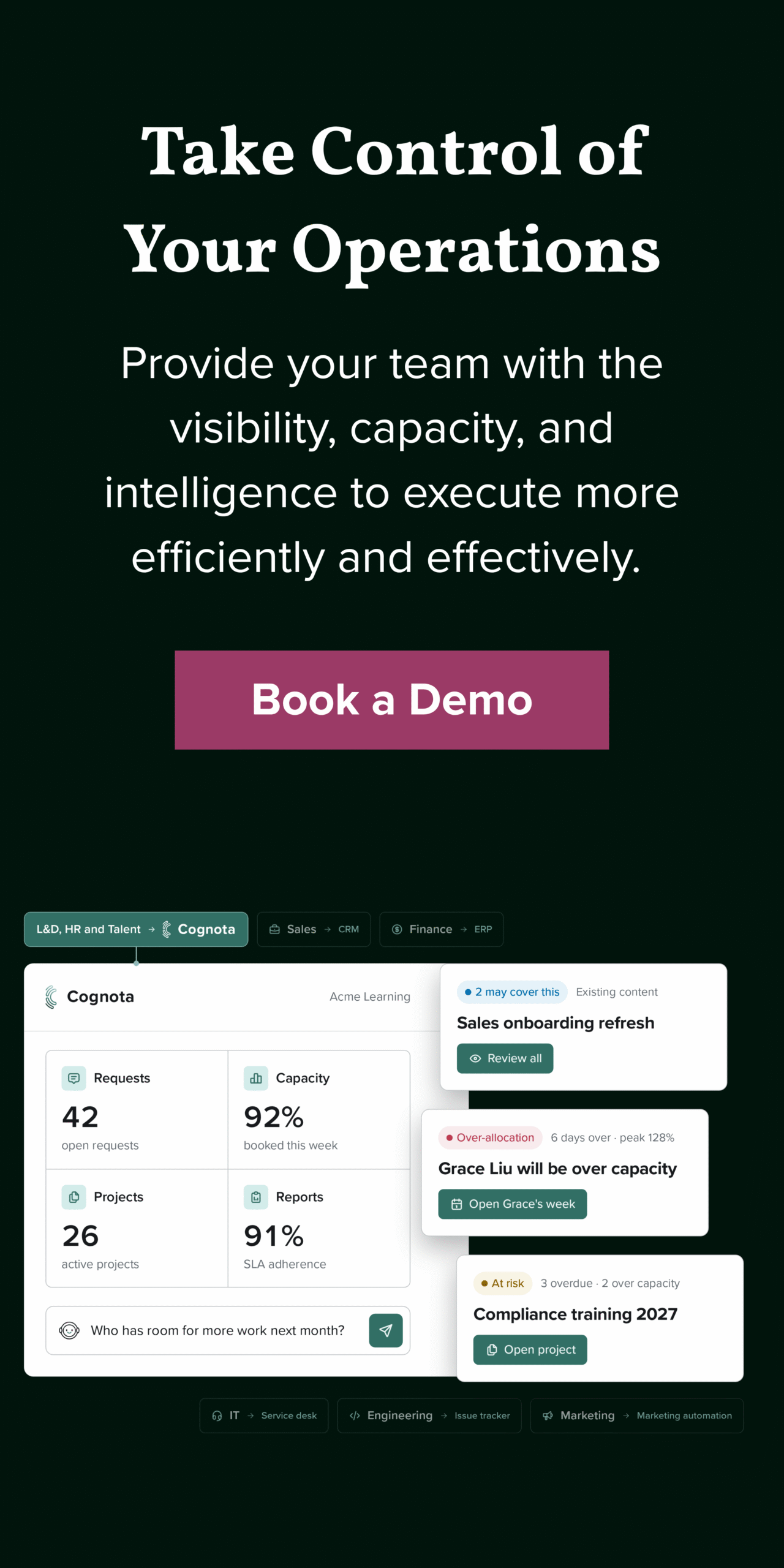
See Cognota in action to explore how a LearnOps® operating model can bring vendor work, internal work, budgets, and business priorities into one connected view.
Start With the Work, Not the Vendor
The most common mistake in vendor management is beginning with a supplier conversation instead of a business need. A senior leader asks for a new program, the team identifies a partner it trusts, and execution begins before the request has been properly assessed. This feels fast. It often creates rework.
Start by defining the work in operational terms: the audience, the business problem, the desired behavior or performance change, the deadline, the required expertise, and the constraints. Just as importantly, identify what the internal team can realistically absorb. A vendor should fill a deliberate capability or capacity gap, not become the default answer to an unclear request.
This is where the Align and Plan disciplines in the LearnOps® Framework matter. Alignment ensures the initiative supports a business priority rather than simply responding to the loudest request. Planning establishes the people, budget, sequencing, and decisions required before external work begins.
There is a trade-off. Too much upfront definition can slow a genuinely urgent response. But urgency does not eliminate the need for clarity. It raises the cost of getting the brief wrong. For time-sensitive work, establish a minimum intake standard rather than skipping intake altogether.
Design a Vendor Management Strategy Around Decisions
A vendor management strategy should make ownership visible at every point where a decision affects cost, quality, timing, or risk. If a team cannot quickly answer who can approve scope changes, who owns stakeholder feedback, or who validates outcomes, the vendor relationship will eventually absorb that ambiguity.
The goal is not to add layers of governance. It is to reduce the coordination burden on learning leaders and partners. Clear decisions make it easier for vendors to deliver their best work because they know what is fixed, what is flexible, and when escalation is appropriate.
Establish one accountable relationship owner
Every strategic vendor needs a named internal owner with authority to coordinate the relationship. This person does not need to execute every project or approve every invoice. They do need a complete view of performance, demand, contracts, active work, and upcoming needs.
Without this role, different business units may engage the same provider independently, each with different expectations and measures of success. The organization loses negotiating leverage, institutional knowledge, and a reliable picture of total spend.
The relationship owner should work closely with project leads, finance partners, and business sponsors. Their role is to see patterns that individual project teams cannot: recurring scope creep, uneven quality, overreliance on a niche partner, or a growing demand area that may justify building internal capability.
Separate partner selection from project approval
A preferred vendor is not an automatic approval for every request. Selection answers whether a provider is qualified and appropriate for a category of work. Project approval answers whether a specific initiative deserves investment now.
That distinction protects both sides. It prevents teams from forcing work toward a familiar partner simply because the relationship already exists. It also avoids repeatedly evaluating a proven provider from scratch when the business need is clear.
Use consistent criteria for selection, including subject-matter capability, experience with comparable enterprise complexity, responsiveness, delivery quality, commercial fit, and capacity. Then evaluate each project based on strategic alignment, expected impact, internal readiness, budget, and timing.
Define the operating cadence before delivery starts
A kickoff meeting is not a governance model. Strategic vendor relationships need a predictable rhythm for project-level status, issue escalation, performance discussions, and forward planning.
For an active project, a short recurring review may be enough to confirm progress against milestones, decisions needed, changes in scope, and risks to delivery. For the broader relationship, quarterly conversations should focus on trends: demand forecasts, resource availability, performance across projects, innovation opportunities, and areas where the partnership is creating unnecessary friction.
The right cadence depends on volume and criticality. A vendor supporting one limited initiative does not need the same level of oversight as a partner embedded in multiple high-priority programs. Match governance to the operational risk, not to a generic policy.
Measure What the Partnership Contributes
On-time delivery and stakeholder satisfaction matter, but they are incomplete measures. They indicate whether a vendor completed work well, not whether the work advanced a meaningful business outcome.
A stronger approach connects vendor performance to three dimensions: capacity, execution, and intelligence. Capacity asks whether the partnership gave the team the right expertise or production bandwidth when needed. Execution asks whether work moved through defined stages with quality, predictability, and controlled change. Intelligence asks whether the team can see the cost, impact, and lessons from vendor-supported work well enough to make better future decisions.
This does not mean every project requires a complex attribution model. Some initiatives will have direct performance measures, while others will rely on leading indicators such as manager adoption, proficiency gains, or process adherence. The standard should be proportional to the investment and business importance of the work.
At minimum, teams should be able to assess whether a vendor delivered against agreed scope, timeline, budget, quality standards, and outcome measures. They should also capture why deviations occurred. A missed milestone caused by late stakeholder feedback is a different management issue than a missed milestone caused by a supplier capacity problem.
Build a Portfolio, Not a Collection of Suppliers
High-performing learning organizations do not treat every vendor relationship as isolated. They manage a portfolio of partners across core capabilities, specialized expertise, and surge capacity.
A small number of strategic partners can create consistency and reduce the effort of sourcing and onboarding for recurring work. At the same time, concentrating too much work with one provider can introduce dependency and limit access to new ideas. A balanced portfolio keeps trusted relationships strong while preserving flexibility for emerging needs.
The Cognota Assist™ Marketplace model reflects an important operational principle: teams need access to vetted expertise without turning every capacity gap into a long-term structural commitment. For learning leaders, the question is not simply, “Do we have a vendor?” It is, “Can we assemble the right capability at the moment business demand requires it?”
This is particularly valuable when demand is uneven. A team may need specialized design, change support, facilitation, content production, or learning technology expertise for a defined period. External capacity can protect internal teams from burnout and prevent priority work from being delayed, provided the work is governed inside the same operating model.
Use Vendor Data to Improve the Whole Function
Vendor management becomes strategic when the data informs decisions beyond the individual relationship. Over time, patterns in project demand, partner performance, spend, and delivery effort reveal where learning operations need attention.
For example, frequent external requests for the same capability may indicate a case for internal skill development or a dedicated center of expertise. Repeated late-stage changes may point to weak intake and stakeholder alignment rather than a vendor quality issue. High satisfaction with low business impact may show that teams are optimizing for service experience instead of performance outcomes.
These insights help learning leaders progress from reactive operations toward the Strategic, Predictive, and Adaptive stages of the LearnOps® Maturity Model. The progression is not about adding bureaucracy. It is about making better choices earlier, with a clearer understanding of demand, capacity, execution, and impact.
A well-run vendor relationship should make the learning function more capable, not more dependent. When partners are connected to clear priorities, accountable workflows, and meaningful measures, they become an extension of the team’s ability to deliver. That is the standard worth building toward.