
Learning capacity trends are no longer a side conversation for enterprise L&D leaders. They are showing up in intake backlogs, delayed launches, overloaded subject matter experts, and teams that are asked to support more transformation work with flat or shrinking resources. The issue is not simply whether a learning team has enough people. It is whether it can see demand early enough, prioritize it with business leaders, and make disciplined decisions about where capacity should go.
For organizations in regulated, fast-changing industries, the stakes are especially high. A new product rollout, policy change, system adoption, or leadership initiative can generate learning demand across multiple business units at once. When requests arrive through email, meetings, and informal channels, leaders are left reacting to volume rather than managing a portfolio of work.
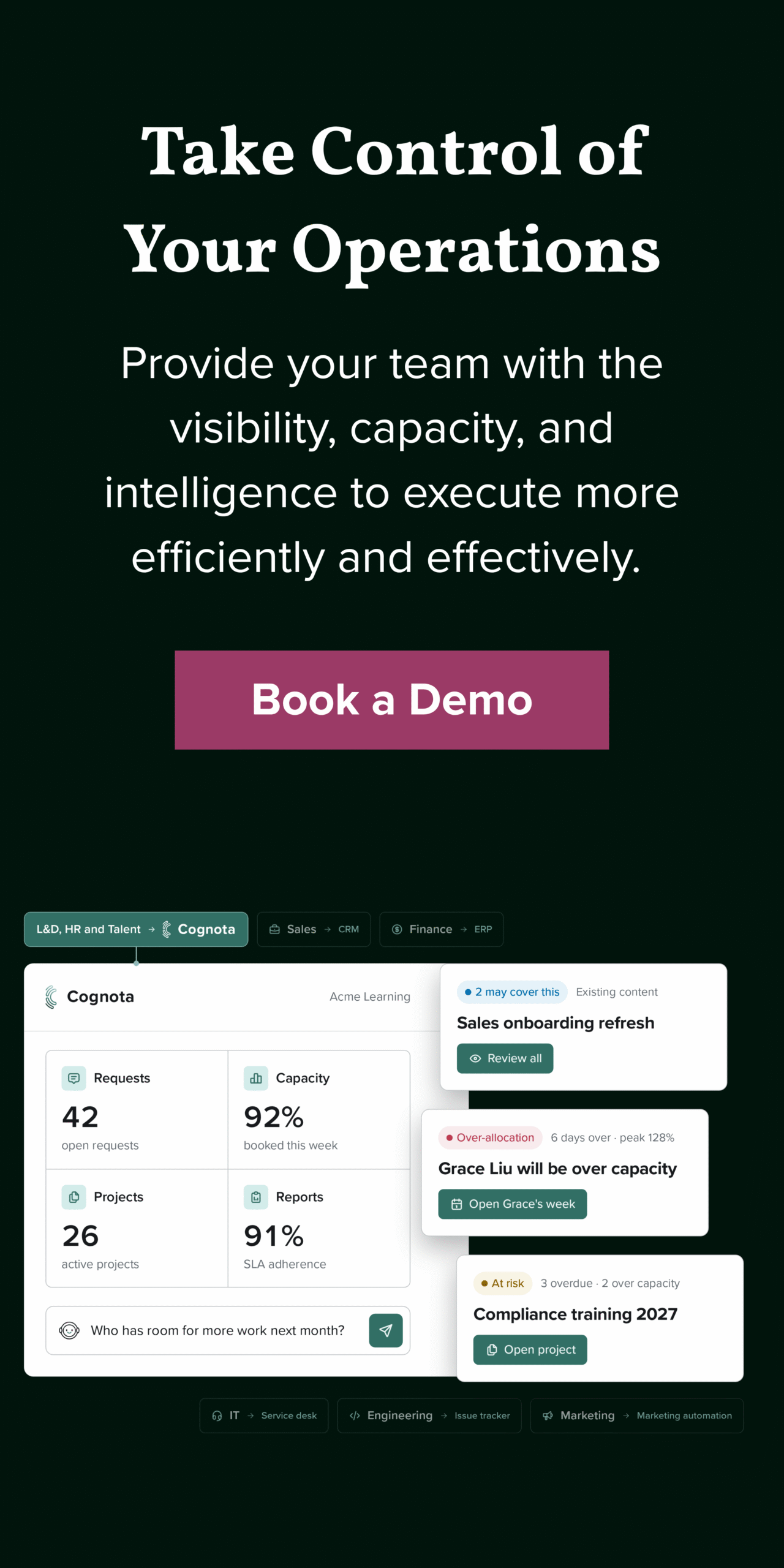
That is why capacity deserves an operating model, not a heroic effort. To see how a LearnOps® platform can bring demand, workflows, resources, and business priorities into one operating view, see Cognota in action.
The Learning Capacity Trends Reshaping Enterprise L&D
The most consequential shift is that demand is becoming less predictable while expectations for speed are rising. Learning teams are being pulled into workforce transformation earlier, which is a positive sign of strategic relevance. But without a stronger planning discipline, earlier involvement can also mean more requests, more revisions, and more competing priorities.
At the same time, leaders are moving beyond simple headcount questions. They want to understand the full capacity picture: internal team availability, specialist skills, review cycles, stakeholder dependencies, budget constraints, and the work that must be paused for a higher-priority initiative. This is a more useful conversation than asking whether the team is busy. Most L&D teams are busy. The business needs clarity on whether the right work is moving at the right pace.
1. Demand management is becoming a leadership capability
A centralized intake process is increasingly foundational because it turns scattered requests into visible demand. The value is not bureaucracy for its own sake. It is the ability to ask consistent questions before work begins: What business outcome is at stake? Who owns the decision? What audience is affected? What happens if this work is delayed? What resources and approvals will it require?
Without that information, every request can appear urgent. With it, L&D leaders can compare initiatives on strategic value, risk, reach, timing, and effort. The result is a more credible partnership with business stakeholders because trade-offs are visible rather than hidden inside a team’s workload.
This is also where many organizations discover that capacity problems are actually prioritization problems. A team may have sufficient resources for the highest-value work, but not for every work request that has accumulated over a quarter. Saying yes to everything is not responsiveness. It is a decision to dilute impact.
2. Skill-based capacity matters as much as total capacity
A capacity plan built only on total hours can create false confidence. Two hundred available hours from generalist instructional designers do not solve a need for compliance expertise, video production, learning data analysis, or a facilitator with deep product knowledge. Enterprise learning portfolios increasingly require a mix of specialized capabilities that are difficult to staff evenly throughout the year.
This is driving a shift from static team models toward more flexible capacity strategies. Internal teams should retain the strategic context, governance, and institutional knowledge that matter most. But there are periods when access to vetted external specialists is the practical way to protect timelines without permanently expanding headcount.
The trade-off is real. External support can add capacity quickly, but it still requires clear briefs, quality standards, ownership, and review processes. If the operating model is unclear, adding more people can create more coordination work. Capacity expands most effectively when work is well-defined and decision rights are clear.
3. AI increases the need for operational discipline
AI is changing expectations for how quickly learning teams can produce, analyze, and iterate. It can reduce effort on certain tasks and help teams move from manual administrative work toward higher-value design and advisory work. But AI does not remove the need to manage demand, align stakeholders, or validate quality.
In fact, faster content creation can expose bottlenecks elsewhere. If development accelerates but approvals still take weeks, cycle time will not improve much. If teams create more assets but cannot connect them to a business objective or measure their effect, the organization may simply produce more activity.
The practical question for L&D leaders is not, “Where can we use AI?” It is, “Which constraints are actually limiting our capacity?” For some teams, the answer is production work. For others, it is intake quality, subject matter expert availability, governance, or the inability to see work in progress across the portfolio. The answer determines where technology and process change will have the greatest effect.
4. Stakeholders expect capacity decisions to be defensible
As learning teams become more central to business change, they face greater scrutiny about how resources are allocated. Leaders need to explain why one initiative is staffed immediately while another is sequenced later, scoped differently, or redirected. Informal decisions are difficult to defend, especially when high-visibility projects compete for the same people.
This is where portfolio-level data changes the conversation. When teams can show demand volume, workload by role, project status, planned versus actual effort, and the consequences of competing priorities, capacity discussions become more objective. The goal is not to turn L&D into a finance function. It is to give learning leaders the operational evidence needed to make sound business decisions.
Industry analysts including Josh Bersin and RedThread Research have consistently emphasized the growing pressure on HR and talent functions to become more strategic, data-informed, and business-aligned. For L&D, that shift is not achieved through better storytelling alone. It requires reliable operational visibility.
How to Respond to Learning Capacity Trends Without Creating More Work
The strongest response is to build capacity management into how the team operates every day. That begins by making all significant work visible, from initial request through delivery and measurement. If leaders only see projects after they are approved, they cannot manage the demand pipeline. If they only see completed work, they cannot intervene before delays or overload occur.
The LearnOps® Framework offers a practical way to organize this discipline. Align learning work to business priorities before commitments are made. Plan capacity, budgets, dependencies, and timelines against the full portfolio. Execute through consistent workflows and governance. Measure both operational performance and business impact. Then optimize using evidence rather than assumptions.
This sequence matters because teams often try to optimize execution before they have solved alignment and planning. Better project management will not fix a portfolio filled with poorly defined, low-value, or duplicative requests. Likewise, measurement will remain difficult when outcomes were never clarified at intake.
A useful starting point is to review the last quarter of work. Look for initiatives that arrived late, changed scope repeatedly, stalled in review, or consumed far more effort than planned. Then ask whether the underlying issue was demand quality, prioritization, resource availability, workflow design, or stakeholder accountability. Patterns will usually emerge quickly.
The LearnOps® Maturity Model can help frame that diagnosis. Reactive teams often manage requests through informal channels and rely on individual effort to keep work moving. Managed teams have more repeatable processes but may still lack portfolio-level insight. Strategic, Predictive, and Adaptive teams increasingly use operational data to anticipate demand, model scenarios, and continuously improve how resources are deployed.
The point is not to label a team as behind. It is to identify the next operational capability that will create the most value. A team with inconsistent intake does not need to begin with advanced forecasting. It needs a reliable way to capture and qualify demand. A team with strong workflows but persistent overload may need resource planning and a flexible model for specialized capacity.
Capacity is ultimately a promise the learning function makes to the business. It is the ability to commit to the work that matters, execute it with discipline, and explain the choices required along the way. Teams that treat capacity as an operational capability, rather than an annual headcount exercise, will be better positioned to deliver when the next business priority arrives.