A new product policy, conduct issue, or regulatory finding can turn into a learning request overnight. The real problem is rarely whether the learning team can build something. It is whether the organization can make the right decision quickly, assign accountable owners, protect capacity for high-risk work, and show what happened after launch. That is the purpose of financial services learning governance.
For banks, insurers, wealth managers, and other regulated enterprises, governance cannot be a quarterly steering committee that approves a long list of courses. It must be the operating discipline that connects business priorities, risk obligations, learning demand, resources, decisions, and evidence. When that discipline is missing, urgent requests crowd out strategic work, teams duplicate effort, and leaders receive activity metrics rather than a credible view of business impact.
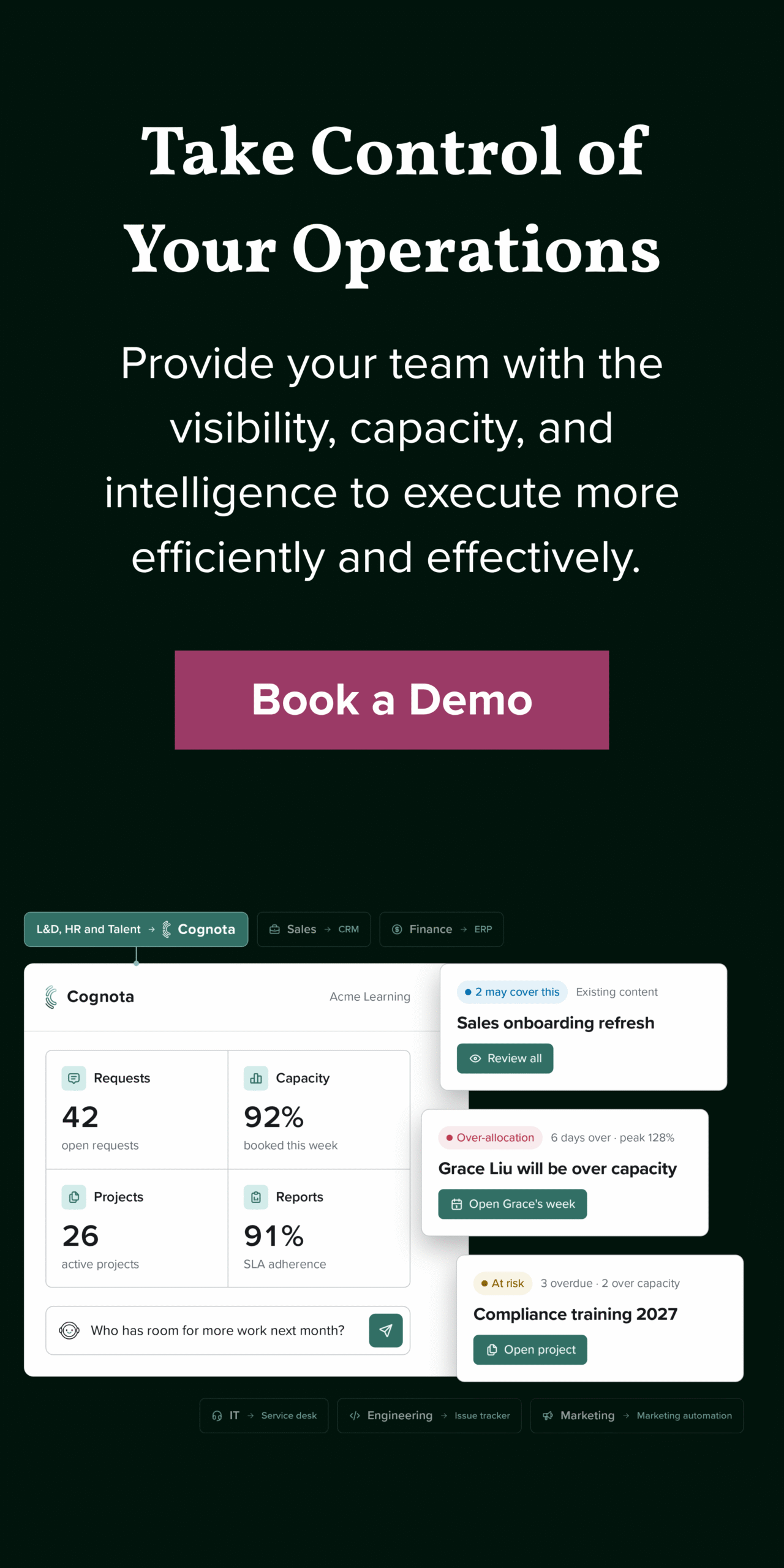
If your team is working to move beyond intake chaos and disconnected project tracking, see Cognota in action to understand how a LearnOps® operating layer can bring structure to the work behind enterprise learning.
Why financial services learning governance is different
Financial services learning teams face a specific governance challenge: not every request carries the same consequence. A program related to a new client service model may be commercially important. A required conduct update may carry regulatory, legal, and reputational exposure. A manager capability initiative may be essential to retention but less time-sensitive. Treating each request as equal creates poor prioritization.
Effective governance makes those differences visible before work begins. It gives business sponsors, risk partners, compliance stakeholders, and L&D leaders a shared way to assess urgency, audience scope, risk, expected outcome, dependencies, and the effort required to deliver.
That does not mean governance should become a permission system that slows the organization down. The trade-off is real. Too little control creates rework and undocumented decisions. Too much control sends stakeholders around the process when they need help most. The goal is proportionate governance: more rigor for initiatives with greater risk, reach, cost, or strategic consequence, and a lighter path for smaller, repeatable requests.
Governance is an operating model, not a meeting
Many teams have elements of governance already. They may have an intake form, a monthly leadership review, or a spreadsheet tracking mandatory learning. What they often lack is a connected operating model. Decisions are made in one place, work is managed in another, budget is tracked elsewhere, and outcome data arrives too late to influence the next decision.
A stronger model follows the five disciplines of the LearnOps® Framework: Align, Plan, Execute, Measure, and Optimize. In a financial services setting, that creates a practical chain of accountability from the original business need to the evidence leaders need to act.
Align learning demand to business and risk priorities
Governance begins before a project is approved. A structured intake should establish who owns the request, what business change is required, which population is affected, what happens if the work is delayed, and how success will be evaluated. It should also capture dependencies such as legal review, compliance approval, operational readiness, or communications.
This creates a crucial distinction between a request and a validated need. A stakeholder may ask for a course, but the underlying requirement could be a process reinforcement, manager communication, performance support, or a targeted intervention for a specific role. Learning leaders need enough context to recommend the right response, not simply accept the proposed solution.
Alignment also makes sponsorship visible. Every significant initiative should have a named business owner who can validate the priority, remove barriers, and participate in outcome review. Without that ownership, L&D can be left carrying accountability for results it does not control.
Plan capacity before promising delivery
Capacity is one of the most overlooked parts of learning governance. In regulated environments, mandatory work can surge with little warning. If the team has no clear view of available skills, active commitments, vendor spend, and upcoming demand, every new priority becomes an exercise in negotiation by escalation.
Planning should show the full portfolio, not just individual projects. Leaders need to see which initiatives are committed, which are awaiting a decision, where specialized skills are constrained, and what must move if a high-priority request enters the queue. This is where governance protects both credibility and people. It replaces vague assurances with transparent choices.
For example, approving an accelerated compliance initiative may be the right decision. But the governance record should also show its consequence: a customer experience program moves, external support is needed, or a lower-priority request is declined. That is not resistance. It is responsible portfolio management.
Execute with clear decision rights
Once work starts, governance should not disappear into status meetings. Teams need agreed decision rights for scope changes, content approvals, audience changes, launch readiness, and exceptions. In financial services, those decisions can involve multiple functions with valid but competing concerns.
A useful principle is to define who recommends, who approves, who must be consulted, and who needs visibility. The exact model depends on the organization. A global insurer with decentralized business units will need different approval paths than a regional bank with a centralized learning team. What matters is that the path is understood before deadlines create pressure.
Execution governance also benefits from a single operational record for each initiative. When intake details, approvals, project milestones, resourcing decisions, and measurement plans live in disconnected systems, teams spend too much time reconciling versions of the truth. An operations layer such as Cognota can centralize that work so leaders can see portfolio health without asking teams to build another manual update.
Measure evidence, not just completion
Completion rates matter for required learning. They can show whether a defined population met an obligation by a deadline. But completion alone cannot establish whether people can apply the expected behavior, whether managers reinforced it, or whether the business risk changed.
Financial services learning governance should set the measurement approach at approval, not after launch. The appropriate evidence depends on the initiative. A product readiness program may track time to proficiency, quality outcomes, or reduced escalation rates. A conduct program may look at manager attestations, scenario performance, policy exception patterns, or audit observations. A leadership initiative may rely on operational and talent indicators over a longer period.
Causation is rarely simple. Market conditions, technology changes, manager behavior, and policy shifts can all influence results. Governance should not promise certainty where it does not exist. It should instead require a reasonable evidence plan, document assumptions, and use the strongest available signals to inform the next investment decision.
This is consistent with the broader shift in the L&D market toward business relevance. Industry analysts such as Josh Bersin have long argued that learning functions earn influence when they connect talent initiatives to organizational performance, rather than reporting learning activity in isolation. For financial services leaders, that connection is also a matter of trust.
Use governance to improve the system
The most mature learning teams do not treat governance as an approval gate. They use it as a feedback loop. They review demand patterns, cycle times, approval bottlenecks, capacity utilization, budget variance, and outcome evidence to identify where the operating model needs to change.
That might mean clarifying intake categories because similar requests arrive under different labels. It might mean establishing pre-approved response patterns for recurring regulatory updates. It might mean shifting specialist capacity toward the work that consistently creates the greatest business value. Optimization is not a separate initiative. It is what happens when operational data is visible and decisions are revisited.
The LearnOps® Maturity Model provides a useful diagnostic lens. Reactive teams respond to requests as they arrive. Managed teams introduce more consistency, but may still struggle to connect work to strategy. Strategic, Predictive, and Adaptive teams increasingly use portfolio intelligence to anticipate demand, allocate resources deliberately, and improve decisions over time. The point is not to label a team. It is to identify the next operating capability that will matter most.
Make governance credible at the executive level
Executives do not need more project detail. They need a clear view of risk, investment, delivery confidence, capacity trade-offs, and the evidence emerging from priority initiatives. A governance rhythm should make those decisions easier, not create another presentation burden for L&D.
Start with a small set of non-negotiables: a standard intake, defined priority criteria, named sponsors, visible capacity, documented decisions, and a measurement plan for material initiatives. Then apply the process consistently enough that stakeholders see it as the fastest path to an informed answer.
Financial services learning governance earns its value when it gives learning leaders the authority to make trade-offs openly, protects teams from unplanned work, and gives the business confidence that learning investment is being managed with the same discipline expected elsewhere. That is how L&D moves from responding to demand to shaping what the organization is prepared to do next.