A request arrives marked urgent: a business leader needs learning for a new process, a compliance change, or a manager population that is missing its targets. The team starts scoping immediately, only to discover later that the audience is unclear, the sponsor has no defined success measure, and three other initiatives compete for the same instructional design capacity. A disciplined learning intake workflow example prevents this pattern by making demand visible before work begins.
For enterprise L&D teams, intake is not an administrative formality. It is the first operational decision point: where learning demand is translated into business need, evaluated against strategy, and assigned a realistic path forward. Done well, intake protects capacity, improves execution, and creates the data needed to demonstrate impact.
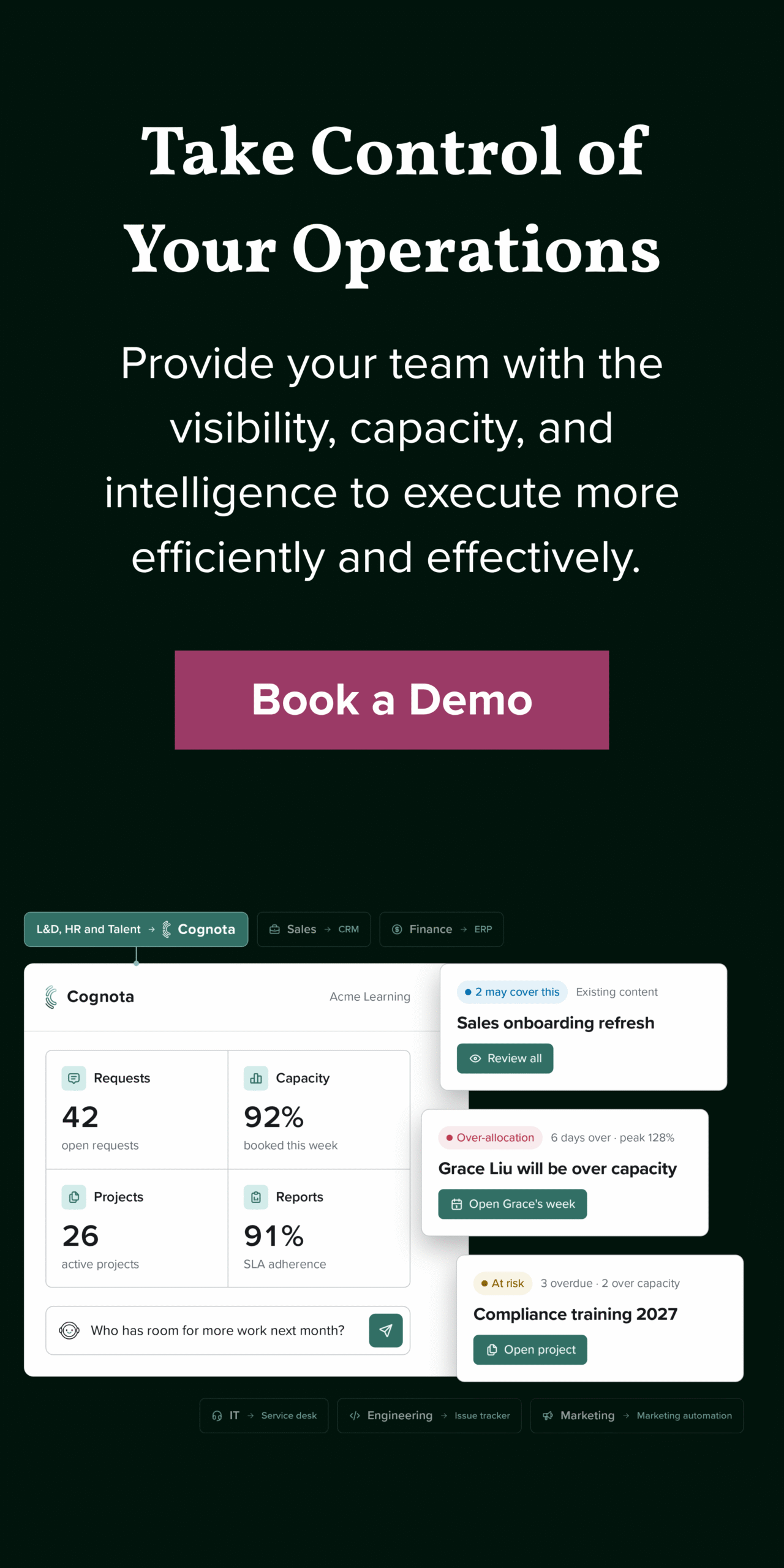
If your team is managing rising demand across spreadsheets, email, meetings, and disconnected project tools, it may be time to see Cognota in action. A LearnOps® platform brings intake, governance, planning, and performance intelligence into one operational layer for learning and talent teams.
Why learning intake breaks down
Most intake processes fail because they confuse collecting requests with managing demand. A basic request form may capture a title, deadline, and requester. It rarely establishes whether learning is the right response, whether the request supports a priority, or whether the team has the capacity to deliver it without displacing higher-value work.
That distinction matters most in organizations with thousands of employees and multiple business units. A sales enablement request, a regulatory requirement, and a leadership initiative can all be legitimate. They cannot all receive the same priority, staffing model, or turnaround expectation.
A mature workflow also creates a constructive way to say “not yet,” “not this way,” or “this is not a learning problem.” That is not obstruction. It is operational leadership. When teams accept every request at face value, they become reactive order-takers. When they govern demand consistently, they can align work to business outcomes.
A learning intake workflow example
Consider a regional financial services organization preparing to introduce a new advisory process. The head of client experience submits a request for learning support because adoption across branch teams is essential to the launch. Here is how a practical enterprise workflow can move that request from demand to an accountable decision.
1. Capture the request in business terms
The requester begins with a structured intake that asks for more than a course title and desired launch date. It captures the business objective, target audience, triggering event, expected behavior change, executive sponsor, risks of inaction, and the measure that will indicate success.
In this example, the business objective is to improve adoption of the new advisory process across 2,400 branch employees. The request identifies a launch date, but it also names the accountable executive and the intended outcome: a defined percentage of eligible client conversations should use the new process within the first quarter.
This is the Align discipline of the LearnOps® Framework in practice. The question is not “What learning do you need?” It is “What business result are you trying to achieve, and where can learning make a credible contribution?”
2. Triage for completeness and fit
A learning operations owner reviews the request against agreed entry criteria. Is there a named sponsor? Is the business problem specific? Is the audience known? Is the deadline fixed because of a regulatory, operational, or launch dependency, or is it simply preferred? Are performance, process, communications, manager reinforcement, or technology changes also required?
The request in this example is strategically relevant and sufficiently defined to move forward. A second request, perhaps for a generic communication skills course with no performance issue or audience data, might return to the requester for clarification. That response should be fast and transparent, not a months-long queue.
Triage is where teams prevent weak inputs from becoming expensive projects. It also reveals patterns. If requests repeatedly arrive without sponsors or success measures, the issue is not individual requester behavior. It is a governance gap.
3. Assess priority against a shared model
The next step is prioritization. Rather than relying on who has the loudest voice or the earliest deadline, the team scores the request using a small set of visible criteria: strategic alignment, business risk, audience reach, urgency, expected value, effort, and dependency complexity.
For the advisory-process launch, strategic alignment and business risk score high. The audience is large, and the launch has hard operational dependencies. The estimated effort is significant because manager enablement, practice activities, and performance support may be needed. That does not automatically make the request a top priority, but it gives the governance group a fact-based view of the trade-offs.
The scoring model should not become a bureaucratic exercise. A simple model used consistently is more valuable than a complicated one no one trusts. Some work, such as a time-sensitive compliance requirement, may need an expedited route. The key is to define that exception in advance rather than allowing every request to claim emergency status.
4. Decide the right intervention
Once the request is prioritized, the team conducts a brief discovery conversation. In this case, interviews with branch leaders reveal that the new process requires knowledge, practice, manager coaching, updated job aids, and system access. A stand-alone learning asset would address only part of the problem.
The resulting recommendation is a blended performance enablement initiative: concise foundational learning before launch, role-based practice for advisors, manager coaching prompts, and in-the-flow support during the first weeks of adoption. The business sponsor confirms the behavior and adoption measures, while operational partners confirm the dependencies.
This is an important intake outcome: sometimes the right answer is a learning initiative; sometimes it is process clarification, communication, or manager accountability. A credible L&D team is willing to distinguish among those choices.
5. Plan capacity, budget, and delivery ownership
Only after the initiative is approved should detailed planning begin. The learning operations team estimates effort by role and phase, assigns a delivery owner, identifies external capacity needs if any, and tests the work against current commitments.
In our example, the team sees that its internal design capacity is constrained during the same quarter. It has three choices: move a lower-priority initiative, reduce the scope to the minimum viable intervention, or add qualified capacity. Each is a business decision with a visible cost and impact, not a private scramble by the L&D team.
This is where Plan connects directly to execution. Demand data without capacity data produces a wish list. Capacity data without priority data produces busywork. Together, they allow leaders to make intentional trade-offs.
6. Govern execution and measure the outcome
After approval, the request becomes an active initiative with milestones, dependencies, owners, and status rules. The sponsor sees progress without chasing the team through email. Learning leaders can see portfolio-level risk, workload, and requests waiting for decisions.
Measurement begins before delivery. For the advisory-process initiative, the team tracks participation and practice completion, but those are not the primary result. The more meaningful measures are manager observation of the new behavior, use of the process in eligible client conversations, and early performance indicators agreed with the business.
This supports the Measure and Optimize disciplines of LearnOps®. If adoption lags, the team can investigate whether the barrier is confidence, manager reinforcement, process friction, or something else. The response may involve changing the intervention, not simply assigning more training.
What to standardize and what to keep flexible
A strong intake workflow is standardized enough to create comparability, but flexible enough to reflect the nature of the work. Every request should have an owner, sponsor, business objective, audience, priority rationale, estimated effort, and decision status. Those fields create the operational record.
The discovery depth should vary. A small update to existing learning does not need the same scrutiny as an enterprise transformation initiative. Likewise, urgent risk-driven work may follow an accelerated approval path, while discretionary development requests can move through regular portfolio governance. Consistency does not mean treating every request identically.
Teams moving from a Reactive to Managed level in the LearnOps® Maturity Model often begin by centralizing intake and making decision criteria visible. Strategic and Predictive teams go further: they use intake data to forecast demand, identify recurring business needs, and make investment decisions before requests become crises.
Make intake a leadership mechanism
The value of intake is not the form. It is the conversation the process makes possible: which business priorities deserve learning investment, what work the team can realistically deliver, and how success will be judged.
When those decisions are visible, L&D can move beyond reacting to demand and start shaping it. That is how learning operations earns greater trust from the business – by making capacity, execution, and intelligence part of every request from the start.