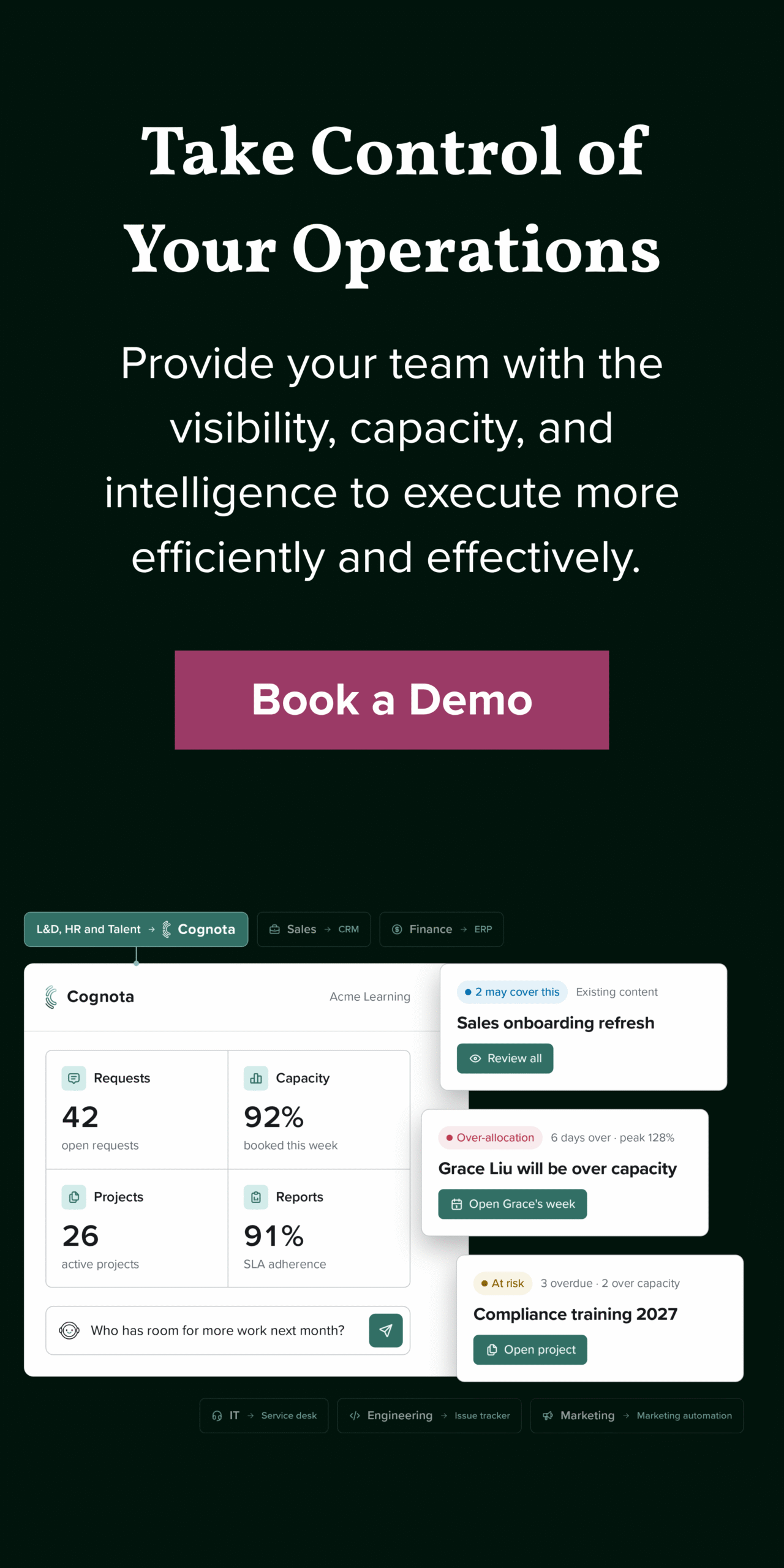
A high-priority leadership program lands with a fixed deadline. A compliance update is due next month. Three business units submit learning requests on the same day. The question is not whether the team is busy. It is whether the work competing for attention deserves the people, budget, and time it will consume. Learning capacity software gives workforce enablement leaders a way to answer that question before commitments turn into missed expectations.
For L&D leaders, capacity is not simply a headcount calculation. It is capacity directed toward alignment, quality, and impact. A team may have hours available on paper while its instructional designers, project managers, subject matter experts, and vendors are already committed to work with different deadlines, dependencies, and business value. Without a shared operational view, the loudest request can become the next priority.
If your team needs one view of incoming demand, available effort, costs, and delivery risk, see Cognota in action. The goal is not to create more administration. It is to give People teams the visibility to make defensible decisions while there is still time to change course.
What learning capacity software should solve
Learning capacity software is the operations layer that connects requests, priorities, work, resources, and spend. It helps workforce enablement teams understand what is in the pipeline, who is doing what, where constraints are forming, and which commitments put strategic work at risk.
That distinction matters because scattered spreadsheets, inboxes, project tools, and finance files rarely tell the same story. According to 2026 joint research from Brandon Hall Group and Cognota, 83% of teams use three to eight tools to manage operations, while 69% want to consolidate. The problem is not that teams lack effort or expertise. It is that the operating picture is fragmented when leaders need it most.
The best systems do more than show utilization. They connect capacity to the work it supports. A leader should be able to see that accepting a new request may delay a regulatory requirement, require external expertise, or push a strategic leadership program beyond its intended launch. That is a decision signal, not a status update.
Capacity is a planning decision, not a utilization target
Teams can overcorrect by treating full utilization as the goal. It rarely is. A team operating at maximum load has little room for urgent business needs, review cycles, changing requirements, or work that is harder than initially scoped. High utilization can look efficient right up until quality suffers and deadlines start to move.
Learning capacity software should help leaders model trade-offs. If a new initiative enters the plan, what needs to move? If a subject matter expert is unavailable, which deliverables are affected? If a vendor cost exceeds the original estimate, can the work still proceed within approved spend? These are practical questions that turn capacity planning into business planning.
The operating model behind better capacity decisions
Capacity data becomes valuable when it follows a disciplined operating model. For workforce enablement teams, that model starts with Align, Plan, Execute, Measure, and Optimize.
Align means establishing a single front door for requests and defining the information stakeholders must provide. Business objective, audience, urgency, expected outcome, deadline, and estimated effort should be visible early. Not every request deserves the same response, and a clear intake process makes that conversation more objective.
Plan is where learning capacity software earns its place. Teams assess demand against available skills, workload, budget, dependencies, and delivery windows. They can sequence work based on enterprise priorities rather than the order in which requests arrived. This is also where leaders identify work that should be handled internally, supported by an expert, deferred, or stopped.
Execute means turning approved priorities into accountable work. Roles, approvals, milestones, and risks need to stay connected to the original commitment. When scope changes, the impact should be visible to the people responsible for decisions, not buried in a project update.
Measure creates a record of what the team delivered, where time and budget went, and whether the work supported the intended business outcome. Optimize uses those patterns to improve future estimates, rebalance workloads, refine intake criteria, and strengthen governance. The point is not perfect forecasting. It is making each planning cycle more reliable than the last.
What to look for in learning capacity software
A useful platform should reflect the reality of enterprise enablement work. It needs to handle planned programs alongside unplanned requests, internal work alongside external expertise, and strategic initiatives alongside necessary operational work.
Start with intake and prioritization. Teams need one place to capture demand and assess it against consistent criteria. This creates a fairer process for stakeholders and gives leaders evidence when they need to explain why some work is sequenced later.
Next, look for resource and financial visibility in the same workflow. Capacity decisions are incomplete when time sits in one tool, project status in another, and vendor spend in a third. The ability to connect effort, cost, and delivery risk makes it easier to protect quality and avoid committing the team to work it cannot support well.
Governance also matters. As requests move across L&D, Talent, HR, business leaders, and outside experts, teams need clear ownership and approval paths. Good governance should reduce uncertainty, not add friction. It establishes one set of rules for how work enters the system, who can approve changes, and when risks need escalation.
Finally, consider how the software supports a mixed delivery model. Sometimes the right answer is internal capacity. Sometimes it is a vetted specialist with the right expertise for a defined need. The decision depends on urgency, strategic importance, available skill, and the cost of delay. Capacity software should make that trade-off visible instead of leaving it to last-minute sourcing.
Moving from reactive work to operational maturity
Many teams begin in a Reactive stage. Work arrives through multiple channels, priorities shift frequently, and reporting requires manual reconstruction. The team delivers, often through extraordinary effort, but leaders struggle to show what is possible next quarter because they cannot see the full demand picture.
In the Managed stage, teams standardize intake, establish clearer ownership, and begin tracking work in a repeatable way. Strategic teams connect capacity, budget, and priorities to business outcomes. Predictive teams use historical patterns to anticipate demand and delivery risk. Adaptive teams continuously adjust plans as conditions change, while protecting the work with the greatest enterprise impact.
Only 1% to 6% of teams reach the Adaptive stage. That should be encouraging, not discouraging. Operational maturity is not a badge reserved for large teams with unlimited resources. It is a progression built through better visibility, consistent decisions, and learning from the work already underway.
The 2026 Brandon Hall Group and Cognota research reinforces why this progression matters. Teams with a dedicated operations lead reported 34% faster delivery, 28% lower costs, and 39% higher stakeholder satisfaction. Those figures do not mean every organization will achieve the same results. They do show that operational ownership changes how teams coordinate demand, capacity, and delivery.
A better question for the next request
When the next urgent request arrives, do not start with, “Can we fit it in?” Start with, “What outcome does this support, what will it require, and what changes if we say yes?” That question creates the space for a better decision.
Learning capacity software helps make that discipline practical. It gives L&D, Talent, and HR leaders a shared view of the work, signals when plans are under pressure, and a clearer basis for action. When the team can explain both what it is doing and why, capacity becomes more than a constraint. It becomes a way to protect the work that matters most.