A new product launch, regulatory change, AI rollout, or leadership transition can expose a workforce capability gap overnight. The problem is rarely a lack of ideas for developing people. It is the lack of a clear operating rhythm to decide which skills matter most, where gaps are real, who owns the response, and what capacity should go toward creating business impact. That is the work of workforce skills planning.
For CHROs, CLOs, and People leaders, skills planning cannot live in an annual workforce exercise or a spreadsheet maintained by one team. It needs to connect business strategy to the everyday work of L&D, Talent, HR business partners, and functional leaders. Otherwise, urgent requests win, strategic priorities wait, and no one has a reliable view of whether the organization is building the capabilities it will need next.
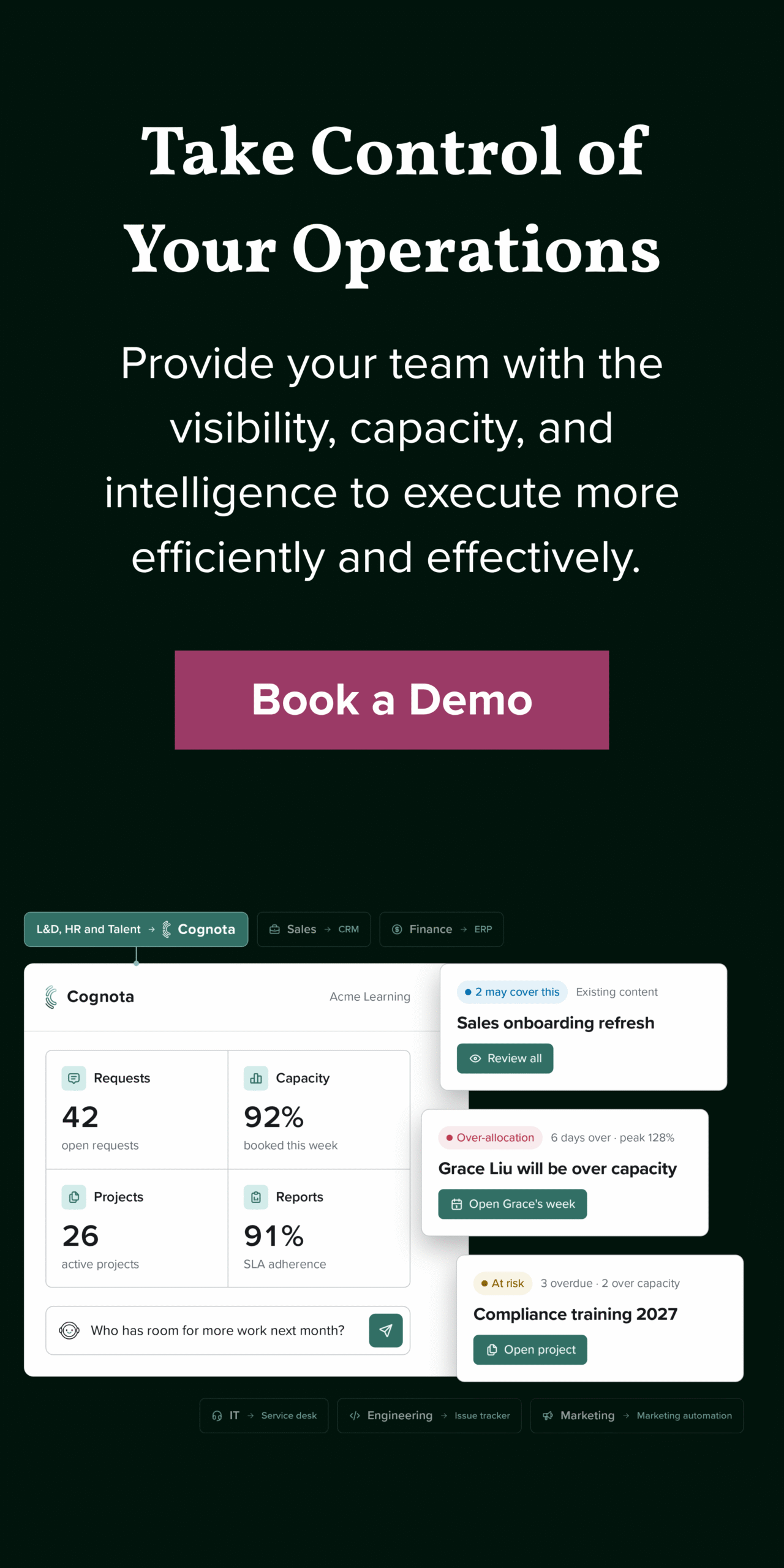
The stakes are operational as much as strategic. The 2026 Brandon Hall Group and Cognota Joint Research Report found that 83% of teams use three to eight tools to manage their operations, while 69% want to consolidate. Fragmented work makes it harder to see demand, capacity, spend, and delivery risk across your People teams. To see how Cognota brings that work into one operating system, see Cognota in action.
What workforce skills planning really means
Workforce skills planning is the disciplined process of identifying the capabilities the business needs, understanding the gaps between current and future proficiency, and organizing the work required to close the gaps. It is not simply building a skills inventory. An inventory can tell you what skills may exist. Planning determines what decisions to make about them.
That distinction matters. A global healthcare organization may identify data literacy as a priority, for example. But the planning work is more specific: Which roles need which level of data literacy? Which business outcomes depend on it? Is the gap best addressed through development, a changed process, leadership reinforcement, external expertise, or a combination? What can the L&D and Talent teams realistically deliver this quarter without sacrificing quality in other critical programs?
Effective planning turns a broad capability ambition into owned, sequenced work. It gives leaders a way to say no, not just yes, when requests compete for limited team capacity and executive attention.
Start with business moments, not a master list of skills
Many organizations begin with a large skills taxonomy, then struggle to turn it into action. A taxonomy can provide useful common language, especially in complex enterprises. But it becomes a distraction when the effort to define every skill is greater than the organization’s ability to make decisions.
Start instead with the business moments that require new or stronger capabilities. These may include entering a regulated market, improving manager effectiveness after a reorganization, adopting new technology, reducing operational risk, or preparing a succession pipeline for critical roles. The question is not, “What skills do we have?” It is, “What must our workforce be able to do to deliver this priority?”
This approach creates a practical boundary around the work. It also brings business leaders into the conversation early, when they can clarify what good performance looks like and what happens if the capability gap remains unresolved. HRBPs are especially valuable here because they hear demand from business leaders before it reaches a formal program request.
Define capability in observable terms
Skills are easiest to prioritize when they describe observable work rather than vague traits. “Strategic thinking” is hard to plan for on its own. “Regional leaders can interpret market signals, make trade-off decisions, and communicate a growth plan” is more useful because it points to a real business context and a clearer standard of performance.
Not every gap requires a learning response. A performance issue may stem from unclear roles, inconsistent manager expectations, flawed workflows, missing tools, or incentives that reward the wrong behavior. Workforce skills planning should surface these dependencies rather than automatically sending every problem to L&D.
Use a shared planning cycle across People teams
A skills plan becomes credible when it follows an operating cadence. Cognota’s operations framework – Align, Plan, Execute, Measure, Optimize – provides a useful way to organize the work without treating planning as a one-time event.
In the Align stage, establish the business priority, accountable executive, target population, and intended outcome. This is where a People leader can challenge ambiguous requests. If a sponsor cannot connect a proposed capability initiative to a business need, it may not deserve immediate investment.
In the Plan stage, assess the gap and decide on the response. This includes defining scope, estimating effort, identifying subject matter expertise, sequencing dependencies, and making budget visible. The most mature teams also assess delivery risk: What other work will be delayed if this initiative becomes the priority? What quality or stakeholder impact follows from that choice?
Execute is where scattered work tends to reappear. Requests arrive through email, project work lives in separate tools, and approvals happen in meetings without a shared record. One front door for demand, shared ownership, and visible milestones help teams maintain alignment as priorities shift.
Measure should extend beyond participation and completion. Those signals may be useful, but they do not show whether the workforce can perform differently or whether the business outcome moved. Measures could include manager observation, quality indicators, time to proficiency, internal mobility, adoption of a new process, or reduced error rates. The right measure depends on the original capability problem.
Finally, Optimize means using those results to improve the next planning cycle. If a leadership program had strong participation but uneven behavior change, the issue may be manager reinforcement or role-specific practice, not the curriculum itself. Planning gets better when teams retain those lessons instead of restarting from zero each quarter.
Make capacity a strategic decision
Most workforce skills plans fail quietly because demand is unconstrained and capacity is invisible. Teams may have a full portfolio of worthy initiatives but no shared method for deciding what comes first. The result is overcommitment, missed expectations, and work that is rushed precisely when quality matters most.
Capacity planning is not about doing less for its own sake. It is about ensuring capacity goes toward alignment, quality, and impact. Leaders need a view of active work, incoming requests, available expertise, budget, and competing commitments across L&D, Talent, and HR. Without it, the organization cannot distinguish between a resource problem, a prioritization problem, and a coordination problem.
The research supports the value of operational ownership. Teams with a dedicated operations lead reported 34% faster delivery, 28% lower costs, and 39% higher stakeholder satisfaction in the 2026 Brandon Hall Group and Cognota research. Those results are not a promise for every organization. They do show why visible processes, clear roles, and reliable data deserve executive attention.
Build governance without slowing the work
Skills planning needs governance, particularly when initiatives involve sensitive role data, leadership decisions, AI-supported analysis, external experts, or significant spend. Governance should clarify decision rights and approval paths, not create a queue of unnecessary meetings.
At a minimum, leaders should know who can submit demand, who validates the business case, who sets priority, who approves investment, and who owns outcome measurement. The same rules should apply whether the work is completed internally or supported by a consultant. When roles are unclear, teams often duplicate work or discover too late that a critical stakeholder was never involved.
This is also where an operations layer earns its place. Your systems of record and delivery are essential, but they do not necessarily manage the work between a capability request and an outcome. Workforce enablement teams need one view that connects demand, priorities, capacity, cost, ownership, and risk before the work becomes another disconnected project.
Know the maturity you are planning from
Not every organization needs a predictive skills model before it can improve. In the LearnOps® Maturity Model, reactive teams respond primarily to incoming demand. Managed teams establish repeatable processes. Strategic teams connect their work to business priorities. Predictive teams use data to anticipate demand, while adaptive teams continuously adjust resources and decisions as conditions change.
Only 1% to 6% of teams reach the Adaptive stage. That is not a reason to delay progress. It is a reason to focus on the next practical improvement. A reactive team may need one intake process and a portfolio view. A managed team may need stronger prioritization criteria. A strategic team may need better outcome measures and cross-functional planning.
The most useful workforce skills planning process is not the one with the most data. It is the one your leaders can use to make clearer decisions, your teams can execute without burnout, and your business can connect to measurable capability gains. Start with the decisions that are currently hardest to make, then build the visibility and operating discipline to make the next decision easier.