
If your learning team is still planning in spreadsheets, email threads, and intake forms that live in five different places, the problem usually is not effort. It is infrastructure. That is why conversations about the top L&D planning tools have shifted. Enterprise teams are no longer just looking for a place to track projects. They need a way to connect demand, capacity, budgets, priorities, and business outcomes.
That shift matters because planning is where most learning functions either gain control or lose it. When planning is fragmented, every downstream activity gets harder. Intake becomes inconsistent. Resourcing turns political. Timelines slip. Leaders ask for impact data, and the team is still trying to reconcile who approved what.
What makes the top L&D planning tools different
The strongest L&D planning tools do more than organize tasks. They help learning teams operate with discipline. For enterprise organizations, that usually means supporting five realities at once: multiple stakeholders, competing priorities, limited internal capacity, financial scrutiny, and pressure to align learning work to business needs.
A basic project tracker can help with visibility, but it rarely solves planning at the level enterprise teams need. The difference comes down to whether the tool can support decisions, not just documentation. Can it standardize intake? Can it show real capacity across the team? Can it connect planned work to strategic priorities? Can it give leaders a clear view of where time and budget are actually going?
That is the line between administrative coordination and operational planning.
The 10 top L&D planning tools worth evaluating
1. LearnOps platforms
If planning is a persistent operational problem, a dedicated LearnOps platform is often the most complete option. This category is built specifically to manage how learning work gets prioritized, scoped, staffed, approved, and measured across the function.
For enterprise L&D teams, that matters because planning rarely happens in isolation. Requests come from across the business. Resources are shared across programs. Budgets need oversight. Leaders want visibility into execution before problems show up. A LearnOps platform brings those workflows into one operating layer, which is especially valuable for teams moving from reactive to more mature planning practices.
This is usually the best fit when the issue is not just project tracking, but the overall operating model behind learning delivery.
2. Work management platforms
General work management tools are often the first upgrade from spreadsheets, and for good reason. They can centralize tasks, timelines, owners, and status updates in a way that immediately improves visibility.
The trade-off is that they are not purpose-built for L&D planning. They can manage work, but they usually require substantial process design to handle learning intake, prioritization, governance, and resource planning well. For smaller teams or teams with strong internal operations support, that may be acceptable. For larger enterprise teams, the customization burden can become its own planning problem.
3. Resource planning software
Some tools focus heavily on people allocation, utilization, and capacity forecasting. These can be useful for L&D teams with shared services models, complex production schedules, or specialist roles that create bottlenecks.
Their strength is workforce visibility. Their weakness is context. A resource planning tool may tell you who is overallocated, but not whether the work itself should have been approved in the first place. If your biggest issue is balancing design, development, and delivery capacity, this category can help. If your challenge starts earlier in intake and prioritization, it may only solve part of the problem.
4. Portfolio and project management systems
Portfolio tools are designed for organizations that need governance across many initiatives. They tend to be stronger than standard task platforms when it comes to approvals, roadmaps, cross-functional dependencies, and executive reporting.
For L&D leaders managing dozens or hundreds of initiatives, that governance can be valuable. Still, these systems are often built for broad enterprise PMO use, not learning operations. That means the terminology, workflows, and reporting logic may not reflect how learning teams actually plan and execute work. They can be effective, but often at the cost of usability for the people doing the work every day.
5. Financial planning tools
Planning breaks down quickly when budget visibility is weak. Financial planning software can help L&D teams manage forecasts, track spend, and compare planned versus actual costs across initiatives.
This category becomes more relevant as budget accountability rises. It is especially useful for teams managing external vendors, large content investments, or multiple funding sources. But on its own, financial planning software will not manage workflow or operational capacity. It strengthens one part of planning, not the whole system.
6. Collaborative documentation platforms
Many teams still use shared documents and knowledge platforms to coordinate planning. These tools are familiar, flexible, and easy to roll out. They can work surprisingly well for documenting briefs, capturing stakeholder inputs, and maintaining planning notes.
The limitation is control. Documentation platforms are good at storing information, but weak at enforcing process. They do not naturally manage approvals, dependencies, or live capacity. Once the volume of requests increases, version control and inconsistency usually follow.
7. Spreadsheet-based planning systems
Spreadsheets remain common because they are flexible and fast. For a single program or a small learning team, they can still be useful. They allow teams to model budgets, timelines, and assignments without waiting on system changes.
But flexibility is also the problem. Spreadsheets depend on manual upkeep, individual ownership, and a level of discipline that rarely holds under enterprise pressure. They break first at the handoff points – when intake grows, when approvals are distributed, or when leadership wants a current view across the portfolio.
8. Business intelligence tools
Some teams use BI platforms to support planning by surfacing demand trends, resource utilization, completion metrics, and operational bottlenecks. These tools are powerful for analysis and executive visibility.
Still, analytics is not planning. BI can show what happened and where constraints exist, but it does not create the workflows needed to act on those insights. It is best treated as a complement to a planning system, not a replacement for one.
9. Service management platforms
For L&D teams that receive high volumes of requests from across the business, service management systems can bring order to intake and triage. They are useful when the front door to learning is chaotic and every stakeholder has a different way of asking for support.
Their value is consistency. Requests can be routed, categorized, and prioritized more effectively. The challenge is that these tools often stop at intake. They may improve how work enters the function without improving how it is planned, staffed, and governed afterward.
10. Hybrid tool stacks
Many enterprise teams do not use one planning tool. They use several. A request form feeds a project tracker, which feeds a spreadsheet, which feeds a quarterly budget review. This stack evolves for understandable reasons. Teams patch around gaps with whatever is available.
Sometimes that works for a while. But hybrid stacks usually create the exact conditions that make planning hard: duplicate data, inconsistent definitions, manual reporting, and no shared source of truth. If your team spends more time reconciling systems than making planning decisions, the stack is costing more than it appears.
How to evaluate top L&D planning tools for your operating model
The right choice depends less on features and more on the maturity of your planning process. If your team is still largely reactive, the first priority is usually standardization. You need structured intake, clear prioritization, and visibility into active work. If your team is more established, the next planning challenge is often capacity and governance. Once those are in place, measurement and optimization become far easier.
This is where a maturity lens helps. In the LearnOps framework, planning is not a standalone activity. It connects alignment, execution, measurement, and optimization. A tool that helps you plan but cannot connect work back to business priorities or forward to operational performance will eventually create another blind spot.
That is also why the common objection – we already have a system for learning – tends to miss the point. Delivery systems and operational planning systems solve different problems. One helps people access learning. The other helps the learning function decide what to build, how to resource it, and how to run it responsibly at scale.
What enterprise leaders should watch for
The best planning tool is not the one with the longest feature list. It is the one that reduces friction in how your team actually works. For most enterprise L&D functions, that means fewer handoffs, clearer decisions, stronger governance, and better visibility for both practitioners and executives.
It also means being honest about where planning is breaking today. If the real issue is intake chaos, do not over-rotate toward analytics. If the problem is overcommitted teams, a prettier project board will not fix capacity. If leaders cannot see the value of planned work, better operational reporting may matter more than another collaboration layer.
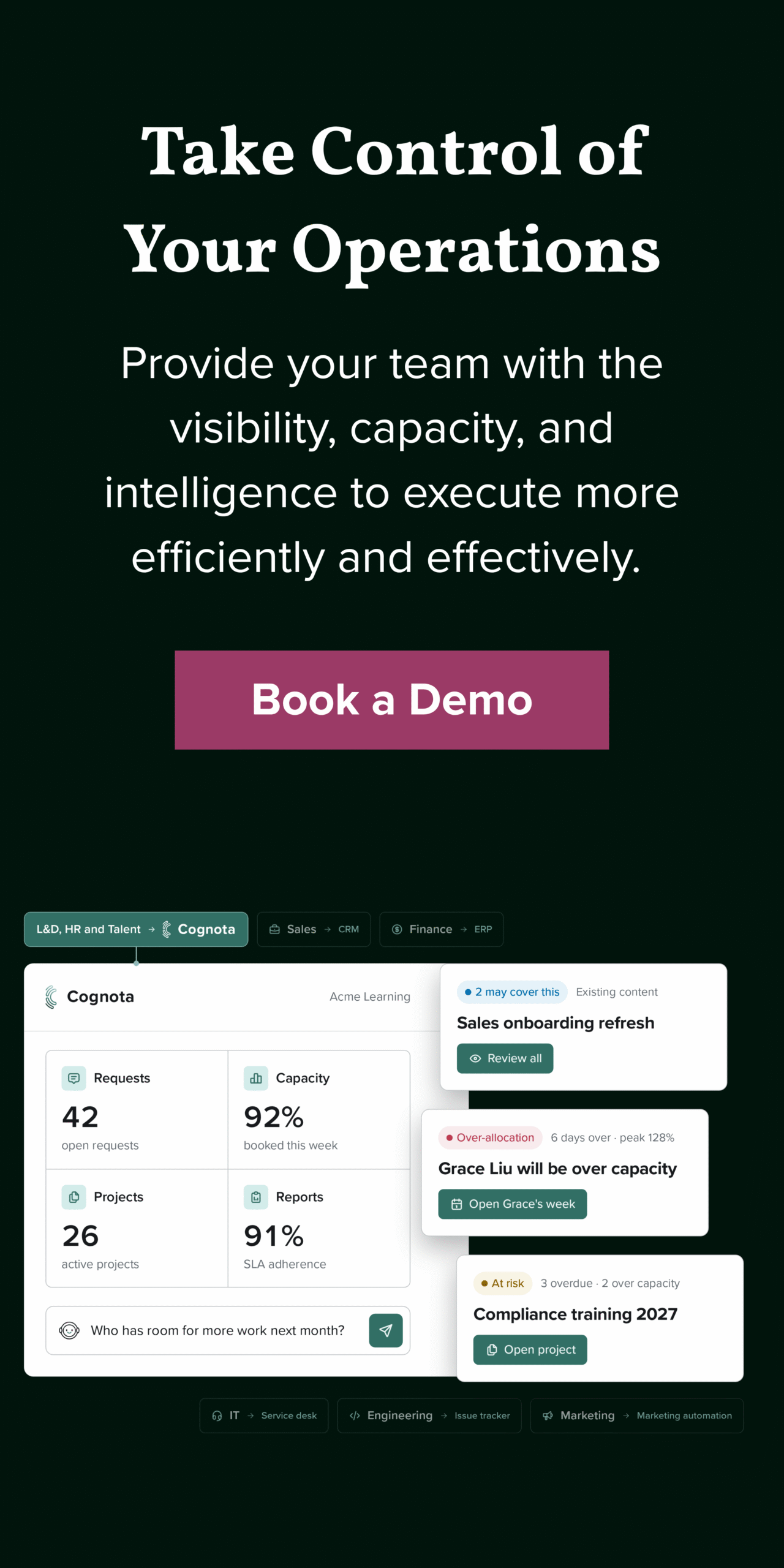
For many teams, the strongest option will be a platform designed to support the full planning discipline, not just one slice of it. Cognota is built for exactly that operating layer between strategy and delivery, where learning teams either gain leverage or get buried in coordination work.
Planning is rarely the most visible part of L&D. But it is often the part that determines whether the function can scale with confidence. When the system behind planning gets stronger, everything after it gets easier to execute.