A learning leader receives a request for a compliance program, a leadership initiative, and a sales enablement refresh – all before lunch. Each request has an executive sponsor, an urgent deadline, and incomplete requirements. The question behind LearnOps versus PMO is not which label sounds more strategic. It is whether your operating model can turn competing demand into work that advances business priorities.
Many enterprise learning teams borrow project management office practices because they need order: intake, governance, reporting, and accountability. That is a sensible response to growing complexity. But a traditional PMO was designed to govern projects across the enterprise. Learning teams have a different operating reality, one that includes shifting skill needs, distributed stakeholders, specialized learning work, constrained capacity, and a growing expectation to demonstrate impact.
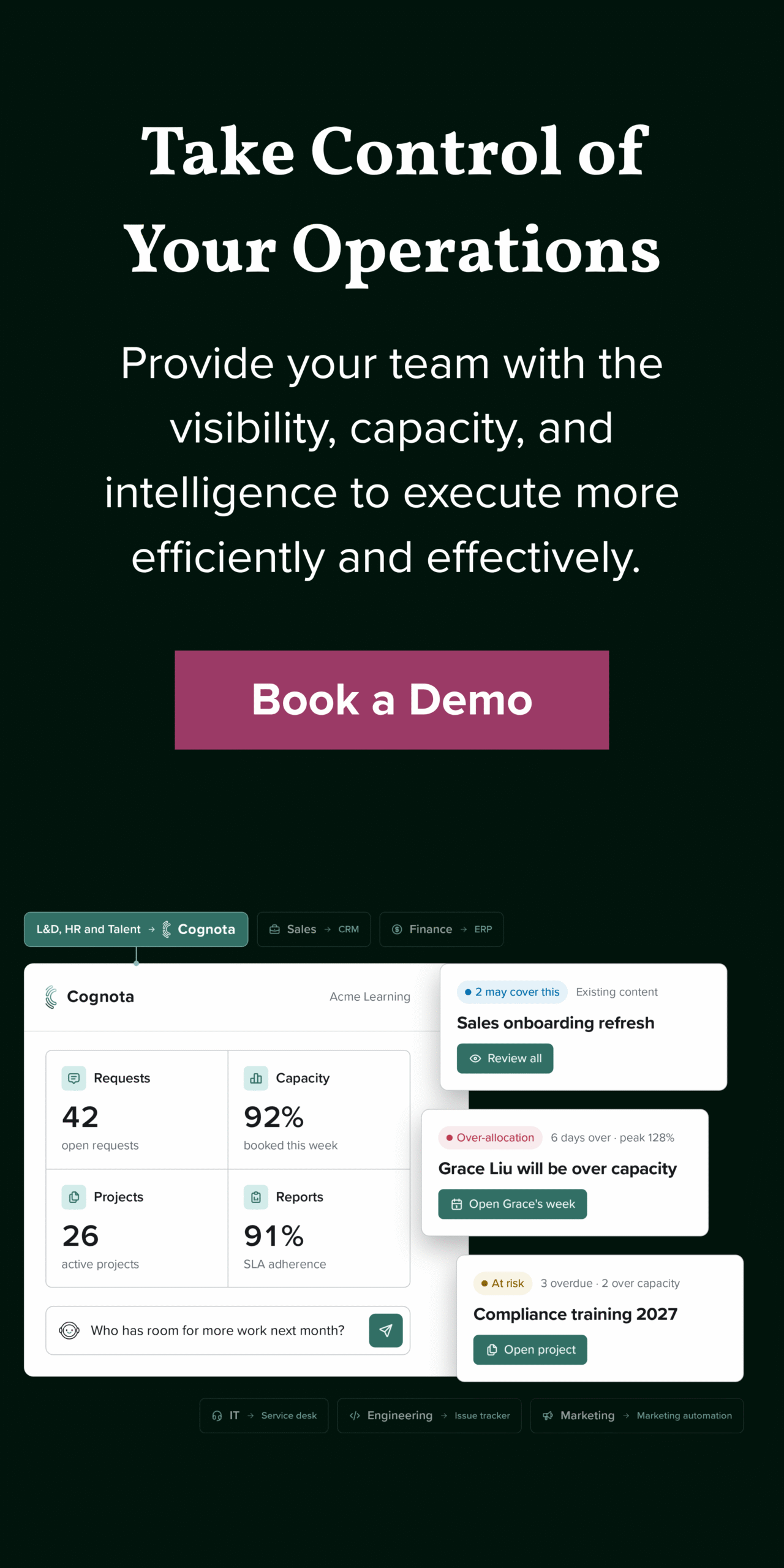
If your team needs a clearer way to manage demand, resources, and outcomes without forcing learning work into a generic project model, see Cognota in action and explore what an operations layer built for L&D can look like.
LearnOps versus PMO: The Core Difference
A PMO is typically an enterprise governance function. Its role may include establishing project standards, prioritizing portfolios, monitoring milestones, managing risks, and providing leadership with visibility into delivery. In organizations with major transformation programs, this discipline can bring valuable structure to work that might otherwise be fragmented.
LearnOps® applies operational discipline specifically to learning and talent work. It treats L&D not as a collection of individual programs but as a business function that must align investments, plan capacity, execute consistently, measure performance, and improve over time. The distinction matters because learning does not simply move through a project plan. It operates as an ongoing service to the business, with a continuous flow of requests and an evolving portfolio of priorities.
A PMO often asks, “Are projects being delivered on time, within scope, and within budget?” LearnOps asks those questions too, then goes further: “Should this work be done? Do we have the right capability and capacity? What business outcome is it meant to influence? What did we learn from the result, and how should the portfolio change?”
That broader operational lens is especially relevant for L&D teams supporting thousands of employees across highly regulated, fast-changing industries. A project can be successfully delivered and still fail to create meaningful business value. LearnOps makes that gap visible.
Where PMO Practices Help Learning Teams
The choice is rarely LearnOps or PMO in an absolute sense. Mature learning organizations can benefit from PMO disciplines, particularly when they are managing major enterprise initiatives, shared dependencies, or a high volume of complex work.
Governance brings needed consistency
PMO practices can help standardize how projects are initiated, approved, tracked, and escalated. For an L&D team that has grown through acquisition, decentralized ownership, or years of ad hoc requests, this consistency can reduce confusion quickly. Clear decision rights and stage gates prevent leaders from treating every request as an automatic commitment.
Portfolio visibility improves executive conversations
A well-run PMO can offer leaders a consolidated view of active initiatives, milestones, spend, risks, and dependencies. Learning leaders need this visibility when they are explaining why a new request cannot start immediately or why a strategic program needs cross-functional support.
Project discipline supports complex delivery
For a major capability initiative with fixed deadlines and multiple stakeholders, formal project management is useful. It helps learning teams coordinate work, surface risks early, and communicate progress in a language enterprise leaders understand.
The limitation is that PMO practices alone do not define the learning operating model. They can organize delivery without solving the upstream problem of demand quality, or the downstream problem of impact and optimization.
Why a Traditional PMO Can Fall Short for L&D
Learning teams are often asked to behave like strategic business partners while operating with spreadsheets, inboxes, disconnected work trackers, and informal prioritization. Adding a generic PMO process may create more control, but it can also introduce friction if it does not reflect how learning work is actually planned and delivered.
First, a project-centric model can underrepresent recurring operations. L&D teams do not only launch discrete projects. They manage a pipeline of requests, maintain programs, respond to business changes, coordinate subject matter experts, allocate internal and external capacity, and assess what should be improved or retired. Treating all of that as a series of projects can obscure the true workload.
Second, generic governance may focus on delivery efficiency while leaving strategic alignment vague. A request may have a sponsor and a due date, yet no agreed performance problem, target audience, success measure, or rationale for choosing a learning intervention. When that happens, the team is governed efficiently into rework.
Third, PMO reporting frequently centers on project health. That is useful, but learning leaders also need to understand demand trends, utilization, cost drivers, stakeholder satisfaction, program performance, and the relationship between learning investments and business priorities. These are operating signals, not just project signals.
LearnOps Connects Capacity, Execution, and Intelligence
LearnOps is built around the reality that L&D performance depends on three connected dimensions: capacity, execution, and intelligence. A team can have strong instructional expertise and still struggle if demand enters through unstructured channels. It can execute quickly and still lose credibility if it cannot show why work was prioritized or what changed as a result.
The LearnOps® Framework organizes this work into five disciplines: Align, Plan, Execute, Measure, and Optimize. Together, they create a practical operating rhythm rather than a one-time governance exercise.
Align the work to business need
Alignment starts before a project is approved. The team clarifies the business objective, the audience, the requested outcome, and the urgency. This creates a more disciplined intake conversation. Sometimes the right answer is a learning initiative. Sometimes it is performance support, a manager intervention, a process change, or a decision to defer the request.
This is not gatekeeping for its own sake. It protects scarce learning capacity from being consumed by low-value or poorly defined work.
Plan against real capacity
Planning is where many teams discover that their portfolio is larger than their available resources. LearnOps makes demand, skills, budgets, and workload visible so leaders can make explicit trade-offs. They can sequence work, rebalance assignments, identify capability gaps, and decide when additional specialized support is warranted.
That is different from simply assigning due dates. It is a capacity decision tied to priorities. For teams facing headcount constraints, this distinction is central to execution credibility.
Execute with connected operational data
Execution requires more than a task list. Learning teams need a shared view of requests, approvals, work in progress, dependencies, ownership, and progress across the portfolio. When operational information is scattered, status updates become a manual activity and leaders make decisions from partial data.
A LearnOps approach creates consistency without assuming every initiative follows the same path. A short update to an existing program should not carry the same governance burden as a global capability initiative. The operating model should support appropriate control, not bureaucracy.
Measure and optimize what matters
Measurement should connect back to the reason work was approved. That may include adoption, proficiency, performance indicators, stakeholder feedback, operational efficiency, or cost. The right measures depend on the initiative and the data available. The objective is not to claim perfect causality where it cannot be proven. It is to build a credible evidence trail for learning decisions.
Optimization then turns that evidence into action. Teams can identify bottlenecks, recurring request types, overloaded roles, underperforming programs, and opportunities to shift investment. This is how L&D moves from responding to demand to actively managing a learning portfolio.
Choosing the Right Model for Your Organization
A PMO may be enough when L&D primarily needs project controls for a limited number of high-complexity initiatives and can rely on another function for portfolio decisions, resource planning, and performance analysis. In that environment, adopting selected PMO practices can be efficient.
LearnOps is the stronger fit when learning is expected to operate as a strategic, measurable enterprise function. It is particularly relevant when demand is rising, priorities compete, leaders need visibility into capacity, and the team must show how its work supports business performance.
The LearnOps Maturity Model can help diagnose where to begin. Teams at the Reactive level are often managing requests through fragmented processes and personal effort. Managed teams have introduced basic controls but may still lack integrated planning and measurement. Strategic, Predictive, and Adaptive teams increasingly use operational data to shape decisions before problems become delivery crises.
No team needs to transform every discipline at once. A practical starting point may be structured intake, a single view of active demand, or capacity planning for the roles creating the most bottlenecks. The right first move is the one that removes a material constraint and gives leaders better evidence for the next decision.
The real opportunity is not to make L&D look more like a PMO. It is to give learning the operating discipline it needs to make better choices, protect its capacity, and earn a stronger role in the business conversations that matter most.