
A high-stakes product launch is approaching, leaders need a new capability built quickly, and three business units submit urgent requests at once. Without governance, the learning team responds to whoever escalates most effectively. Work starts before priorities, scope, capacity, or expected outcomes are clear.
That is not a project-management problem alone. It is an operating-model problem. Knowing how to govern learning projects gives enterprise L&D leaders a disciplined way to decide what work enters the portfolio, who owns key decisions, how resources are assigned, and when an initiative should change course or stop. The result is not more process for its own sake. It is greater capacity, stronger execution, and better intelligence about where learning investment creates value.
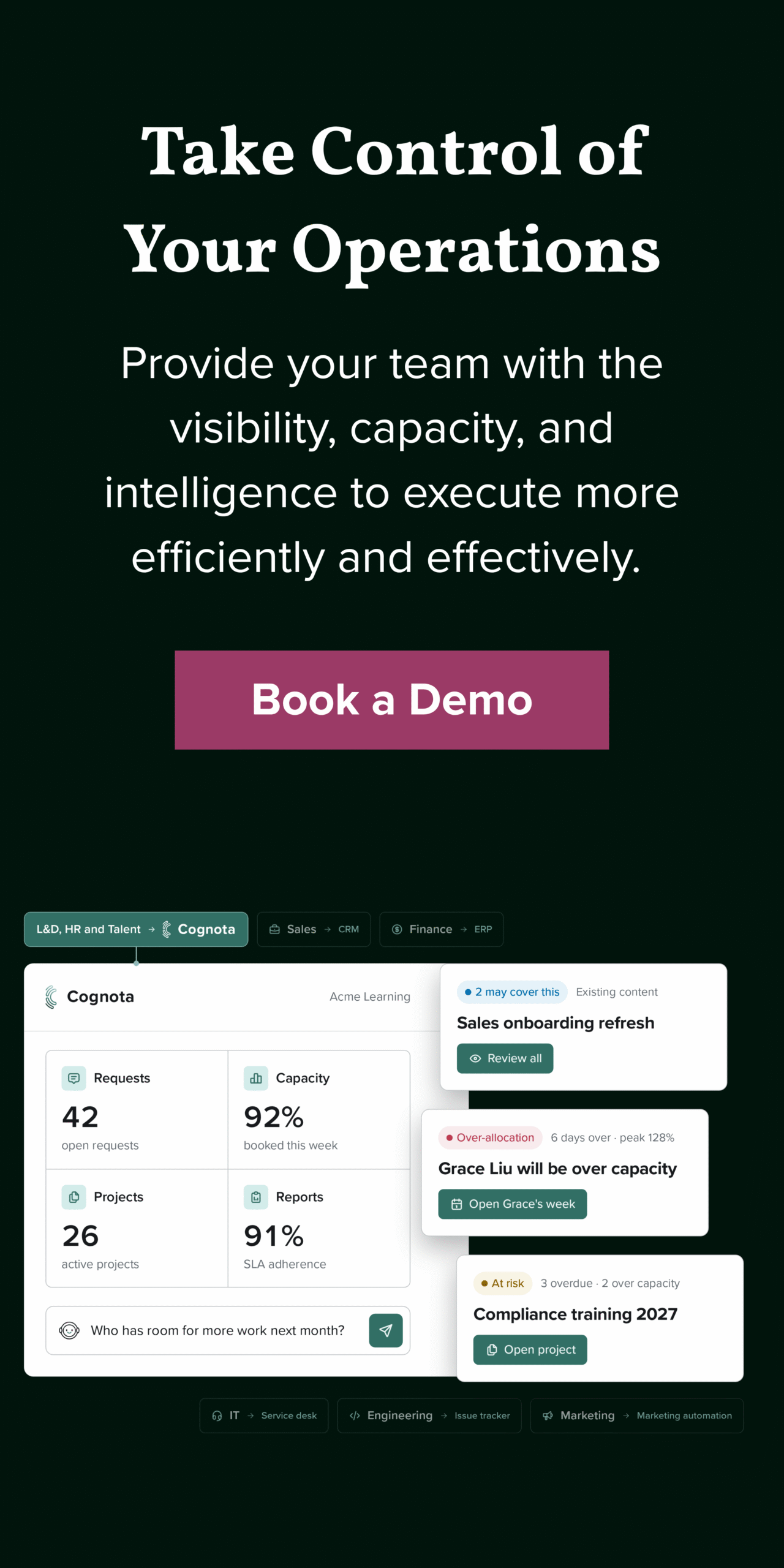
Governance is especially important when a team supports multiple functions, regions, and strategic initiatives with finite internal expertise. If your learning operation needs a clearer system for managing demand and execution, see Cognota in action through its LearnOps platform introduction.
Governance starts before a project is approved
Many teams treat governance as a status meeting that begins after a project has been assigned. By then, the most consequential decisions may already be locked in. The business need may be vague, the requested solution may be preselected, and the team may have committed time it does not have.
Effective governance begins at intake. Every request should enter through a consistent process that captures the problem to solve, the audience affected, the business owner, the required timing, the risk of inaction, and the outcome the sponsor expects to influence. This does not require turning every request into a lengthy business case. It does require enough information to distinguish a strategic need from a preference for a particular learning asset.
The central question is simple: what business priority does this work support? A request tied to a regulatory change, a new operating model, a revenue-critical launch, or a documented performance gap deserves a different level of attention than a request with no defined sponsor or success measure.
This is the Align discipline in the LearnOps® Framework. Learning teams earn strategic influence when they make alignment visible before work begins, rather than attempting to explain it after resources are spent.
Set explicit decision rights
Projects stall when everyone can offer input but no one has authority to decide. They also become risky when a learning team is expected to own business outcomes it cannot control.
Define decision rights at the portfolio and project levels. Senior learning leaders should own the operating standards, prioritization approach, and capacity decisions. Business sponsors should own the problem definition, stakeholder access, and accountability for the operational conditions surrounding the learning intervention. Project leads should own delivery decisions within agreed scope, budget, and timeline boundaries.
Be equally clear about escalation. For example, a project lead may be able to make minor design adjustments, while a material change in audience, launch date, or required effort returns to the sponsor and governance forum for a decision. This prevents the slow accumulation of “small” changes that quietly consume the team’s capacity.
How to govern learning projects through the portfolio
Project governance cannot be effective when each initiative is assessed in isolation. A portfolio view reveals the choices individual project conversations can hide: duplicated requests, overloaded subject-matter experts, competing launch dates, and low-value work consuming scarce specialist capacity.
Use a small set of consistent criteria to prioritize the portfolio. Strategic alignment, business impact, urgency, risk, audience reach, effort, and sponsor commitment are usually enough. The purpose is not to produce a mathematically perfect score. It is to make trade-offs explicit and repeatable.
A regulatory requirement may receive priority because the cost of delay is high. A leadership program may deserve investment because it supports a multi-year workforce strategy, even if its near-term measures are less direct. Conversely, a popular request may need to wait if it has no defined business owner or displaces work with greater enterprise value. Governance makes these decisions visible, which is more credible than pretending every request can be accommodated.
Capacity planning belongs in the same conversation. A project is not approved simply because it is valuable. It must also be feasible within the available design, program management, technology, and subject-matter-expert capacity. When demand exceeds supply, leaders have three honest options: sequence work differently, reduce or reshape scope, or add capacity. The worst option is silently accepting all work and asking the team to absorb the gap.
Create a governance cadence that drives decisions
A governance forum should not become another meeting for reading status updates aloud. Its job is to make decisions, remove barriers, and maintain portfolio health.
For most enterprise learning teams, a monthly portfolio review works well for approving new work, rebalancing priorities, and reviewing capacity. Active, high-risk, or highly visible initiatives may need shorter project-level check-ins. The exact cadence depends on the pace of the business. A team supporting frequent product releases will require faster decisions than one managing a stable annual compliance calendar.
Each meeting should focus on exceptions and choices: projects that are off plan, dependencies that require sponsor action, shifts in business priority, and work that should be paused or retired. Routine progress data should be available before the meeting so leaders can spend their time governing, not collecting updates.
Governance also works best when the same source of operational truth shows demand, project status, resource allocation, budget, and outcomes. Fragmented spreadsheets and disconnected workspaces make it difficult to see the portfolio as it actually is. They also force project managers to spend time reconciling information instead of managing decisions.
Measure more than delivery activity
On-time completion and stakeholder satisfaction matter, but they are not enough to govern a learning portfolio. They describe whether work was delivered, not whether it was the right work or whether it influenced performance.
Use measures that connect to the original reason for approval. Depending on the initiative, that could include adoption of a new process, reduced time to proficiency, improved quality, lower error rates, manager observation, or progress against a defined business metric. Attribution is rarely perfect, particularly for complex change initiatives. That is not a reason to avoid measurement. It is a reason to set practical evidence standards before launch and be transparent about what the data can and cannot prove.
Track operational measures alongside impact measures. Intake volume, cycle time, rework, utilization, budget variance, and project throughput reveal whether the learning function can execute predictably. When paired with outcome data, they help leaders identify a common but costly pattern: a team may be delivering a high volume of work efficiently while investing its best capacity in initiatives with limited strategic value.
This is where the Measure and Optimize disciplines become consequential. Governance should create a feedback loop, not a final approval stamp. Evidence from completed work should improve future prioritization, scoping, and resourcing decisions.
Use maturity to decide what to improve first
Not every team needs a complex governance structure immediately. Teams operating in a reactive mode may need only a single intake process, a visible prioritization rule, and a weekly review of active work. Teams with more established practices can introduce portfolio scenarios, capacity forecasting, outcome thresholds, and formal stage gates.
The LearnOps® Maturity Model provides a useful diagnostic. Reactive teams respond to demand as it arrives. Managed teams establish repeatable processes. Strategic teams align portfolios to business priorities. Predictive and Adaptive teams use operational and outcome data to anticipate demand, optimize investments, and adjust with confidence.
The goal is not to imitate the most mature organization overnight. It is to identify the constraint that most limits performance now. If leaders cannot see incoming demand, improve intake first. If approved work routinely exceeds available capacity, make resource planning a governance requirement. If stakeholders question learning’s value, strengthen outcome definition and measurement before adding more reporting.
Strong governance gives learning leaders permission to make better choices in public. It creates a shared language for saying yes, no, not yet, or not in this form. More importantly, it ensures the team’s limited expertise is directed toward work that matters – and gives the business a clearer view of what that work is achieving.