A learning request arrives with an urgent deadline, three stakeholders, an unclear business problem, and a promise that it is “just a quick course.” The team opens a project, assigns tasks, and gets moving. Weeks later, the work is delivered, but the original need has changed, capacity is stretched, and no one can clearly connect the output to a business outcome.
That is the real distinction in learning workflow versus project management. Project management helps teams move a defined body of work from start to finish. A learning workflow governs how demand enters the function, how work is prioritized, who makes decisions, how resources are allocated, and how results inform the next decision. Enterprise L&D teams need both, but they should not mistake one for the other.
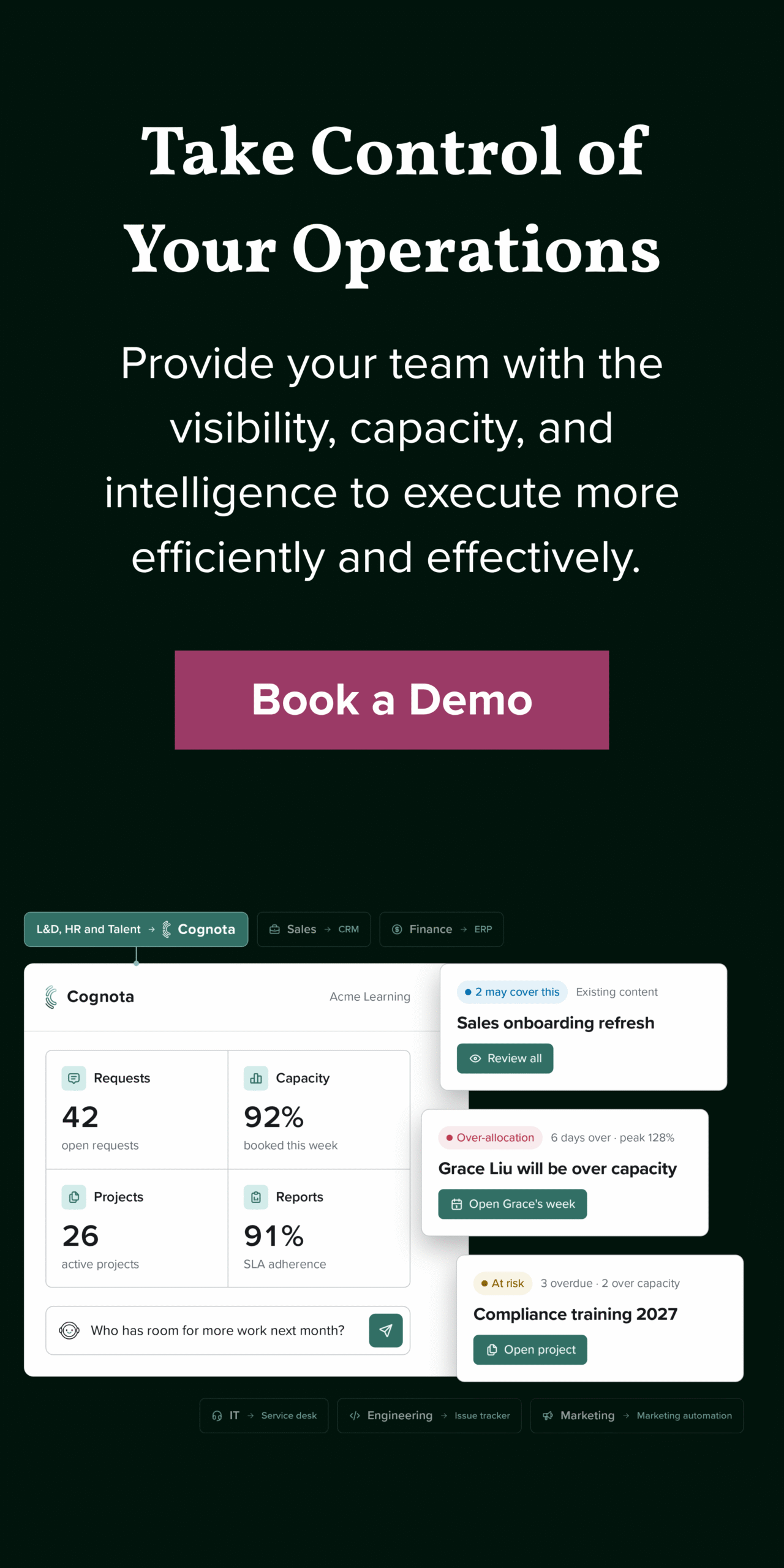
For teams managing a growing portfolio of learning, talent, enablement, and change initiatives, the gap is operational. If work enters through email, meetings, and disconnected spreadsheets, even disciplined project management cannot create a reliable operating model. To see what an operations layer designed for learning teams can look like, see Cognota in action.
Why project management alone falls short for L&D
Project management is built around execution. It creates structure once a project has been approved: scope, milestones, owners, dependencies, risks, and deadlines. That discipline is valuable. A complex onboarding redesign or regulatory learning initiative should have a clear plan, visible ownership, and active risk management.
But L&D work rarely begins as a well-scoped project. It begins as demand. A business leader may request a new program before the performance need is diagnosed. A sales enablement team may need support while the product strategy is still moving. A compliance requirement may be nonnegotiable, while a leadership development request competes for the same instructional design capacity.
Project tools tend to assume the work already deserves a place on the roadmap. Learning operations must answer the questions that come first: Is this the right intervention? Which business priority does it support? What is the true effort? Can the team take it on now? Is there a better option than building something new?
When those decisions happen outside a defined workflow, the team becomes reactive by default. It may deliver projects efficiently while still spending too much capacity on low-value work.
What a learning workflow actually manages
A learning workflow is not simply a sequence of tasks for building learning. It is a connected set of decisions and handoffs that turns business demand into measurable learning outcomes.
It starts at intake, where requests are captured consistently rather than interpreted through fragmented conversations. The goal is not to slow stakeholders down with bureaucracy. It is to gather enough context to make an informed decision: the audience, desired business outcome, urgency, sponsor, constraints, available assets, and expected measures of success.
From there, the workflow supports triage and prioritization. Some requests should become projects. Others may be addressed through performance support, curation, communications, manager reinforcement, or a decision not to proceed. That is not a failure of service. It is evidence that L&D is managing demand as a strategic portfolio rather than an order queue.
The workflow continues through resourcing, approvals, production, review, launch coordination, measurement, and optimization. Crucially, it connects these stages. A shift in scope should affect capacity plans. A delayed approval should be visible as a delivery risk. Measurement findings should influence future prioritization, not sit in a separate dashboard after the work is done.
Learning workflow versus project management: the practical difference
The easiest way to understand the difference is to look at the unit of management. Project management manages a project. Learning workflow manages the system of work across the learning function.
A project manager might ask, “Are we on track to deliver this program by June?” A learning operations leader also asks, “What will delivering this program displace, what decision is blocking it, and how will we know it was the right investment?” Both questions matter. The second protects the team’s capacity and credibility.
This distinction becomes more urgent as enterprise learning teams support more business units, more channels, and more specialized work. A team may have dozens of active projects, hundreds of requests, a mix of internal and external contributors, and competing executive priorities. Individual project plans do not provide a full view of demand, supply, spend, or strategic alignment.
A learning workflow does. It creates the operational visibility required to manage the portfolio, not just the deliverables inside it.
The operating model behind high-performing learning teams
Cognota’s LearnOps® Framework frames this work across five disciplines: Align, Plan, Execute, Measure, and Optimize. Project management is central to Execute, but it cannot carry the full operating model on its own.
Align establishes the connection between learning demand and business priorities. Without alignment, teams may be busy but unable to explain why one initiative outranked another.
Plan turns demand into a feasible portfolio by considering capacity, budget, skills, dependencies, and timing. This is where many teams discover that their problem is not a lack of project discipline. It is a lack of reliable information about the work they have already committed to.
Execute is where project management earns its place. Teams need clear workflows, accountable owners, governed approvals, and visibility into progress. Yet execution is stronger when it begins with better intake and realistic plans.
Measure looks beyond completion rates and delivery dates. It asks whether the initiative achieved its intended outcome and whether the effort was proportionate to the value created. Not every program will have the same measurement design, but every major investment should have a clear success standard.
Optimize closes the loop. It uses delivery data, stakeholder feedback, capacity patterns, and outcome evidence to improve how the function works. This is what moves a team beyond recurring fire drills.
Where teams commonly get stuck
Many L&D functions are not short on capable people or good intentions. They are constrained by an operating environment that makes good decisions difficult. Requests arrive through too many channels. Stakeholders expect immediate commitments. Resource planning lives in separate files. Leaders receive status updates but not a portfolio-level view of trade-offs.
The result is a familiar pattern: work is accepted before it is sized, projects are launched before ownership is settled, and measurement is discussed after delivery. Teams compensate with heroic effort. Over time, that effort becomes expensive, hard to sustain, and difficult to scale.
The LearnOps® Maturity Model offers a useful diagnostic lens. Reactive teams respond to incoming demand with limited consistency. Managed teams introduce repeatable processes, but may still struggle to tie decisions to enterprise priorities. Strategic, Predictive, and Adaptive teams increasingly use operational data to plan capacity, anticipate demand, and continuously improve performance.
Maturity is not about achieving process for its own sake. It is about giving L&D leaders the information and control needed to make better choices under pressure.
How to use both without creating more process
The answer is not to replace project management with an elaborate approval maze. It is to put project management in the right place: inside a governed learning workflow.
Start by standardizing the front door for work. Every request does not need the same path, but every request should enter through a consistent process that captures the decision-making information your team needs. Then establish clear criteria for priority, urgency, strategic alignment, and effort.
Next, make capacity visible before commitments are made. This includes the availability of internal roles, the effort required at each stage, and the impact of new work on current priorities. If a high-priority initiative must move forward, leaders should be able to see what will move out, slow down, or require additional support.
Finally, connect delivery data to performance conversations. If review cycles routinely delay launches, that is an operational issue to address. If a certain business area repeatedly requests work without defined outcomes, that is an alignment conversation. A workflow makes these patterns visible early enough to act on them.
The strategic shift: from managing projects to managing learning operations
Project management asks whether the team delivered the work. Learning operations asks whether the function is directing its finite capacity toward the work that matters most.
That shift changes the relationship between L&D and the business. Instead of being seen primarily as a production team, L&D can operate as a disciplined partner that evaluates demand, makes trade-offs explicit, plans investment, and improves performance over time.
The next time a request arrives labeled urgent, do not begin with a task list. Begin with the workflow that helps your team decide what the business actually needs, what it will take to deliver it, and what success should look like when the work is done.