A learning request arrives with a short deadline, an executive sponsor, and an unclear business problem. The team starts building because the work feels urgent. Three weeks later, stakeholders are debating scope, a subject matter expert is unavailable, and no one can explain who approved the effort or how success will be measured. If that pattern sounds familiar, learning teams need to know how to map learning workflows before adding more work to the queue.
A workflow map makes the operating reality visible. It shows how demand enters the function, who makes decisions, where handoffs occur, what capacity is required, and how results return to the business. For enterprise L&D teams, this is not process documentation for its own sake. It is the foundation for increasing capacity, improving execution, and building the intelligence needed to make better investment decisions.
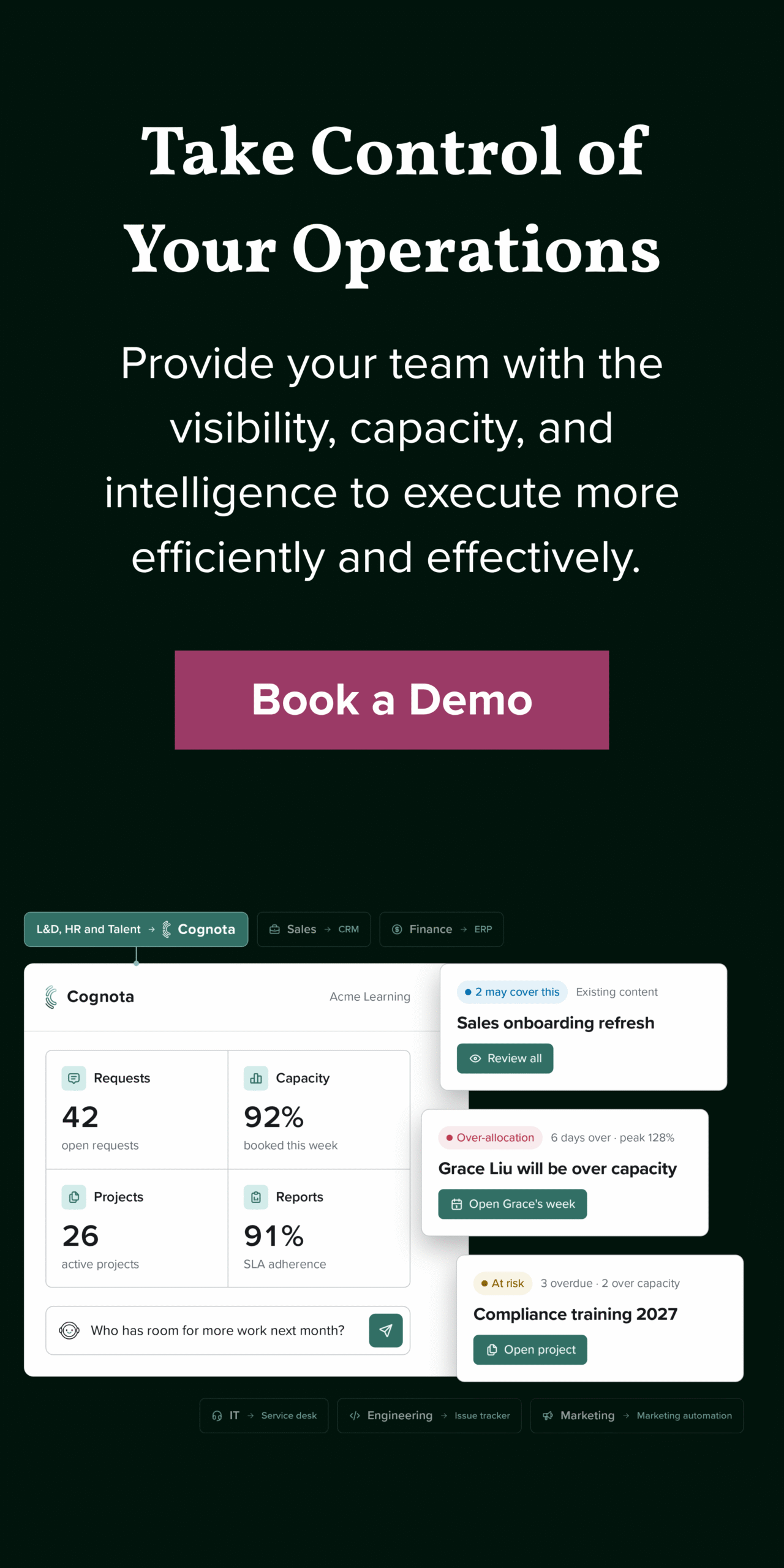
Cognota helps learning and talent teams put that operational discipline into practice. See how the LearnOps platform brings intake, planning, execution, and measurement into one operating layer.
Why learning workflows break under pressure
Most learning workflows do not fail because people lack commitment. They fail because the work crosses too many disconnected systems, teams, and decisions. A business leader submits a request through email or a form. L&D clarifies the need in a meeting. Project details move into another system. Resource availability lives in a spreadsheet. Status updates happen in chat. Measurement may be considered only after launch.
That fragmentation creates a predictable set of costs: duplicate work, ambiguous ownership, delayed approvals, overloaded specialists, and weak visibility into the value of the portfolio. It also makes prioritization political. When every request follows a different path, the loudest stakeholder often receives attention before the most consequential business need.
The goal is not to force every learning initiative into an identical sequence. A compliance initiative, a product launch, and a leadership capability program should not be managed in exactly the same way. The goal is to create a consistent operating model with clear decision points, defined exceptions, and reliable data.
How to map learning workflows around business outcomes
Start with the work as it actually happens, not the idealized process people describe in workshops. Ask a recent project team to walk through one completed initiative from first request to post-launch review. Follow the evidence: the request, approvals, meetings, project records, resource assignments, and performance data. This reveals the real workflow, including informal workarounds that often consume the most time.
Use the LearnOps® framework to organize what you find: Align, Plan, Execute, Measure, and Optimize. These five disciplines keep the map connected to strategic decisions rather than reducing it to a diagram of tasks.
1. Align demand to a defined business need
Every workflow should begin with an intake decision, not a production commitment. Capture the sponsor, target audience, business objective, desired performance change, deadline, strategic priority, and the consequence of doing nothing. If the request cannot answer why learning is the right intervention, it is not ready to enter design.
This is where teams separate requests from validated demand. A request for a course may point to a knowledge gap, but it may also signal a process issue, unclear manager expectations, or a technology barrier. Mapping this decision point protects capacity and improves the quality of the work that moves forward.
Define who has authority to approve, defer, redirect, or decline demand. In many teams, this is the first major gap. Without explicit governance, L&D becomes a fulfillment function instead of a strategic partner.
2. Plan scope, capacity, and dependencies
Once an initiative is approved, map the planning decisions that determine whether it can be delivered responsibly. Identify the work required, the roles needed, the estimated effort, key dependencies, budget considerations, and the delivery risk. A workflow map should make it easy to see when one instructional designer, facilitator, learning technologist, or subject matter expert has become the constraint for several priority projects.
This step requires a trade-off. Highly detailed plans can create administrative burden for small, low-risk requests. Too little planning creates surprises later. Establish a lighter path for repeatable or limited-scope work and a more rigorous path for high-visibility, cross-functional, or regulated initiatives.
Capacity planning is especially critical when business demand rises faster than headcount. Leaders need visibility into committed work, available capacity, and the impact of adding a new priority. Without it, teams can only say yes or no based on instinct. With it, they can have a credible conversation about sequencing, scope, and resourcing.
3. Execute with clear owners and handoffs
The execution portion of a workflow often receives the most attention because it contains visible activity: analysis, content development, reviews, communications, launch preparation, and stakeholder updates. Yet the issue is rarely the task list. It is the handoff between tasks.
For each stage, document one accountable owner, the inputs required to begin, the expected output, the decision needed to move forward, and the system of record. If a review is needed, clarify who is reviewing for accuracy, who is approving for business alignment, and how long each party has to respond. “Stakeholder review” is not a workflow step until those details are defined.
Look for loops. If a project regularly cycles from review back to development, determine whether the root cause is late stakeholder involvement, unclear acceptance criteria, or missing source material. Do not simply add more review meetings. The map should expose the cause of rework so the team can change the operating condition that created it.
4. Measure from the beginning, not after launch
Measurement belongs in the workflow before work begins. Map when the team establishes the baseline, what indicators will show progress, who owns data collection, and when results will be reviewed with the sponsor. For a sales enablement initiative, the relevant signal may be improved ramp time or sales behavior. For a safety initiative, it may be fewer incidents or stronger adherence to a critical process.
The appropriate measure depends on the business objective and the level of influence learning has on the result. L&D should avoid claiming sole credit for enterprise outcomes shaped by multiple factors. But it should be able to demonstrate contribution, explain the evidence, and use findings to make better portfolio decisions.
This is a key distinction between a Managed and Strategic learning operation in the LearnOps® Maturity Model. Managed teams have more consistent processes. Strategic teams connect those processes to business impact and use the insight to guide investment.
5. Optimize the workflow, not just the project
A workflow map is a living operational asset. Review it after major initiatives and at a regular portfolio cadence. Track where requests stall, where work is repeatedly re-scoped, which approvals add value, and where demand exceeds available skills or capacity.
Some friction is necessary. A meaningful intake review may slow a request slightly, but it prevents weeks of misaligned production. Other friction is simply waste, such as manually copying status information across systems or chasing approvals with no service expectation. The work is to distinguish between control that improves outcomes and effort that only obscures them.
What a useful workflow map must show
A useful map does more than show boxes and arrows. It connects operational activity to decisions and outcomes. At a minimum, it should show the trigger that begins the work, the roles involved, the sequence of actions, approval points, handoffs, systems of record, expected turnaround times, and measures of success.
It should also show exception paths. What happens when a request is urgent? What happens when a sponsor changes scope after approval? What happens when internal capacity is unavailable? If exceptions are invisible, they become unofficial processes that undermine the standard path.
Keep the first version practical. A map that takes months to perfect will be outdated before it is used. Begin with the highest-volume or highest-risk workflow, validate it with the people doing the work, and improve it through use. The objective is operational clarity, not a polished artifact.
Turn workflow mapping into a maturity advantage
Learning workflow mapping is a diagnostic exercise as much as a design exercise. If work enters through uncontrolled channels, priorities are unclear, and measurement is inconsistent, the team may be operating reactively even if individual projects are delivered well. If demand is governed, capacity is visible, execution is coordinated, and outcomes inform future decisions, the organization is moving toward a more adaptive LearnOps® model.
That progression matters because enterprise learning leaders are being asked to do more than deliver programs. They are expected to direct limited capacity toward the work that supports transformation, performance, and growth. A mapped workflow gives them the operational evidence to lead that conversation with confidence.
The next request that arrives is an opportunity to test the system. Rather than asking only, “How quickly can we build this?” ask, “What business result are we trying to influence, what will this require, and how will we know the work was worth doing?” Those questions are where a scalable learning operation begins.