
Most enterprise learning teams are not short on strategy. They are short on operating capacity. That is why AI agents learning operations is becoming a serious conversation in L&D, not a novelty. When demand for learning keeps rising, budgets stay tight, and proving impact gets harder, teams need more than content delivery. They need operational support that helps them move faster, make better decisions, and stay aligned to the business.
The key shift is this: AI agents are most useful when they are applied to operational work, not just content generation. For learning leaders, that means less focus on writing course copy and more focus on the work that slows teams down every day – intake, prioritization, planning, workflow coordination, and measurement.
Where AI agents fit in learning operations
In enterprise L&D, the biggest friction usually happens between demand and execution. Requests come in from every direction. Priorities compete. Capacity is unclear. Budgets are spread across multiple initiatives. Progress is tracked in disconnected systems, if it is tracked at all.
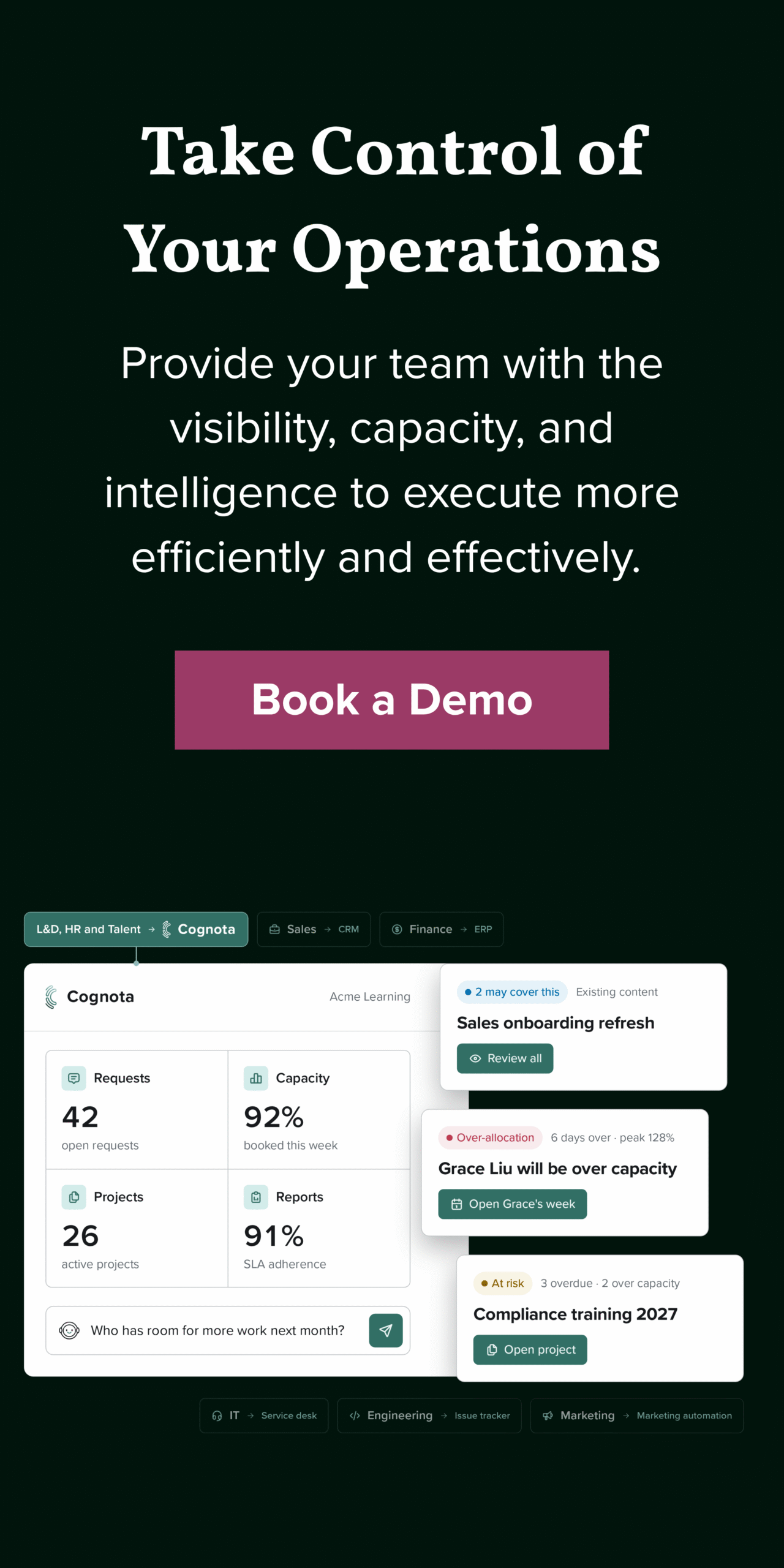
This is where AI agents can add value. They can support repeatable decisions, surface risk earlier, and reduce manual coordination. An agent can help categorize incoming requests, identify missing information, recommend routing paths, flag misalignment to stated business goals, or summarize project status across workstreams. None of that replaces the judgment of an experienced learning leader. It gives that leader better operating leverage.
That distinction matters. AI in learning is often framed as automation for its own sake. In practice, enterprise teams need controlled, auditable support that improves execution. The goal is not to remove humans from the process. The goal is to reduce low-value administrative work so teams can focus on stakeholder alignment, program quality, and business outcomes.
AI agents learning operations across the LearnOps framework
The strongest use cases show up across the full operating model, not in one isolated task. In Align, AI agents can help assess incoming requests against strategic priorities and identify patterns in business demand. In Plan, they can support resource forecasting, highlight bandwidth constraints, and help teams see where delivery risk is growing.
In Execute, agents can keep work moving by monitoring dependencies, prompting owners for updates, and summarizing progress for stakeholders. In Measure, they can consolidate operational and performance signals into clearer reporting. In Optimize, they can help identify recurring bottlenecks, rework patterns, and areas where intake or governance needs to improve.
That mirrors a core LearnOps® reality: operational maturity is built through consistent discipline, not one-time fixes. AI agents can strengthen those disciplines, but only if the underlying process is already defined well enough to support them.
What mature teams get right first
The teams that benefit most from AI agents are usually not the ones chasing the newest feature. They are the ones with enough operational structure to apply AI in a targeted way. They know how work enters the function. They have defined stages for planning and execution. They can see who owns what, where capacity stands, and how initiatives connect to business goals.
If those basics are missing, AI tends to amplify confusion. An agent cannot create clarity from a broken intake process or produce trustworthy recommendations from fragmented data. This is why operational maturity matters. Teams in a more reactive state often need to standardize workflows before they can expect meaningful results from AI support.
For many organizations, that is the real opportunity. AI agents are not the starting point. They are the accelerant.
The trade-offs leaders should think through
There is real upside here, but there are also constraints. Governance matters, especially in regulated industries where learning activity intersects with compliance, risk, or sensitive workforce data. Teams need clear rules around what agents can access, what they can recommend, and where human review is required.
There is also a change management issue. If AI agents are introduced as a way to cut headcount or bypass decision-makers, adoption will stall. If they are introduced as operational support for teams already under pressure, the response is usually very different. Framing matters. So does transparency.
Leaders should also be realistic about where AI helps most. It tends to perform better in structured, repeatable workflows than in politically complex decisions that require context, influence, or deep organizational judgment. That does not reduce its value. It simply means the best enterprise use cases are often narrower and more operational than early hype suggested.
What this means for L&D leaders now
The practical question is not whether AI will affect learning operations. It already is. The better question is whether your operating model is ready to use it well.
A useful place to start is with the friction points your team feels every week. Where does work get stuck? Where is decision-making inconsistent? Where are leaders asking for visibility that your team cannot easily provide? Those are often stronger entry points than broad AI experimentation.
For enterprise L&D teams, this is ultimately about capacity, execution, and intelligence. AI agents can improve all three, but only when they are tied to a clear operating model. That is the difference between adding another layer of technology and building a learning function that can scale with discipline.
The teams that pull ahead will not be the ones using the most AI. They will be the ones using it to run learning operations with more clarity, control, and business alignment.