
A sales leader submits an urgent training request on Monday. By Wednesday, a compliance stakeholder has a completely different priority. By Friday, your team is juggling three half-scoped asks, no agreed owner, and no clear business case. If that pattern feels familiar, this corporate training intake guide is for you.
For enterprise L&D teams, intake is not an admin step. It is where strategy either holds or breaks. When requests enter the function through email, chat, spreadsheets, and hallway conversations, the result is predictable – inconsistent prioritization, unclear requirements, strained capacity, and weak measurement later on. Better intake creates better execution because it forces the right decisions earlier.
Why a corporate training intake guide matters
Most learning teams are not short on demand. They are short on operational structure. That distinction matters. The problem is rarely that the business is not asking for support. The problem is that requests arrive with uneven quality, unclear urgency, and little connection to business outcomes.
Without a defined intake process, L&D becomes reactive. Teams spend time clarifying basics after work has already started. Stakeholders assume every request is high priority. Resource planning turns into guesswork. And when leaders ask what learning delivered, the evidence is often incomplete because the request never started with measurable intent.
This is one of the clearest signs of operational maturity. In the LearnOps framework, intake sits at the front end of Align and Plan. If those disciplines are weak, Execute becomes chaotic, Measure becomes partial, and Optimize becomes difficult. Teams that look busy but struggle to show impact are often dealing with an intake problem, not an effort problem.
What good intake actually does
A strong intake process does three things at once. It improves alignment by tying requests to business goals. It protects capacity by helping the team assess effort before committing. And it strengthens intelligence by standardizing the data needed to prioritize, govern, and measure work.
That does not mean every request needs heavy process. Some organizations overcorrect and create forms so long that stakeholders work around them. Intake should create clarity, not friction for its own sake. The right level of structure depends on volume, complexity, and risk.
A compliance-driven request in a regulated environment should not be handled the same way as a manager-led request for presentation skills. One needs governance and traceability. The other may need a faster triage path. Good intake is standardized where it matters and flexible where it helps.
The core elements of a corporate training intake guide
Every enterprise team will adapt its process, but a few elements should be non-negotiable.
Start with the business problem
The first question is not, what training do you want? It is, what business issue are you trying to solve?
That shift changes the quality of the conversation. Stakeholders often request a course when what they really need is faster onboarding, fewer quality errors, stronger manager accountability, or a cleaner process. If L&D accepts solution requests at face value, it limits its own ability to advise.
A useful intake process captures the underlying problem, the target audience, the desired outcome, and the risk of inaction. That gives the team enough context to determine whether training is the right response and what level of intervention is warranted.
Define success before work begins
If a request cannot describe what success looks like, it is not ready for prioritization.
Success measures do not need to be perfect, but they should be specific enough to guide design and later evaluation. That might include reduced time to proficiency, increased completion of a critical workflow, improved manager confidence, or lower error rates in a regulated process. The point is to create a line of sight between the request and the outcome.
This is where many teams gain immediate credibility. Instead of taking orders, they lead a disciplined intake conversation grounded in business value.
Clarify sponsorship and decision rights
Many training requests have a requester but not a true sponsor. That distinction matters because a sponsor owns the business outcome, not just the ask.
Your intake process should identify who is accountable for the initiative, who approves scope, and who signs off on priority. If those roles are vague, projects tend to stall, expand, or get deprioritized midstream. Intake is the best place to surface that risk early.
Estimate effort before making commitments
One of the fastest ways to damage trust is to say yes before understanding effort. Yet many teams do exactly that because intake is treated as a front door rather than a planning discipline.
A workable intake process includes early effort sizing. Not full project planning, but enough to understand complexity, dependencies, required skills, and likely demand on team capacity. This is especially important for enterprise teams balancing strategic initiatives, compliance obligations, and urgent business requests.
When effort is visible, prioritization becomes more credible. Leaders can see the trade-offs instead of assuming work appears from unused bandwidth.
How to structure intake without slowing the business
The best intake models usually have two stages: request capture and review.
Request capture should be simple. Stakeholders provide the core facts needed to assess the ask. Review is where L&D and business owners decide whether to move forward, reshape the request, or decline it. Combining both into one step either creates friction upfront or leads to weak decisions later.
For high-volume teams, a triage model often works well. Requests can be routed by type, urgency, strategic relevance, and risk. A recurring onboarding request may follow one path. A regulatory update may follow another. A leader-driven capability request may require a different review group. The point is not bureaucracy. It is appropriate governance.
This is also where operational maturity becomes visible. Reactive teams treat every request as an exception. Managed teams create consistent routing. Strategic teams connect intake to planning, portfolio visibility, and business priorities. Predictive and adaptive teams go further by using intake data to forecast demand patterns, identify bottlenecks, and improve resource allocation over time.
Common intake mistakes enterprise L&D teams make
The most common mistake is accepting vague requests because the team wants to be responsive. Responsiveness feels helpful in the moment, but it creates rework later.
The second mistake is treating intake as a form instead of a decision process. A form can collect information. It cannot create alignment on its own. Teams still need a review cadence, ownership, and prioritization criteria.
The third mistake is failing to connect intake to capacity. If demand enters one system and resourcing happens somewhere else, the organization loses visibility into whether commitments are realistic. That is where work queues swell and stakeholder expectations drift.
Another frequent issue is measuring too late. If intake does not establish the business goal, target audience, and success criteria, evaluation becomes retrospective guesswork. Teams end up reporting activity instead of impact.
Turning intake into an operational advantage
A mature intake process does more than organize requests. It helps L&D operate as a business function.
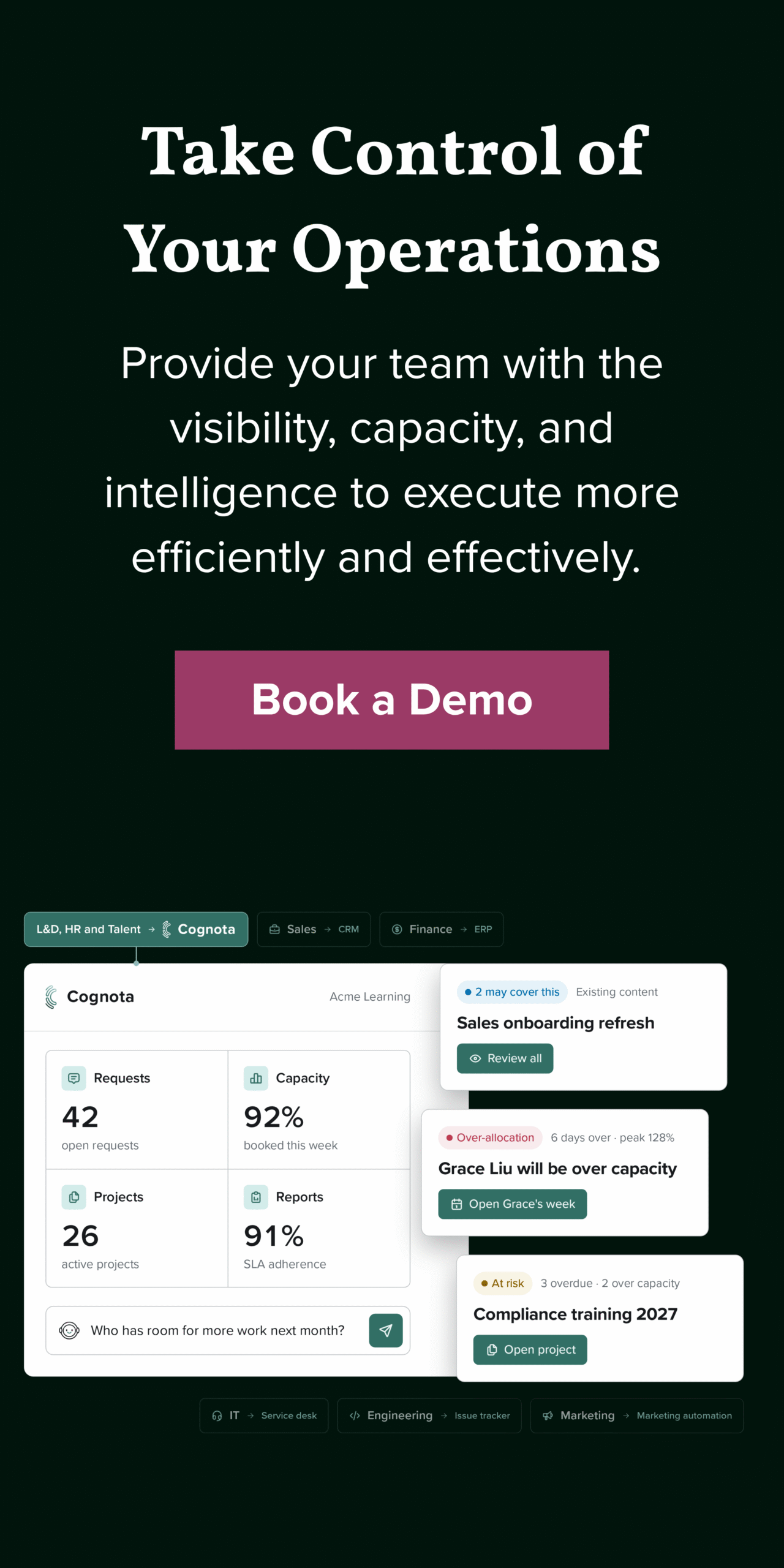
When intake data is structured, leaders can see where demand is coming from, which business units generate the most work, what types of initiatives consume the most capacity, and where projects tend to stall. That visibility improves planning conversations with senior stakeholders because the discussion shifts from anecdote to evidence.
It also strengthens governance. Teams can distinguish strategic work from opportunistic work, identify duplicate requests, and flag initiatives that need cross-functional sponsorship. Over time, intake becomes a source of operational intelligence, not just a queue.
This is where the operations layer matters. The LMS may deliver learning experiences, but intake governs how learning work gets requested, evaluated, prioritized, and resourced before delivery ever begins. That gap is exactly why modern enterprise teams are investing in LearnOps practices and platforms like Cognota.
A better standard for the corporate training intake guide
If your intake process lives in inboxes, side conversations, and manually updated trackers, the issue is not just inefficiency. It is limited control over alignment, execution, and measurement.
A better corporate training intake guide sets a higher standard. It asks for the business problem before the solution. It defines success before work starts. It makes sponsorship visible. It exposes effort early. And it gives leaders a consistent way to prioritize demand against real capacity.
That kind of discipline does not make L&D less responsive. It makes the function more credible. It gives teams the structure to say yes with intention, no with evidence, and not yet with a clear rationale.
If your team is under pressure to do more with fewer resources, intake is one of the best places to start. Not because it is glamorous, but because it changes what gets worked on, how work gets done, and what the business can trust your team to deliver next.