When every business request is labeled urgent, l&d capacity planning stops being an administrative exercise and becomes a leadership discipline. Enterprise learning teams are expected to support transformation, compliance, onboarding, enablement, and change – often with the same team size, the same budget pressure, and even less time to think. That is why capacity planning matters. It tells you what your team can realistically deliver, what it cannot, and where trade-offs need to be made before execution breaks down.
The problem is that many L&D teams still plan capacity informally. Work arrives through email, chat, meetings, and executive asks. Priorities shift weekly. Project effort is estimated inconsistently, if it is estimated at all. Leaders know their teams are stretched, but they cannot always show where the overload sits or what it is costing the business. That is the gap between activity and operations.
What l&d capacity planning really means
At its core, l&d capacity planning is the process of matching incoming demand to the people, time, skills, and budget available to deliver learning work. Not just in theory, but in operational terms. It answers practical questions: How much work is in flight? Which roles are at risk of overload? Where are the bottlenecks? What should be prioritized now, delayed, outsourced, or declined?
For enterprise teams, this is bigger than resourcing. Capacity planning sits inside a broader operating model. In the LearnOps® framework, the planning discipline only works when it is connected to alignment, execution, measurement, and optimization. If requests are not tied to business priorities, planning becomes a scheduling exercise. If execution data is weak, planning becomes guesswork. If outcomes are never measured, demand keeps growing without discipline.
That is why mature teams do not treat capacity as a back-office concern. They treat it as infrastructure for better decisions.
Why L&D capacity planning breaks down
Most breakdowns are not caused by a lack of effort. They come from structural issues.
The first is invisible demand. Teams often plan around major projects but underestimate the steady drain of ad hoc requests, stakeholder reviews, revisions, and administrative work. A team may appear to have room on paper while operating at full load in reality.
The second is role-based imbalance. Overall utilization can look reasonable while key specialists are overloaded. Instructional design may be maxed out while project management has available hours. Learning operations may absorb intake chaos while leadership sees only total headcount. Capacity is rarely a team-wide average problem. It is usually a role, skill, or workflow problem.
The third is weak intake discipline. If every request enters the system as a priority, none of them are truly prioritized. Without a consistent intake process, L&D becomes reactive by default. The team works hard, but not always on the highest-value work.
The fourth is planning without business context. Capacity plans fail when they are disconnected from the reality of enterprise change. A merger, product launch, regulatory shift, or workforce transformation can alter demand quickly. Planning needs enough structure to create control and enough flexibility to absorb change.
What good capacity planning looks like in practice
Strong capacity planning is not about predicting the future perfectly. It is about creating enough operational visibility to make better trade-offs early.
That starts with demand clarity. Every request should be captured through a defined intake process, with consistent information about business objective, urgency, estimated effort, required roles, dependencies, and target timeline. This does two things at once. It gives L&D a clearer picture of demand, and it helps stakeholders understand that learning work consumes finite operational capacity.
The next step is effort visibility. This is where many teams struggle. Estimation does not need to be perfect, but it does need to be standardized. If one manager estimates in hours, another in weeks, and a third by intuition, planning quality collapses. Mature teams create shared effort ranges based on project type and complexity, then refine them over time using actual delivery data.
From there, resource visibility matters just as much as project visibility. Leaders need to know not only who is assigned, but what capabilities those people represent. Capacity is shaped by skill mix, not just headcount. A team with open bandwidth in one role cannot always absorb work constrained in another.
Finally, good planning includes decision rules. When demand exceeds capacity, what happens? Do business-critical projects move first? Are smaller requests batched? Is external support used for overflow or specialized work? Capacity planning becomes far more effective when these choices are defined before the pressure hits.
A practical model for L&D capacity planning
For most enterprise teams, the cleanest approach follows five moves: align, intake, estimate, allocate, and adjust.
Alignment comes first. Before reviewing workloads, define what types of work matter most to the business. This is where executive priorities, compliance obligations, strategic initiatives, and workforce needs should shape the queue. If everything remains equally important, no planning method will fix the problem.
Intake creates control. Centralize requests, require the right inputs, and make submission visible. This does not slow work down. It reduces thrash, duplicate effort, and informal escalation.
Estimation turns requests into operational reality. Build a common language for effort by project type, review cycle, and role involvement. Some teams resist this because learning work can be unpredictable. That is true. But a rough standard is still more useful than none.
Allocation matches work to real availability. This means accounting for business-as-usual work, meetings, planned time off, and operational overhead, not just project hours. If your team appears to have 100 percent availability, the model is wrong.
Adjustment is where planning becomes a living process rather than a quarterly artifact. Review demand, active work, utilization, and constraints regularly. If priorities change, the plan should change with them.
Capacity planning is also a maturity signal
There is a clear difference between teams that react to work and teams that operate with intention. The LearnOps® Maturity Model makes that visible.
Reactive teams usually rely on heroic effort. They accept work through fragmented channels, overcommit talented people, and discover capacity issues after delivery starts slipping. Managed teams introduce basic workflows and improve visibility, but planning may still happen in spreadsheets and side conversations.
Strategic teams connect capacity to business priorities and use data to make trade-offs. Predictive teams go further by spotting demand patterns, role constraints, and delivery risk before they turn into bottlenecks. Adaptive teams continuously optimize how work flows, where resources are applied, and when variable capacity should be added.
That progression matters because capacity problems are rarely solved by asking people to work harder. They are solved by improving operational maturity.
When internal capacity is not enough
There are times when the right answer is not to redistribute work internally. A regulatory deadline, enterprise rollout, or sudden spike in transformation activity can outpace even well-run teams.
This is where leaders need a disciplined view of flexible capacity. External support can make sense for specialized expertise, temporary overflow, or speed on business-critical initiatives. But it should be used intentionally. If outside help is covering chronic intake failure or unclear priorities, the underlying problem remains.
The strongest teams use external capacity as part of an operating model, not as a last-minute rescue. They know which work must stay internal, which can be extended through trusted partners, and how to protect governance while expanding execution capacity.
The real payoff of better planning
The immediate benefit of l&d capacity planning is fewer surprises. But the bigger value is credibility.
When L&D leaders can show demand patterns, utilization constraints, and the trade-offs behind prioritization, conversations with stakeholders change. Instead of defending delays, they can frame choices. Instead of saying the team is overwhelmed, they can show exactly where capacity is constrained and what options exist.
That shift matters in enterprise environments where learning is expected to support business performance, not simply deliver content. Capacity planning gives L&D a stronger operational footing. It helps protect teams from burnout, improves execution quality, and makes planning more defensible at the leadership level.
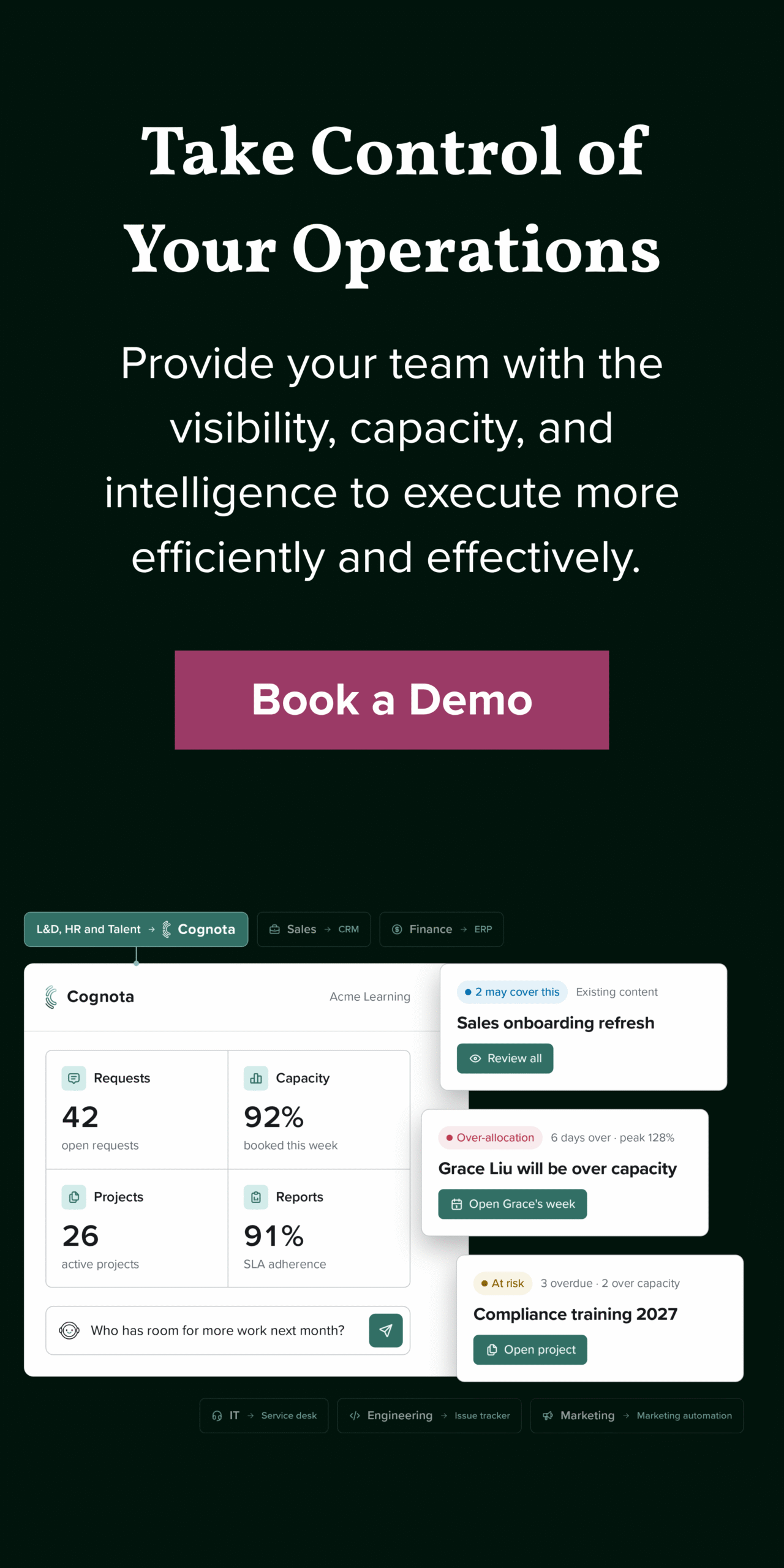
Cognota was built around this reality: learning teams do not just need systems for delivery. They need operational infrastructure that helps them plan capacity, manage demand, and execute with discipline.
If your team is constantly busy but still struggling to keep pace, that is not a personal failure. It is a signal that the operating model needs to catch up with the complexity of the work. Capacity planning is one of the clearest places to start.