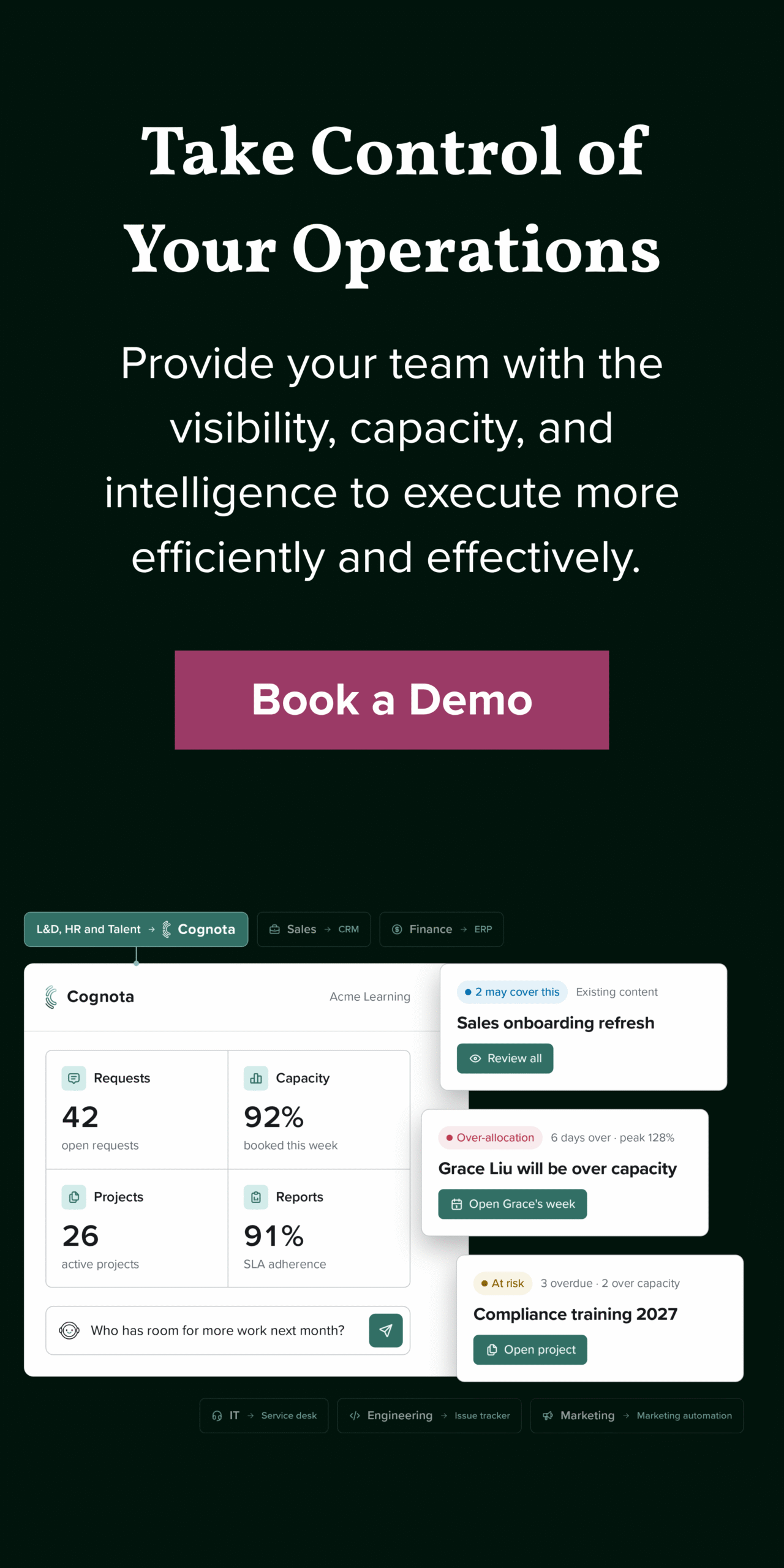
AI teammates can draft a leadership program brief in minutes, summarize stakeholder feedback, or flag duplicate requests before your team spends hours scoping work. That speed is useful only if your People teams can explain who directed the work, what information the AI used, and who approved the result. Learning how to govern AI teammates is not about putting friction around every prompt. It is about making responsible execution repeatable.
For L&D, Talent, and HR leaders, the risk is rarely that one person uses an AI tool badly. The larger risk is dozens of well-intentioned people using AI in different ways, with different data, standards, and approval habits. The result is scattered work, inconsistent quality, and little visibility into where AI is helping or creating exposure.
The 2026 Brandon Hall Group and Cognota Joint Research Report found that 83% of teams use three to eight tools to manage operations, while 69% want to consolidate. Adding AI without an operating model can turn an already fragmented environment into an even harder-to-manage one. Schedule a platform introduction to see how one operating system can bring requests, decisions, capacity for high-impact work, and governance into view.
Start with the work AI teammates are allowed to do
An AI teammate is not just a chat window. It is an AI agent assigned to a defined role in a workflow, such as analyzing intake requests, creating a first draft of a project brief, or checking a program plan against agreed requirements. Governance starts by defining that role in business terms.
Ask three questions for each use case: What outcome is the AI helping produce? What inputs can it access? What decision, if any, can it influence? A teammate that turns approved notes into a first draft has a different risk profile from one that recommends which leadership requests receive priority.
This distinction matters because not every task needs the same level of review. Low-risk, repetitive work may need periodic quality checks. Work involving employee data, performance decisions, succession discussions, legal interpretation, or sensitive business strategy requires tighter boundaries and explicit human approval.
Define authority, not just access
Access answers whether an AI teammate can retrieve information. Authority answers what it may do with that information. Your governance model should state whether the AI can draft, recommend, route, update a record, or trigger a next step. It should also state what remains solely a human decision.
For example, an AI teammate may classify incoming learning requests against your priority criteria. It should not decide that a compliance request is declined or that a leadership initiative loses funding. The AI can provide a signal. An accountable leader makes the decision.
Put AI governance inside the operating workflow
A policy document stored in a shared folder will not govern day-to-day work. Teams need governance where requests are received, work is planned, approvals are made, and results are measured. Otherwise, the rules become optional when deadlines tighten.
The most effective model follows the same operational discipline high-performing workforce enablement teams use for all work: Align, Plan, Execute, Measure, and Optimize.
In the Align stage, connect each AI use case to a business need and an accountable owner. Do not approve AI activity because it is novel or because another function is experimenting with it. Establish the problem being solved, the intended users, the decision rights, and the success measure.
In Plan, document the workflow. Specify the approved inputs, required human review points, escalation path, and expected turnaround time. This is also where you decide whether the work should be handled by an internal AI teammate, a subject matter expert, or an external specialist. AI is not always the right answer, especially when context, judgment, or change management determines success.
In Execute, make the rules visible in the work itself. A project owner should be able to see that AI generated a first draft, that a reviewer validated it, and that the final deliverable met the agreed standard. Visibility protects the team from both hidden risk and duplicate effort.
In Measure, assess more than output volume. Track cycle time, rework, stakeholder satisfaction, exceptions, and the quality of final decisions. Faster drafting is not a win if it creates more review cycles or erodes confidence in the work.
In Optimize, use those signals to adjust the AI teammate’s role. Expand authority only when evidence shows the process is reliable. Tighten safeguards when patterns reveal weak inputs, inconsistent judgment, or unclear ownership.
Create one set of rules for people and AI
AI governance often fails because it is treated as a technology policy rather than an operating standard. People teams already have rules for approving work, handling confidential information, managing vendors, and prioritizing demand. AI should fit within those rules, not sit beside them.
That means every AI-enabled workflow needs a named business owner, a process owner, and a reviewer when the risk warrants one. The business owner is accountable for the outcome. The process owner maintains the workflow and its rules. The reviewer checks material outputs before they influence a decision or reach a stakeholder.
This clarity also prevents a common failure mode: assigning accountability to “the AI.” AI teammates can perform tasks, surface patterns, and create drafts. They cannot own a workforce outcome, explain a trade-off to an executive, or accept responsibility for a poor decision.
Make approvals proportionate to risk
Over-governance slows useful work. Under-governance creates avoidable exposure. The answer is a tiered approval model that matches oversight to the task.
A low-risk task might include summarizing an approved project meeting or formatting a standard communication. A moderate-risk task might include recommending learning modalities based on approved intake data. A high-risk task might involve personal employee information, performance signals, workforce planning, or recommendations that shape access to opportunity.
For low-risk work, a team lead may review samples on a regular cadence. Moderate-risk outputs may require review before they are shared or acted on. High-risk use cases should have explicit approvals, restricted data access, and clear escalation when the AI produces uncertain or conflicting results.
The point is not to create a committee for every output. It is to remove ambiguity before work starts, so teams know when they can move quickly and when they must pause.
Govern the inputs as carefully as the outputs
An AI teammate can only work from the information it is given. If your intake data is incomplete, your priorities are unclear, or project artifacts live across disconnected systems, the AI will make those operational weaknesses more visible, not less.
Set standards for input quality. Define which source is authoritative for project scope, budget, approved messaging, and stakeholder requirements. Restrict sensitive information to approved use cases. Require teams to identify assumptions when source material is missing rather than allowing the AI to fill gaps with plausible language.
This is where operational maturity becomes a competitive advantage. Teams at a reactive stage may use AI to keep up with demand. Managed and strategic teams use it to standardize work and improve decision quality. The small share of adaptive teams go further, using trusted operational signals to continually refine how work gets prioritized and delivered.
Audit for confidence, not surveillance
Governance needs evidence. Keep a practical record of the AI teammate’s assigned role, approved data sources, key instructions, approvals, exceptions, and material output changes. This gives leaders a way to investigate issues, demonstrate responsible practice, and improve the workflow without turning every interaction into a compliance exercise.
Review patterns monthly or quarterly, depending on the volume and sensitivity of work. Look for recurring edits, stakeholder complaints, inaccurate recommendations, unapproved data use, or steps where humans routinely override the AI. Those are not signs that AI failed. They are signals that the process needs a clearer rule, better inputs, or a narrower scope.
AI teammates should make workforce enablement work more visible, not more opaque. When L&D, Talent, and HR leaders govern the work through defined roles, proportionate approvals, and measurable outcomes, they create room for speed without giving up quality or trust. The next useful question is simple: where could an AI teammate take on a bounded task today, while your team keeps ownership of the decision that matters?