A leadership program slips because no one can see which work is already committed. A succession review gets delayed while teams reconcile spreadsheets. Performance cycle requests arrive through email, meetings, and side conversations, then become urgent before anyone has agreed on priority. These are not isolated execution problems. They are the daily operating reality that TalentOps is designed to address.
Talent leaders are being asked to build stronger leadership benches, improve performance, make succession more credible, and connect talent investments to business outcomes. Yet many teams are still managing the work behind those programs across disconnected tools, informal intake processes, and reporting that arrives after a decision is needed. The result is a talented team spending too much time coordinating work and too little time improving it.
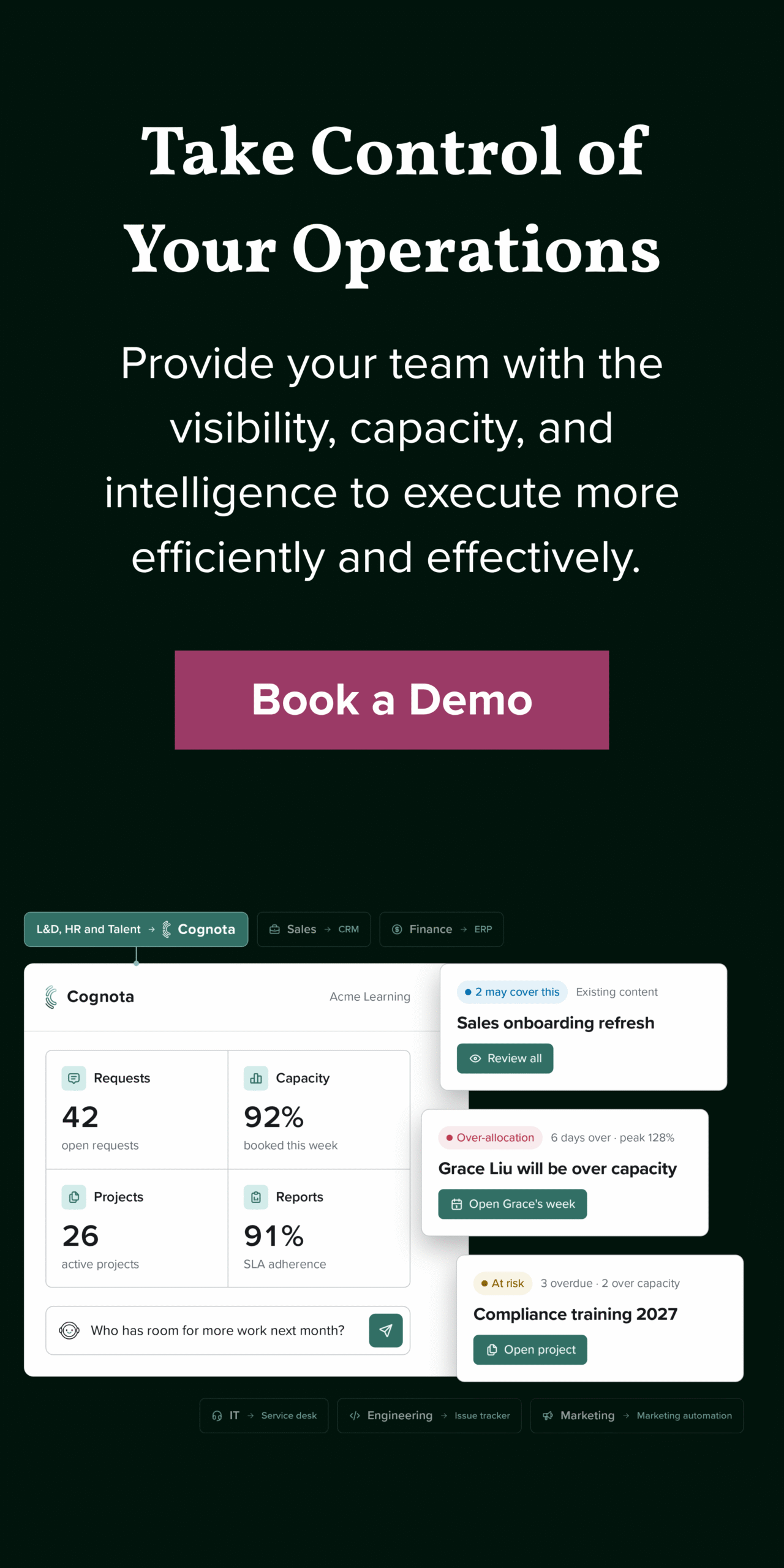
TalentOps creates the operational discipline behind talent strategy. It gives teams one place to understand demand, assign ownership, weigh capacity against priorities, manage approvals, and track whether the work delivered made a difference. See Cognota in action to explore what an operating system for talent work can look like in practice.
TalentOps is the work behind talent strategy
Talent strategy is often visible at the program level: a new leadership curriculum, a refreshed performance process, a high-potential population, or a succession slate. The operational work that makes those programs viable is less visible, but no less consequential.
That work includes intake from business leaders, scoping requests, aligning stakeholders, planning resources, coordinating internal and external contributors, managing budgets, documenting decisions, and reporting progress. When those activities live in separate systems and spreadsheets, the team loses a shared picture of what is happening.
TalentOps is not another name for talent management. It is the operating model for managing how talent work moves from request to result. The distinction matters because a well-designed program can still fail to deliver business value if the team cannot see competing priorities, identify delivery risk early, or establish clear accountability.
For a Chief Talent Officer or VP of Talent who owns several People teams, this is a visibility issue first. What is the team being asked to deliver? What is already underway? Where is capacity going? Which initiatives are tied to business priorities, and which are consuming time because no one has made a decision to stop, defer, or redesign them?
Why talent teams are reaching an operational breaking point
The pressure on talent teams has expanded faster than their operating models. Businesses want more tailored leadership development, more frequent performance conversations, clearer internal mobility, stronger succession readiness, and better skills visibility. Each request may be valid. Together, they can overwhelm a team without a disciplined way to evaluate demand.
The 2026 Brandon Hall Group and Cognota Joint Research Report found that 83% of teams use three to eight tools to manage their operations, while 69% want to consolidate. That gap is familiar to most talent leaders. Information may exist, but it is scattered across project trackers, email threads, shared drives, budget files, survey tools, and stakeholder updates.
Fragmentation creates a hidden tax. It slows decisions because leaders must assemble a status view manually. It creates rework when requirements change without a clear record. It makes it hard to explain why a strategic initiative is delayed, even when the real cause is competing demand or an approval bottleneck outside the talent team’s control.
The answer is not to standardize every piece of talent work into a rigid process. Leadership, performance, and succession programs have different rhythms and stakeholders. The answer is to establish a common operating layer: one set of rules for intake, prioritization, ownership, governance, and measurement, with flexibility in how each program is delivered.
The five disciplines of effective TalentOps
High-performing talent operations follow a practical cycle: align, plan, execute, measure, and optimize. This framework does not turn talent into an assembly line. It gives teams a repeatable way to apply judgment where it matters most.
Align demand to business priorities
Alignment starts before a request becomes a project. When a business leader asks for a leadership intervention, a succession initiative, or support for a performance challenge, the talent team needs a consistent way to clarify the problem, audience, expected outcome, sponsor, urgency, and level of effort.
A single front door for requests changes the quality of the conversation. Instead of beginning with, “Can you build this?” the team can ask, “What business result needs to change, and is this the highest-value use of capacity right now?” That is how talent teams move from order-taking to strategic partnership.
Plan capacity, cost, and ownership together
Capacity planning is often reduced to a headcount conversation. For TalentOps, it is a portfolio conversation. Leaders need to see what their teams are working on, how much effort each initiative requires, which work depends on outside expertise, and what must give if a new priority enters the queue.
This is where trade-offs become explicit. An urgent executive request may deserve immediate attention, but it may also delay a leadership program launch or compress time for quality review. Neither decision is inherently wrong. The risk comes from making the trade-off invisibly.
Clear ownership is equally important. Every initiative should have a responsible owner, defined approvers, and a documented decision path. When ownership is vague, talented people compensate through extra meetings and follow-ups. When it is clear, the team can spend more time on program quality and stakeholder outcomes.
Execute with governance, not bureaucracy
Governance is often misunderstood as friction. In practice, the right governance reduces friction by making expectations visible. Teams need agreed workflows for approvals, changes in scope, vendor engagement, risk escalation, and stakeholder communications.
The goal is not to add approvals for their own sake. It is to ensure that the right people make the right decisions at the right point in the work. A high-risk succession initiative may require more oversight than a recurring talent review. TalentOps should support that difference rather than force both through the same process.
The strongest teams also make work visible while it is underway. Leaders should not have to wait for a quarterly update to learn that a critical program is blocked, over capacity, or missing a decision. Early signals give leaders time to intervene while options still exist.
Measure outcomes, not activity
Talent teams have never lacked activity metrics. Completion rates, attendance, program launches, and satisfaction scores can be useful operating measures. They are not enough to show whether talent work is improving business performance or workforce capability.
Outcome measurement depends on the initiative. A leadership program may examine readiness for expanded roles, manager effectiveness, retention of key talent, or progress against a strategic capability need. A succession effort may focus on bench strength, successor readiness, coverage for critical roles, and the quality of development actions.
The discipline is to define the intended outcome before delivery begins, then capture the evidence needed to assess it. Not every outcome can be attributed to one program, and talent leaders should avoid overstating causality. But teams can still make better decisions when they connect effort, investment, signals, and results more consistently.
Optimize the portfolio as conditions change
Talent priorities are not fixed for a full year. A reorganization, growth plan, leadership transition, or emerging skills gap can change what matters quickly. Teams need an operating rhythm that lets them review the portfolio, rebalance capacity, and act on delivery signals without restarting the entire planning process.
This is where operational maturity becomes visible. Reactive teams respond to the loudest request. Managed teams document and coordinate work. Strategic teams align work to business priorities and measure its value. Predictive and adaptive teams use signals to anticipate demand, identify risk sooner, and continuously improve how the portfolio performs.
Only a small share of workforce enablement teams reach the adaptive stage. That should not discourage talent leaders. It should clarify the opportunity: maturity is built through better visibility and better decisions, not through a one-time transformation announcement.
What changes when TalentOps is working
A functioning TalentOps model changes the conversation inside the People function. Instead of asking why the talent team is late, leaders can see the work in context: shifting demand, constrained capacity, dependencies, and decisions waiting for action. Instead of debating whose spreadsheet is current, teams can focus on the next best action.
It also improves the experience of business partners. HRBPs and business leaders get clearer expectations on how requests enter the team, how priorities are assessed, and when they will receive an answer. Talent practitioners get a more defensible way to protect time for work that supports leadership strength, succession readiness, and business growth.
The purpose is not perfect process. It is a talent function that can lead with evidence, execute with ownership, and show how its work contributes to the organization’s most important workforce decisions. Start with one question: can your team see the full portfolio of talent work well enough to make a confident choice about what happens next?