A high-stakes learning request arrives with an executive sponsor, a tight deadline, and a familiar instruction: move fast. The team starts designing before the audience, performance need, available content, reviewers, and success measures are fully clear. Three weeks later, the request changes. The work is revised, approval cycles restart, and capacity disappears into effort no one planned for.
That is the real challenge behind how to reduce learning rework. Rework is not usually a content problem or a sign that your team lacks commitment. It is an operating problem. When demand enters through scattered channels, priorities shift without a shared decision process, and stakeholders join too late, even excellent teams end up rebuilding work they already completed.
For enterprise L&D leaders, the cost extends beyond a delayed launch. Rework crowds out strategic work, makes capacity difficult to forecast, and weakens confidence with business partners. It also creates a misleading picture of productivity: the team may look busy while spending a material share of its time correcting avoidable upstream decisions.
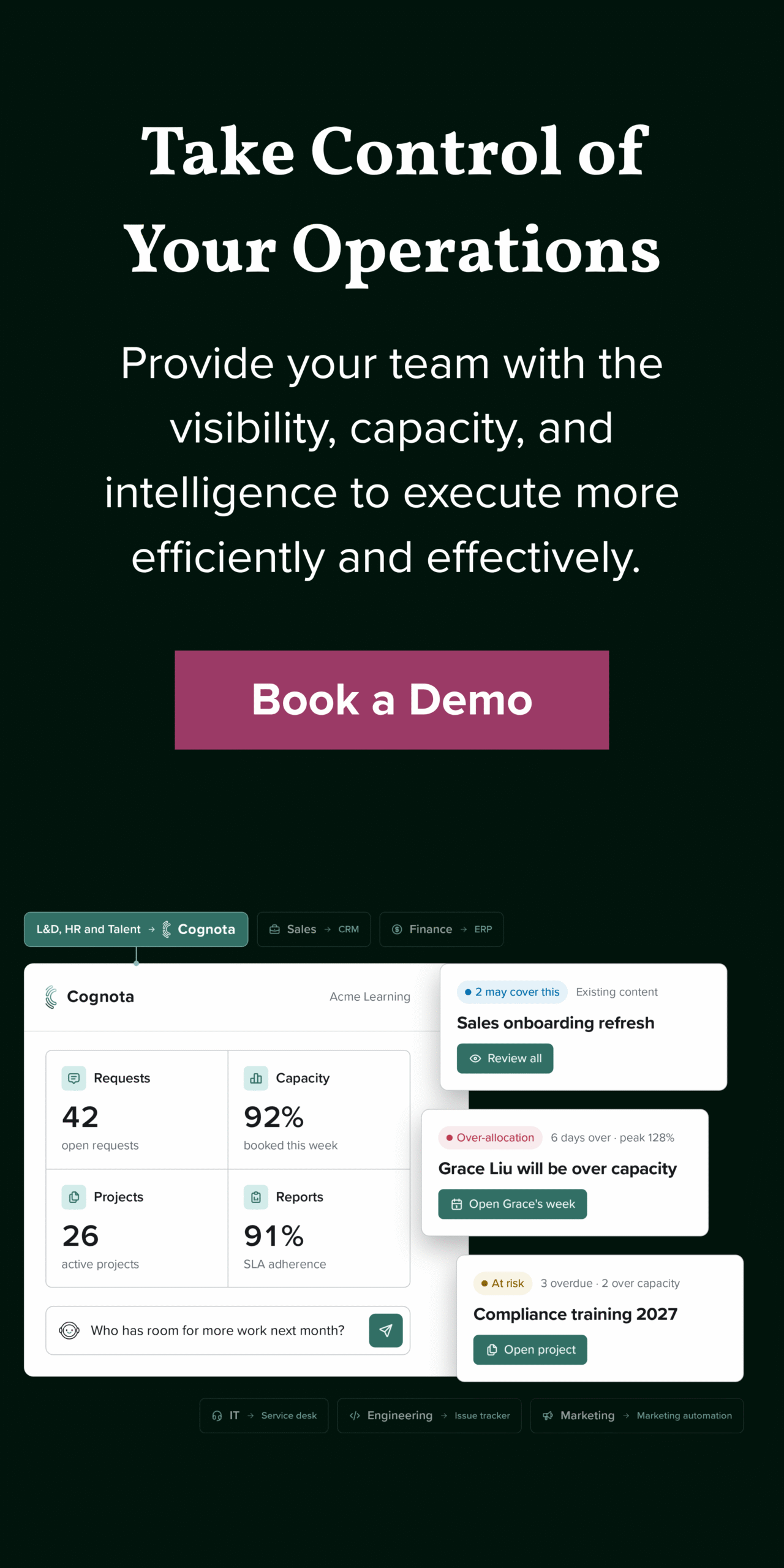
If your learning team needs one place to see demand, capacity, approvals, and delivery risk, see Cognota in action. The objective is not to add process for process’s sake. It is to give your team the visibility to make better decisions before work begins.
Why learning rework keeps happening
Most learning rework begins before design. A business leader may request a course when the underlying need is manager reinforcement, a process change, a performance support asset, or a communications plan. If the request is accepted as written, the team can efficiently produce the wrong solution.
The second source is unclear ownership. A project may have a sponsor, a subject matter expert, a reviewer, and a learning lead, but no documented decision-maker for scope, audience, final approval, or changes after sign-off. When those roles overlap, feedback becomes direction. Teams revise against competing preferences instead of an agreed outcome.
Finally, many teams lack a full operational view. The 2026 Brandon Hall Group and Cognota Joint Research Report found that 83% of teams use three to eight tools to manage operations, while 69% want to consolidate. When requests, project plans, budget details, capacity data, and feedback live in separate places, it is hard to spot a risky project early. Rework becomes visible only after it has consumed time.
This is why a better authoring process alone rarely solves the issue. Authoring quality matters, but it cannot compensate for weak intake, late decisions, or unmanaged changes.
How to reduce learning rework with better intake
The fastest way to reduce learning rework is to stop treating every request as a ready-to-build solution. Create one front door for learning demand, whether requests originate with HR business partners, business unit leaders, compliance teams, or functional managers. The goal is not to slow people down. It is to capture the few details that determine whether work should start, change shape, or wait.
A useful intake process asks for the business objective, affected audience, timing, sponsor, performance gap, known constraints, and the consequence of doing nothing. It should also establish what success looks like after delivery. “Employees complete the program” is an activity measure. “Managers consistently apply the new approval process” is a business-relevant outcome.
This conversation can feel like friction when a stakeholder expects an immediate yes. In practice, it protects both sides. A request for a broad onboarding module may become a targeted intervention for one role and one critical moment. That is not a smaller response to the business need. It is a more precise one.
Qualify urgency without rewarding urgency theater
Not every urgent request has the same business impact. Separate true time-critical work, such as a regulatory change or an imminent system rollout, from requests that became urgent because planning started late. Both may deserve support, but they should not automatically receive the same priority.
Set visible criteria for prioritization: business risk, strategic alignment, reach, deadline, expected impact, effort, and dependencies. Then use those criteria consistently. When leaders can see why work is prioritized, they are more likely to bring teams in earlier and less likely to demand last-minute exceptions.
There will always be exceptions. The discipline is not eliminating them. It is recording the trade-off – what gets delayed, what capacity is consumed, and what delivery risk increases – so leadership can make an informed decision.
Align scope before production starts
Once a request is approved, translate it into a short, shared definition of the work. This should confirm the audience, business outcome, solution approach, scope boundaries, milestones, approvers, budget assumptions, and dependencies. It is not a lengthy project artifact. It is a decision record that makes later changes visible.
Scope boundaries are especially valuable. State what the project will not cover, along with what must be true for the work to proceed. For example, a leadership program may depend on executive participation, final competency definitions, and local manager communications. If those dependencies are unresolved, the delivery date is an assumption, not a commitment.
Teams often avoid this level of specificity because they want to remain flexible. Flexibility is valuable, particularly in transformation work. But flexible scope without a change process simply transfers uncertainty into production, where it costs more to resolve.
Put approval rights where decisions belong
Feedback is necessary. Unlimited feedback is rework. Establish who can provide input, who consolidates it, and who makes the final decision at each stage. Subject matter experts should validate accuracy. Sponsors should confirm alignment to the business need. The learning team should retain authority over learning design and production choices.
A practical rule is to require consolidated feedback from each stakeholder group. If five reviewers send five separate sets of comments, the learning lead becomes the interpreter of organizational politics. If one accountable owner consolidates the group’s input, the team receives a clear decision instead.
Define the point at which a requested change becomes a scope change. A factual correction is different from a new audience, additional module, revised policy, or new outcome. The latter may be the right decision, but it should trigger a conversation about timing, capacity, and impact rather than quietly entering the build.
Plan capacity against the work that matters
Rework grows when teams commit based on available people rather than real capacity. A designer may appear to have room next month, but that view is incomplete if it excludes review cycles, existing commitments, subject matter expert availability, unplanned demand, and the time required to manage changes.
Plan capacity by role and by work stage. This lets leaders see whether the constraint is design, project management, content review, localization, vendor coordination, or stakeholder approval. The answer is not always more capacity. Sometimes the right move is to sequence work differently, simplify the solution, defer a lower-value request, or bring in specialized support for a constrained period.
The same 2026 research found that teams with a dedicated operations lead reported 34% faster delivery, 28% lower costs, and 39% higher stakeholder satisfaction. Those results point to a broader lesson: operational ownership helps teams protect delivery quality because someone is accountable for the system of work, not just individual projects.
For CLOs and People leaders responsible for several teams, this view also matters beyond L&D. Learning requests often connect to talent, performance, leadership, change, and HR priorities. One view across your People teams makes dependencies and competing commitments easier to address before they become late-stage changes.
Measure the signals behind rework
Do not measure rework only as a vague frustration. Track it as an operational signal. Start with the percentage of projects that change scope after approval, the number of revision rounds per deliverable, approval turnaround time, work that starts without complete intake information, and hours spent on unplanned changes.
Then look for patterns. Does rework cluster around a specific business unit? Does it happen more often when a certain type of request bypasses intake? Are projects with unclear sponsors consistently delayed? These signals turn a recurring complaint into a decision about process, governance, or stakeholder behavior.
Be careful not to create a metric that punishes teams for responding to legitimate business change. A changing market, acquisition, policy update, or strategic shift can require a changed learning response. The useful distinction is between necessary adaptation and avoidable churn caused by missing clarity or late involvement.
Move from reactive delivery to disciplined operations
Cognota’s LearnOps® framework follows a practical progression: align, plan, execute, measure, and optimize. Rework declines when these stages are connected rather than handled as separate administrative tasks. Intake creates alignment. Prioritization and capacity planning turn alignment into a feasible plan. Governance keeps execution on track. Measurement shows where the process needs to improve.
Teams at a reactive maturity stage often succeed through individual effort and institutional knowledge. That can work for a while, especially with experienced people. It does not scale well when demand rises, stakeholders multiply, or leaders need a reliable view of impact. Managed and strategic teams build repeatable operating practices so quality does not depend on who happens to be available.
The most useful next step is small but visible: choose one recurring source of rework and make it measurable. It might be incomplete intake, late approvals, or untracked scope changes. Improve that point in the workflow, share the result with stakeholders, and use the evidence to earn support for the next operational improvement. Less rework is not simply more output. It is more capacity directed toward learning that changes performance.